
Major vs Minor Forex Pairs: Volatility & Cost Trade-Offs
Published
By NextTrade Editorial

Major and minor forex pairs differ in liquidity, trading costs, and volatility. Major pairs, EUR/USD, GBP/USD, USD/JPY, USD/CHF, USD/CAD, AUD/USD, and NZD/USD, involve the US dollar and a major world currency, making them the most traded and liquid instruments globally. Minor pairs, also called crosses, combine two major currencies but exclude the USD (such as EUR/GBP or GBP/JPY). Because majors attract higher trading volume, they typically offer tighter spreads, faster execution, and more predictable price movement. Minors and exotic pairs trade with wider spreads and lower liquidity, particularly outside peak session hours. This article explains the differences in cost, risk and opportunity so active and aspiring traders can align pair selection with their strategy, risk tolerance and trading style.
Quick answer: What sets major and minor pairs apart
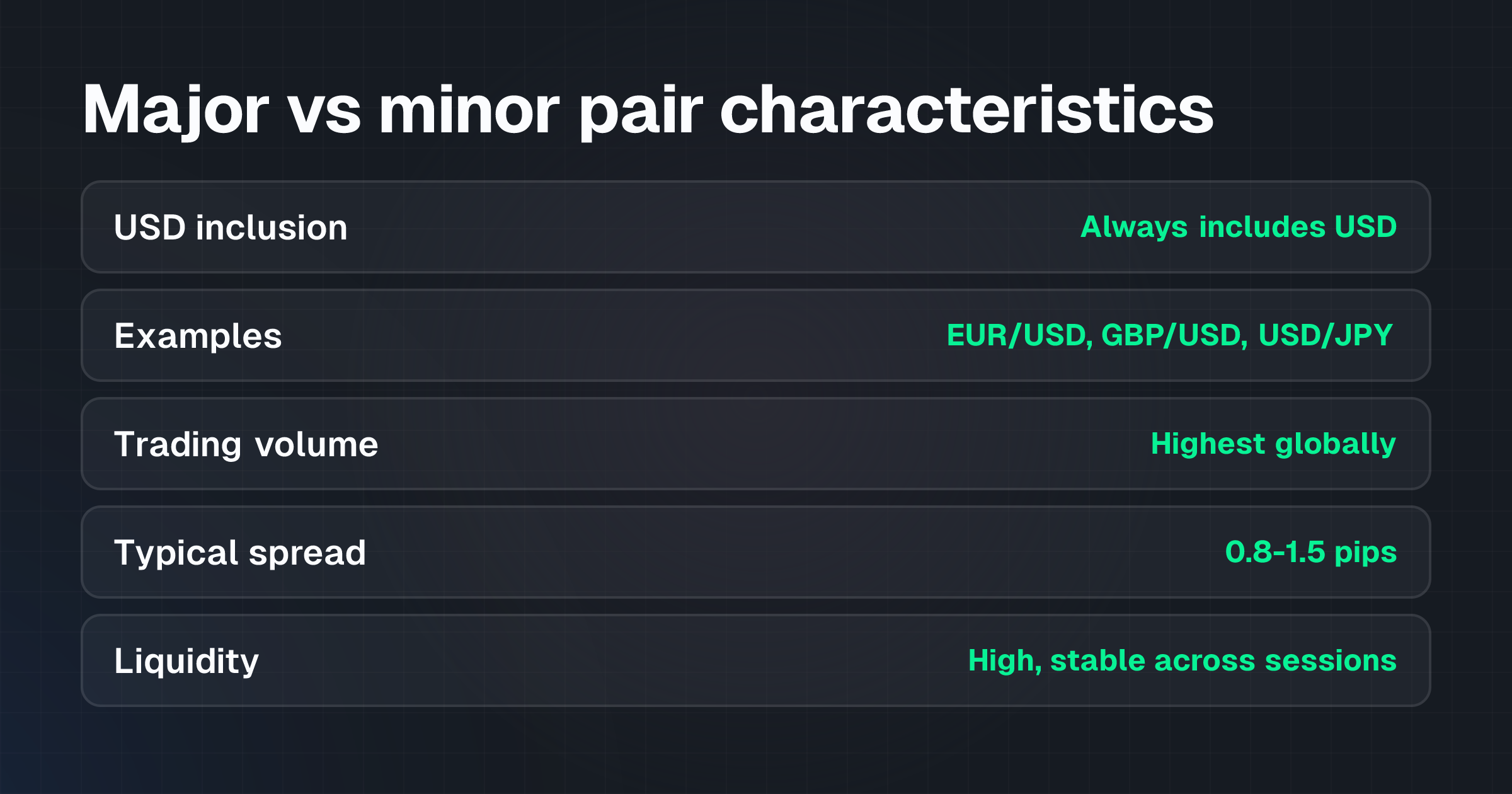
Seven currency combinations anchor the major category: EUR/USD, GBP/USD, USD/JPY, USD/CHF, USD/CAD, AUD/USD, and NZD/USD. Each involves the US dollar paired with a large economy's currency. They account for the bulk of global forex trading volume and offer tight spreads, high liquidity, and stable execution.
Minor pairs (crosses) exclude the USD but pair two major currencies, for example, EUR/GBP, GBP/JPY, or EUR/JPY. Exotic pairs pair a major currency with one from an emerging or smaller economy and are rarely discussed in this article because they fall outside the scope of this comparison.
The practical difference comes down to cost and timing. Majors trade with lower costs and tighter spreads because of their huge daily volume. Minors trade with wider spreads and are more prone to slippage, especially outside the overlap of their constituent currencies' primary trading sessions. That spread difference directly affects your per-trade cost, and session timing affects your ability to enter and exit at desired prices.
What the term means
Major pairs
A major forex pair includes the US dollar and one of the world's largest, most liquid economies. The seven major pairs are:
- EUR/USD (euro and US dollar)
- GBP/USD (British pound and US dollar)
- USD/JPY (US dollar and Japanese yen)
- USD/CHF (US dollar and Swiss franc)
- USD/CAD (US dollar and Canadian dollar)
- AUD/USD (Australian dollar and US dollar)
- NZD/USD (New Zealand dollar and US dollar)
These pairs account for the majority of global forex turnover. They trade continuously across the world's major financial centres.
Minor pairs (crosses)
A minor pair, or cross, excludes the USD but combines two major world currencies. Examples include EUR/GBP, GBP/JPY, and EUR/JPY. While both currencies are major, the absence of the US dollar reduces overall trading volume compared to majors, which translates to wider spreads and lower liquidity.
Key definitions
Liquidity is the ease with which an asset can be converted into cash or closed out of a position without affecting its market price. Higher liquidity means tighter spreads, faster fills, and lower slippage. Major pairs have high liquidity; minors have lower liquidity, especially outside their peak trading windows.
Spread is the difference between the bid price (what a buyer will pay) and the ask price (what a seller will charge). It's the most visible trading cost. Major pairs typically offer spreads from 0.8 to 1.5 pips. Minors often trade at 2-5 pips or wider during low-liquidity periods.
Volatility is the degree of price variation over time. It affects both trading opportunity and risk. Some minors can exhibit higher volatility than majors during news events or when liquidity dries up, amplifying both potential gains and losses.
Commission is a fee charged per lot or round trip, separate from the spread. Some account types charge no commission but offer wider spreads; others offer raw (very tight) spreads but add a per-lot commission. For example, NextTrade's Standard account charges no commission with a typical EUR/USD spread of 1.3 pips, while Raw and VIP accounts offer spreads from 0.0 pips but charge $7 per lot (Raw) or $4 per lot (VIP) on forex round trips.
Session overlap refers to periods when two major trading sessions run simultaneously, creating a spike in liquidity and tighter spreads for pairs linked to those sessions. EUR/USD benefits from London-New York overlap. USD/JPY benefits from Tokyo-London overlap.
How it works
Why major pairs have tighter spreads
Major pairs trade among the highest volumes globally because central banks, large institutions, multinational corporations, and retail traders all participate. This constant demand and supply keep bid-ask spreads narrow. A bank can fill a large EUR/USD order instantly because thousands of counterparties are ready to trade at nearly the same price at any moment.
Minor pairs trade a fraction of that volume. When you place a trade in a minor pair, the liquidity provider must work harder to hedge or offset the position, so they widen the spread to compensate for the added risk and cost. Outside peak hours for the two constituent currencies, that spread can expand further.
Session timing and liquidity windows
Forex markets operate across three primary sessions: Tokyo, London, and New York. Each has peak hours when its local market is most active.
EUR/USD is most liquid during the London-New York overlap (roughly 13:00-17:00 UTC). GBP/USD also benefits from this overlap. USD/JPY is tightest during the Tokyo and London sessions. EUR/GBP (a minor) is tightest when both European markets are open, roughly 08:00-16:00 UTC. GBP/JPY (a minor) sees higher liquidity during London-Tokyo overlap.
Trading a minor pair outside these windows can result in significantly wider spreads and larger slippage if you need to execute quickly.
Volatility and market depth
Major pairs move steadily in response to economic data and central bank policy, but their large volume acts as a stabiliser. If unexpected news hits, thousands of traders react, but the market absorbs those trades without wild swings in price.
Minor pairs can react more sharply to regional news because fewer traders and less capital are in the market. A Swiss economic surprise may move EUR/CHF (a minor) much more sharply than it moves EUR/USD (a major), even though both pairs contain the euro.
Worked example
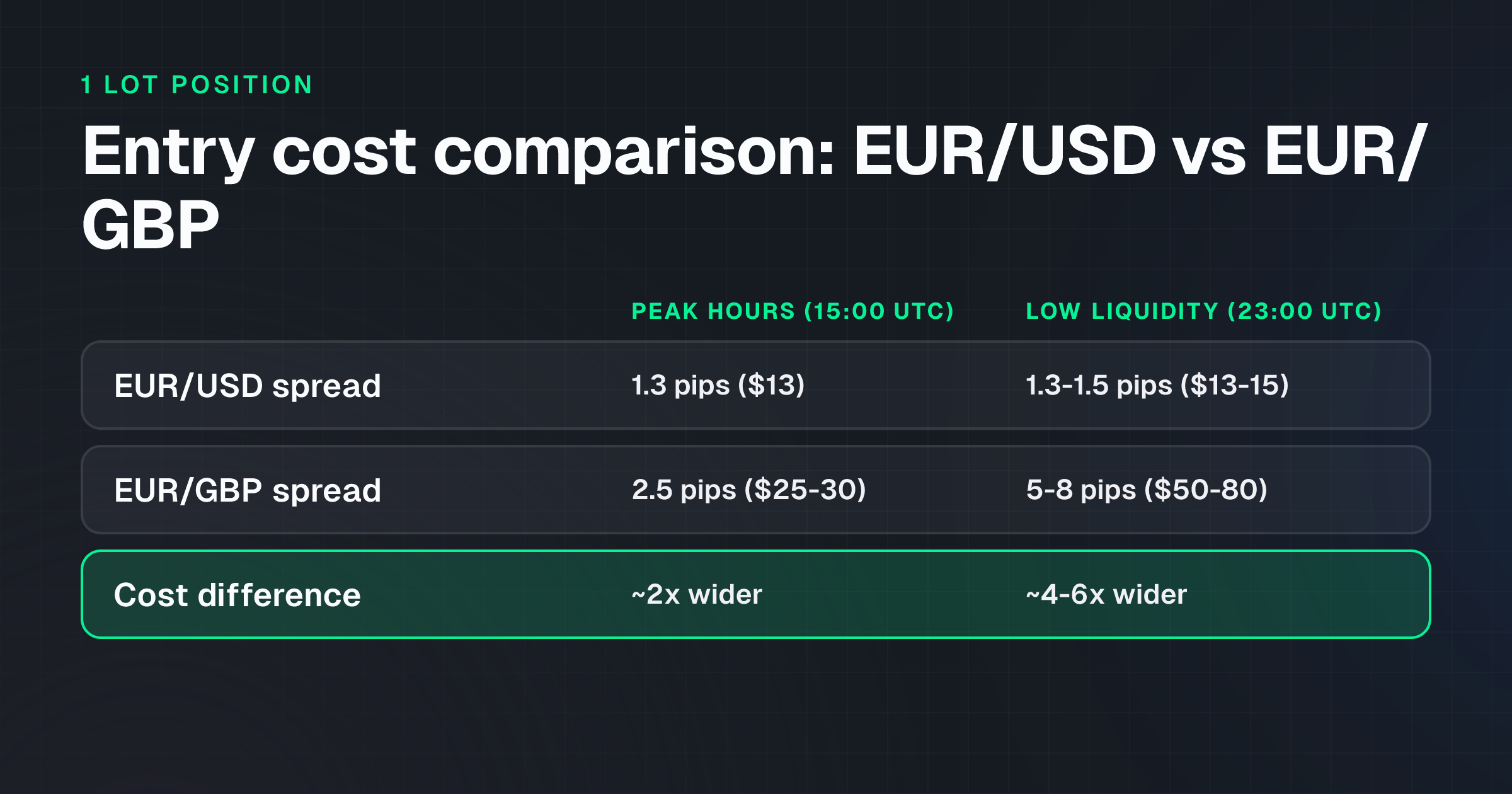
This example illustrates how spread differences and session timing affect the cost of a trade. It's hypothetical and educational; it's not a recommendation.
Scenario: A day trader enters EUR/USD and EUR/GBP
EUR/USD (major pair):
- Time: 15:00 UTC (London-New York overlap, peak liquidity)
- NextTrade Standard account spread: 1.3 pips
- Position size: 1 lot (100,000 units)
- Entry cost (spread only): 1.3 pips × 10 USD/pip = 13 USD
EUR/GBP (minor pair):
- Time: 15:00 UTC (European session, still liquid)
- Assumed spread: 2.5 pips (wider than major, but still reasonable at this hour)
- Position size: 1 lot
- Entry cost (spread only): 2.5 pips × typical GBP conversion ≈ 25-30 USD equivalent
Same trades, 23:00 UTC (low-liquidity window for EUR/GBP):
- EUR/USD spread: still roughly 1.3-1.5 pips (major pairs remain tight)
- EUR/GBP spread: could widen to 5-8 pips or more
- Entry cost for EUR/GBP: 5-8 pips × typical GBP conversion ≈ 50-80 USD equivalent (more than double the peak-hour cost)
If you place a market order in EUR/GBP at 23:00 UTC and the bid-ask spread is 8 pips wide, your actual fill price may be worse than the quoted spread if the market moves against you during execution (slippage).
Conclusion from the example: Trading EUR/USD during peak overlap costs roughly 13 USD for a round-trip spread. The same position in EUR/GBP at peak hours costs 25-30 USD; outside peak hours it can cost 50-80 USD or trigger slippage. For a scalper placing 20 trades per day, this difference compounds quickly.
Spreads from 0.0 pips across 130+ instruments. Open Account
Costs and practical constraints
Spread comparison: Next Trade examples
NextTrade's Standard account offers a typical EUR/USD spread of 1.3 pips. This is a major pair, so it reflects the tight spreads available on highly liquid instruments.
The company doesn't publish typical spreads for minor pairs; this article doesn't cover that data. However, general market observation shows that minors trade at spreads typically 1-5 times wider than majors, depending on liquidity and time of day.
For traders seeking even tighter spreads, NextTrade offers:
- Raw account: Spreads from 0.0 pips, with a commission of $7 per lot on forex round trips (minimum deposit $100).
- VIP account: Spreads from 0.0 pips, with a commission of $4 per lot on forex round trips (minimum deposit $10,000).
The choice between Standard (spread only) and Raw/VIP (tight spread plus commission) depends on trading frequency and position size. A scalper placing 100 trades daily pays significantly more in commissions on Raw or VIP. A swing trader placing 5-10 trades per week may save money with zero-spread execution.
Slippage and execution risk
Slippage occurs when the price at which a market order executes differs from the quoted price. In major pairs during peak hours, slippage is typically minimal (a fraction of a pip). In minor pairs or during low-liquidity windows, slippage can easily add 1-3 pips or more to your effective entry cost, especially on larger orders.
Time-of-day constraints
If you trade minor pairs, you must plan around session overlap. Trading EUR/GBP at 03:00 UTC (outside European hours) exposes you to much wider spreads and execution risk than trading at 10:00 UTC. This constrains when you can profitably trade these pairs if you're a scalper or day trader.
For swing traders or position traders holding positions for days or weeks, the spread cost is often less critical than the direction and timing of your thesis. But cost still matters: wider spreads reduce your margin of safety on every entry.
Risks and limitations
Higher trading costs in minors erode profits
The wider spreads and commissions in minor pairs mean you must generate larger returns to cover costs and profit. If you trade EUR/GBP and pay 50 pips of cost (spread plus slippage) on entry and exit combined, your winning trade must move EUR/GBP by at least 50 pips to break even. A EUR/USD trade with 2-3 pips of cost can be profitable on a 5-10 pip move.
Reduced execution certainty outside peak sessions
Trading a minor pair at 02:00 UTC may result in an order that takes seconds to fill, or one that fills at a price far worse than the quoted spread. This unpredictability can cause unexpected losses, particularly if you use tight stop-loss orders.
Larger price swings in lower liquidity
When fewer traders are in the market, any large order can move the price sharply. If you place a 10-lot order in a minor pair during a low-liquidity window, the market impact of your order can push the price against you before you finish executing. This is especially relevant for traders managing larger position sizes.
Leverage amplifies losses as well as gains
NextTrade offers leverage up to 1:1000 on major forex pairs on MetaTrader 5 and 1:500 on TradeLocker. Leverage increases market exposure and potential profits, but it also increases the speed and scale of potential losses. A 100-pip move in EUR/USD with 1:100 leverage turns into a 10,000% loss if your capital is exhausted. This risk applies to all pairs, but is felt more acutely in volatile minors where spreads are already wide.
News events can trigger gaps and slippage
Economic announcements from either constituent currency can cause major volatility and gaps in price, especially in minor pairs where liquidity is thinner. A Bank of England announcement may gap GBP/JPY several pips instantly, filling your stop-loss order at a far worse price than intended.
Common misunderstandings
"Minor pairs are always riskier than majors"
This is misleading. A well-researched trade in a minor pair during peak liquidity may be less risky than a poorly-timed trade in a major pair. Risk depends on position sizing, leverage, stop-loss placement, and the quality of your trading thesis, not solely on which pair you choose. Minor pairs do carry higher execution costs, which reduce your margin of safety.
"Raw spreads mean free trading"
Spreads from 0.0 pips sound free, but they come with commission. A Raw account with a 0.0 pip spread plus $7 per lot commission (round trip) may actually cost more than a Standard account with a 1.3 pip spread if you trade frequently. Calculate your all-in cost before switching account types. See Raw Spread vs Standard Account: Which Costs Less? for a full breakdown.
"Major pairs never move sharply"
Major pairs can move sharply during major economic announcements, geopolitical crises, or central bank policy shifts. The 2016 Brexit referendum, for example, caused GBP/USD to swing 10% in a single session. High liquidity doesn't mean low volatility in absolute terms; it means volatility is absorbed more smoothly by the market.
"All trading is better during London or New York hours"
Session overlap increases liquidity for specific pairs, but it doesn't guarantee profits or lower risk. If you don't have a sound trading strategy, tight spreads alone won't make you money. Some traders may find other sessions suit their schedule or analysis better. Choose sessions based on your trading plan, not just spread tightness.
"Commission accounts are always cheaper than spread-only accounts"
This depends on your trading frequency and position size. A scalper placing 100 trades daily at 1 lot each pays far more commission on a Raw account than a Standard account charge, even if the Raw spread is tighter. A swing trader placing 2-3 trades per week may genuinely save money on a commission account. Calculate your expected monthly cost for your typical trading activity before deciding.
Practical checklist
Before choosing between major and minor pairs, work through this checklist:
- Define your trading style. Are you a scalper (5-50 pips per trade, 1-10 minute holds), day trader (holds of hours to a day), or swing trader (holds of days to weeks)? Scalpers need very tight spreads. Swing traders tolerate wider spreads.
- Choose your session. Which global session aligns with your availability and timezone? Major pairs are liquid all day; minors require session alignment with both constituent currencies.
- Calculate all-in costs. For your account type and typical trade frequency, what's the total monthly cost of spreads, commissions, and expected slippage? Use this to set minimum profit targets.
- Check economic calendars. Identify which currencies and pairs are linked to major economic data releases in your trading hours. Plan to avoid or size down around high-impact news if you lack a news-trading strategy.
- Understand leverage limits. NextTrade offers 1:1000 on major forex pairs (MT5) and 1:500 on TradeLocker. Know your broker's limits and how they interact with your position size and stop-loss distance.
- Set realistic profit targets. Your profit target must exceed your all-in trading costs plus the natural price volatility you expect. A 3-pip target in a 2-pip spread pair isn't viable.
- Paper trade first. Use a demo account to place trades in your chosen pair during your chosen session. Observe actual spreads, slippage, and execution speed before risking real capital.
- Monitor session transitions. If you trade near session starts or ends, monitor how spreads behave. Many brokers widen spreads in the final minutes of one session and the opening minutes of the next.
Frequently asked questions
What leverage does NextTrade offer on major vs. minor pairs?
NextTrade provides leverage up to 1:1000 on major forex pairs via MetaTrader 5, and 1:500 on TradeLocker. The research doesn't specify whether different leverage limits apply to minor or exotic pairs; check the platform or contact support for your specific pair. Remember that high leverage increases both potential gains and the speed of potential losses.
Why are spreads tighter during London-New York overlap?
The London-New York overlap (roughly 13:00-17:00 UTC) combines the two largest forex trading sessions globally. Volume is highest, so more buyers and sellers are present at nearly the same price. Banks and large institutions can fill orders instantly, so market makers compete by offering tighter spreads. Outside this window, spreads widen because volume and competition fall.
Can I trade minor pairs profitably on a Standard account?
Yes, but you must choose the right session and expect wider costs. Trading EUR/GBP during London session hours may still offer spreads of 2-3 pips, manageable for swing traders. Trading the same pair at 23:00 UTC may result in 5+ pip spreads and poor execution. Profitability depends on your strategy, position sizing, and trade timing, not the account type alone. The wider spreads reduce your margin of safety, so your trading thesis must be stronger to overcome that cost.
Should I switch to a Raw or VIP account?
Switch if your trading frequency is high enough that commissions are offset by savings from zero spreads. A scalper placing 50 trades daily at 1 lot each would pay roughly 350 USD in commissions on Raw account per week (50 × 7 = 350). On Standard, those same trades in EUR/USD would cost 50 trades × 1.3 pips × 10 USD/pip = 650 USD. In this case, Raw saves money. For a trader placing 5 trades per day, the math reverses: the small spread cost is cheaper than accumulating commission. Use your broker's cost calculator or run the numbers yourself.
What is slippage, and why is it worse in minor pairs?
Slippage is the difference between your expected execution price and your actual fill price. In major pairs with tight spreads and high liquidity, slippage is usually negligible. In minor pairs or low-liquidity windows, your market order may execute several pips away from the quoted price if the market is moving quickly or the spread is very wide. This adds directly to your trading cost. For more context, see Slippage in Forex Trading: Causes and Controls.
How do I know which pair suits my strategy?
Start by identifying your trading style (scalping, day trading, or swing trading) and your availability in global market hours. Then match your pair choice to liquidity. Scalpers and day traders should focus on major pairs during peak sessions. Swing traders can trade minors if their thesis is strong, but must size positions carefully and avoid trading during extreme low-liquidity windows. See How to Choose Forex Pairs for Your Trading Strategy for a structured decision framework.
Next step
Understanding the difference between major and minor pairs is foundational, but it's only part of choosing which pairs to trade. Your next steps depend on your situation:
- If you need a detailed comparison of two specific pairs, see EUR/USD vs GBP/USD: Which Pair Suits Your Trading Style?.
- If you want to explore how session overlap and spreads vary across NextTrade's instrument list, see Forex Pairs at NextTrade: Spreads and Trading Sessions.
- If you need to understand how to calculate your all-in trading cost, including commission, see Raw Spread vs Standard Account: Which Costs Less?.
- To dive deeper into how economic events move pairs, read Forex Fundamental Analysis: How to Read Economic Surprises.
- Ready to place your first trade? Open a free demo account with NextTrade on MetaTrader 5 or TradeLocker to practise trade entry, exit, and position sizing in real market conditions without risking capital.
Risk Warning: CFDs are complex instruments and carry a high risk of losing money rapidly due to leverage. The majority of retail investor accounts lose money when trading CFDs with this provider. You should consider whether you understand how CFDs work, and whether you can afford to take the high risk of losing your money.
General Information: This article is for educational purposes only and doesn't constitute financial advice, a recommendation, or an offer to buy or sell any financial instrument. Past market performance doesn't establish what will happen next. Forex and CFD trading involve substantial risk of loss. All trading involves risk. The examples in this article are hypothetical and educational only; they're not recommendations to place specific trades. Always check the current product terms and conditions before opening or funding an account with any broker.
TagsTrading Educationmajor vs minor forex pairsforex pair liquidityforex spreadscurrency crosses