
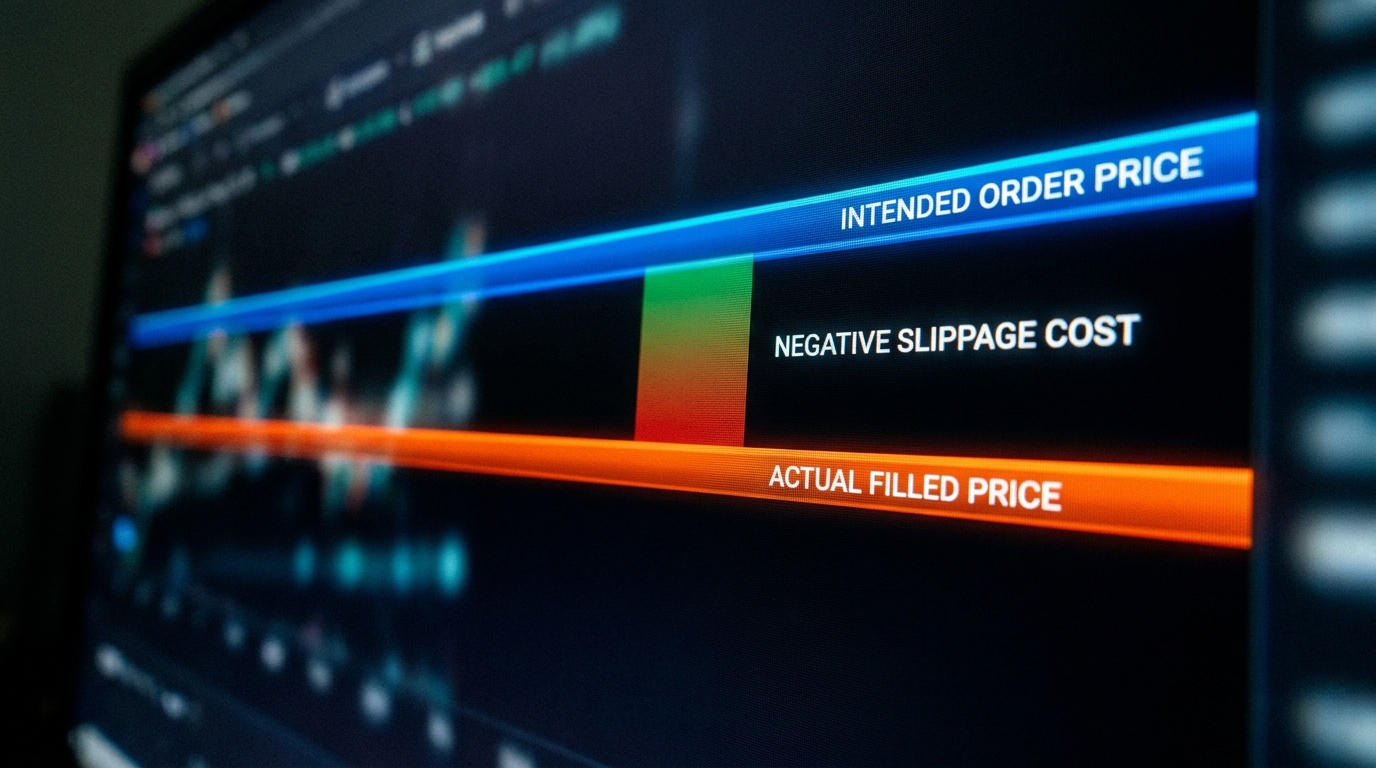
Slippage is the difference between the price you expect when you place an order and the price you actually receive when it fills. A 5-pip gap might seem trivial. Scale to standard lot sizes, add leverage, or trade during volatile markets, and slippage compounds into a material cost that cuts into profit or magnifies loss faster than most retail traders anticipate. Market gaps, liquidity shifts, and execution delays all drive the problem, and they interact in ways that make slippage difficult to predict and impossible to eliminate entirely.
This article explains how slippage forms, works through real-cost examples showing its impact on your account, and covers the practical steps active traders use to manage exposure to it.
Quick answer: slippage as a hidden trading cost
Slippage happens when price moves between the moment you submit an order and the moment it executes.
You place a market order to buy EUR/USD at 1.0850. By the time the order reaches the market and fills, the price is 1.0855. That 5-pip difference is slippage. Your intended entry never materialised.
Negative slippage, receiving a worse fill than expected, is the norm. Positive slippage exists but appears less often. Stop-loss orders face the highest risk: during fast markets or news releases, price can gap straight through your stop level, leaving you with a far worse exit than planned. Even small slippage adds up over dozens of trades, and with leverage up to 1:1000 available, a few pips of deviation translate into material account impact quickly.
What the term means: slippage and related concepts
Slippage is the cost you pay when your execution price differs from the price you intended.
It sits alongside the bid-ask spread but isn't the same. The spread is the standing gap between what a buyer will pay (bid) and what a seller will accept (ask). Slippage occurs when price moves during the time your order is being processed.
Negative slippage means you received a worse price than expected, paying more to buy or receiving less when selling. Positive slippage means you received a better price, though this is less common.
Market order is an instruction to buy or sell immediately at the current market price. Market orders fill quickly but offer no price guarantee, making them most vulnerable to slippage.
Limit order is an instruction to buy or sell only at a specific price or better. Limit orders protect your intended price but may never fill if the market moves away.
Stop-loss order is an order designed to close a position when a certain price is reached, to contain losses. Stop-loss orders can suffer severe slippage during fast or gapped markets, resulting in exits far worse than intended.
Market gap is a sudden, significant jump in price where no trading occurs between one session close and the next open. Gaps commonly occur around news announcements or between overnight sessions.
Liquidity refers to how easily an asset can be bought or sold without affecting its price. Low liquidity increases slippage risk because fewer buyers and sellers mean wider price swings for each trade.
Volatility is the degree of price variation over time. High volatility increases slippage risk because prices move faster and farther between order submission and execution.
How it works: the mechanics of slippage
Slippage results from three overlapping factors: execution timing, market conditions, and order type.
Execution timing and order delay
When you place an order, a time gap exists between submission and execution. During fast market movement, prices shift within milliseconds. Market orders have no price protection, so they fill at whatever price is available when the order reaches the market. If prices moved against you during that delay, you experience negative slippage.
Market liquidity and spread widening
Liquidity refers to the volume of buy and sell interest at a given price. During high-liquidity periods, typically during overlapping major trading sessions, spreads tighten and slippage tends to be smaller. During low-liquidity periods, such as Asian session trading of EUR/USD or trading exotic currency pairs, spreads widen and slippage risk increases. Fewer buyers and sellers mean larger price jumps for each trade executed.
Volatility and news events
Volatility spikes around economic data releases, geopolitical announcements, or sudden shifts in market sentiment. Price moves rapidly and can gap past intended levels entirely. Stop-loss orders are particularly vulnerable: in a fast market, price can gap through your stop level without filling at that price, instead executing much worse, sometimes dozens of pips away.
Account type and order infrastructure
The account you hold and the execution infrastructure your broker uses affect slippage exposure. NextTrade offers three account types, Standard, Raw, and VIP, with different spread and commission structures. Raw and VIP accounts offer spreads from 0.0 pips plus commission, while Standard accounts have all-in spreads. The order management system and platform you use, NextTrade provides MetaTrader 5 and TradeLocker, which integrates TradingView charts, also shapes how quickly and at what prices orders execute.
Worked example: calculating slippage impact
These examples are hypothetical and educational. They show how slippage translates into account cost.
Scenario 1: Negative slippage on a market order
You place a market order to buy 1 standard lot of EUR/USD at 1.08500. By the time the order fills, the price is 1.08505.
- Intended entry: 1.08500
- Actual entry: 1.08505
- Slippage: 5 pips negative
- Cost per pip on 1 standard lot: $10
- Total cost: 5 pips × $10 = $50
Your trade opens $50 worse than intended before commissions or spreads.
Scenario 2: Stop-loss slippage during a news event
You hold a sell position on GBP/USD with a stop-loss order placed at 1.25000 to limit your loss. A major news announcement causes GBP/USD to gap upward rapidly. Price gaps to 1.25020, and your stop-loss fills at that level.
- Intended stop price: 1.25000
- Actual execution price: 1.25020
- Slippage: 20 pips negative
- Cost per pip on 1 standard lot: $10
- Total additional loss: 20 pips × $10 = $200
Your intended stop-loss was exceeded by $200 due to the gap.
Scenario 3: Positive slippage (less common)
You place a market order to sell 0.5 standard lots of USD/JPY at 150.200. The order fills at 150.190.
- Intended exit: 150.200
- Actual exit: 150.190
- Slippage: 10 pips positive
- Cost per pip on 0.5 lots: $5
- Extra profit: 10 pips × $5 = $50
You closed at a better price than expected, gaining $50.
Position size amplification
Slippage cost scales with position size. The same 5-pip slippage costs $50 on 0.1 lots but $500 on 1 standard lot. Large positions magnify the monetary impact of small deviations, making position sizing a core slippage control.
Costs and practical constraints: managing slippage in real trading
Position sizing limits slippage impact
Larger position sizes amplify the monetary cost of slippage. A 5-pip slip on 0.1 lots costs $5; the same slip on 1 standard lot costs $50. Traders who consistently use smaller position sizes reduce the absolute dollar impact of slippage on their account, even if the percentage impact is identical.
Leverage increases exposure to slippage losses
Leverage magnifies both profits and losses. NextTrade offers leverage up to 1:1000. Slippage combined with high leverage means small price deviations translate into large account percentage moves. A $50 slippage loss is 0.5% of a $10,000 account; at 1:100 leverage on a $100 deposit, that same $50 loss represents 50% of equity.
Order type trade-offs
Market orders fill immediately but offer no price guarantee. Use them in liquid, stable markets or for small sizes.
Limit orders protect your intended price but may not fill if the market moves away. Use them when price precision matters more than execution certainty.
Stop-limit orders trigger a limit order when your stop price is hit. They prevent execution at an undesirable price but carry the risk of not filling if the market moves too fast.
Market timing affects slippage probability
Trading during overlapping major sessions, when liquidity is highest, reduces slippage risk. Trading exotic pairs, commodities, or indices outside peak hours increases it. News releases and economic data announcements coincide with volatility spikes and wider slippage risk.
Broker infrastructure and execution model
Your broker's execution infrastructure and order routing system affect how quickly and at what prices orders fill. NextTrade's approach emphasises fair pricing and transparency, with published spreads and commissions for each account type. The platforms available, MetaTrader 5 and TradeLocker, offer execution tools that traders can use to manage order timing and type.
Risks and limitations: what slippage control cannot do
Slippage cannot be eliminated
Even in ideal conditions, small slippage occurs due to the time required to route and fill orders. No order type, position size, or trading time guarantees zero slippage.
Stop-loss orders remain vulnerable in gaps
Stop-loss orders can be "gapped through" during fast market moves, resulting in exits far worse than intended. This risk is highest around news events and during low-liquidity sessions. Traders cannot prevent gaps; they can only prepare for them through appropriate position sizing and mental acceptance of larger-than-intended losses in extreme conditions.
Limit orders may not execute
Setting limit orders too far from the market ensures price protection but increases the risk that the order never fills and you miss the trade entirely. Traders face a trade-off between price certainty and execution certainty.
Missing profitable moves with overly tight limits
If you set limit buy orders only at very specific prices, you may miss profitable moves if the market shifts away before hitting your price. This is an opportunity cost, not a direct financial loss, but it affects trading results over time.
Underestimating cumulative slippage
A single 5-pip slip seems small. Over 100 trades, if slippage averages 5 pips per trade, the cumulative cost becomes material. Traders often underestimate how slippage compounds when trading frequently.
Common misunderstandings: what slippage is not
Slippage is not the spread. The spread is the standing difference between bid and ask; slippage is the additional price movement after you place an order. Both cost money, but they're separate.
Slippage is not commission. Commission is a fixed charge per trade. Slippage is a variable cost that depends on market conditions and execution timing.
Slippage is not always your broker's fault. Slippage from market gaps and volatility spikes is a result of market structure, not broker conduct. However, broker infrastructure and execution speed do influence slippage magnitude.
Positive slippage is not guaranteed. While it does occur, negative slippage is far more common. Traders should not plan for or expect positive slippage to offset losses.
Slippage control is not a trading strategy. Limiting slippage is part of risk and cost management, not a path to profitability. Slippage management protects capital; it doesn't generate returns.
Practical checklist: steps to manage slippage
-
Understand your broker's execution model. Know whether you trade on Standard, Raw, or VIP accounts and how spreads and commissions differ. Check NextTrade's account types and pricing structure.
-
Choose your order type based on market conditions. Use market orders in liquid markets; use limit orders when price precision matters; use stop-limit orders when you need both protection and controlled execution.
-
Size positions conservatively. Smaller positions reduce the absolute dollar impact of slippage. Test your risk tolerance and position sizing before scaling up.
-
Avoid trading high-impact news. Economic announcements and geopolitical events create volatility spikes and slippage risk. If you do trade around news, accept larger slippage risk and size accordingly.
-
Trade during high-liquidity periods. Major session overlaps offer tighter spreads and lower slippage risk. Avoid exotic pairs or major pairs during low-liquidity sessions if slippage is a concern.
-
Set realistic stop-loss levels. Stop-loss orders can gap through; set levels with that risk in mind. Don't assume your stop will fill at the exact price you set.
-
Monitor slippage over time. Track the difference between your intended and actual fills. Over 50-100 trades, identify patterns: which pairs, which times, which order types produce the most slippage. Adjust your approach based on that data.
-
Use limit orders for precise entries and exits. If a specific price is non-negotiable, use a limit order. Accept that it may not fill, but you avoid slippage surprises.
-
Review platform tools. MetaTrader 5 and TradeLocker both offer order management tools. Familiarise yourself with pending order types, modification options, and execution features available to you.
-
Keep a trading journal. Record your intended entry or exit price and your actual fill price. Over time, this reveals where slippage is costliest and where your order type choices are working or failing.
Frequently asked questions
What is the typical amount of slippage I should expect?
Slippage varies by market conditions, pair, and liquidity. During high-liquidity periods, slippage on major pairs may be only 1-3 pips. During low-liquidity sessions or around news events, slippage can exceed 20-30 pips or more. There's no single "typical" figure; it depends on when and what you trade.
Can I avoid slippage entirely by using limit orders?
Limit orders prevent negative slippage by guaranteeing a price, but they may not fill if the market moves away from your limit price. You trade price certainty for execution risk. In fast markets, your limit order may never execute, and you miss the move entirely.
Does slippage happen on CFD trading the same way as forex?
Yes. CFDs on indices, commodities, and cryptocurrencies experience slippage from the same sources: liquidity, volatility, and execution timing. Exotic CFDs may have wider slippage risk due to lower liquidity than major forex pairs.
How does leverage increase my slippage risk?
Leverage itself doesn't change slippage magnitude in pips. However, leverage magnifies the account impact of those pips. If slippage costs you $50 and you have a $100 deposit with 1:100 leverage, that's 50% of your equity. The same $50 on a $10,000 account is 0.5%. Leverage amplifies slippage losses relative to your account size.
Can I use a stop-loss order to lock in profits without slippage risk?
Stop-loss orders can gap through during fast markets, so your profit lock may not work as intended. If you want to limit slippage on a profit-taking order, consider using a limit order instead. Place it at the price you want to exit, and accept that it may not fill if the market moves away.
What is the relationship between spreads and slippage?
Spreads and slippage are separate costs. The spread is the constant gap between bid and ask. Slippage is the additional price movement that occurs after you place an order. You can review current spreads and commission structures for different account types to understand your baseline costs.
Next step
Slippage is a cost embedded in active trading. Understanding how it forms, measuring it in your own trades, and adjusting your position size and order type based on market conditions are practical steps to manage it. Keep a simple record of intended versus actual fills over your next 50 trades. Identify which pairs, times, and order types produce the most slippage for you. That pattern will guide whether you need to adjust your trading schedule, position size, or order type strategy.
To explore how slippage interacts with other execution and risk controls, review position sizing and stop-loss best practices, how to choose currency pairs for your strategy, and the structure of trading costs including spreads and commissions.
Risk warning: CFDs are complex instruments and carry a high risk of losing money rapidly due to leverage. Retail accounts at NextTrade have negative balance protection. However, you should ensure you understand how these instruments work and consider whether you can afford to take the high risk of losing money. Past performance is not a guide to future results.
General information: This article is provided for educational purposes only. It does not constitute investment advice or a recommendation to buy, sell, or hold any financial instrument. Always consult the terms applicable to your account before trading. Market conditions, slippage, and execution prices vary. The examples in this article are hypothetical and for illustration only.
TagsTrading Educationforex slippageslippage tradingnegative slippagestop loss slippage