
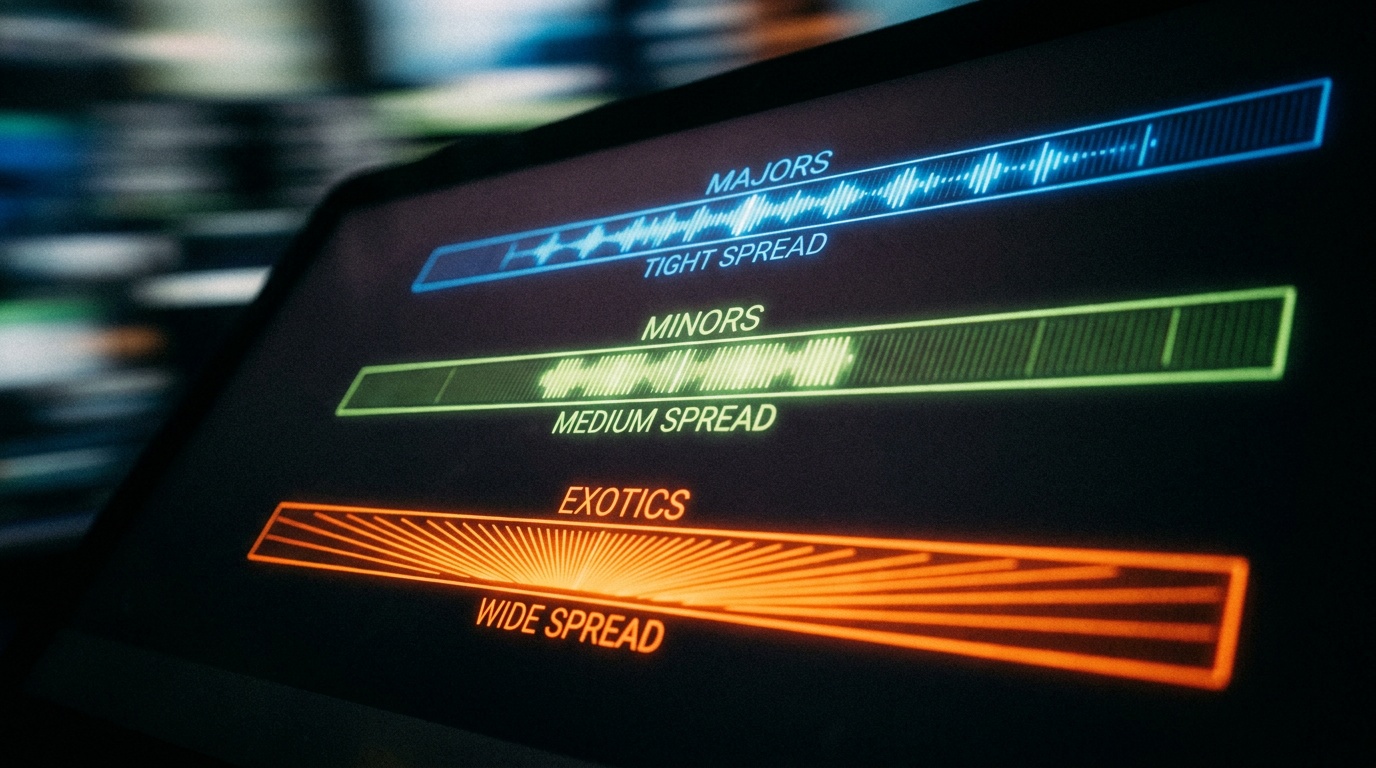
Spreads and liquidity vary significantly across currency pairs, and choosing the right pair for your strategy directly affects trading costs and execution quality. NextTrade offers over 40 forex pairs across three account types, each with different spread and commission structures. Major pairs like EUR/USD typically offer the tightest spreads and highest liquidity, while exotic pairs have wider spreads and lower trading volumes. This guide explains how spreads work, compares costs across NextTrade's account types, and helps you align pair selection with your trading style and preferred market sessions.
Quick answer: comparing spreads and liquidity across NextTrade's currency pairs
Spreads and liquidity differ across currency pairs depending on trading volume and market session. On NextTrade, major pairs such as EUR/USD offer the tightest spreads: 1.3 pips on a Standard account, or from 0.0 pips plus $7 per lot commission on a Raw account. Minor pairs and exotics have wider spreads due to lower trading activity.
To minimize costs, match your pair choice to your account type and strategy. Active scalpers benefit from Raw or VIP accounts with tight spreads and per-lot commissions, while longer-term traders may find Standard accounts suitable despite wider spreads.
What the term means: spreads, liquidity and currency pair types
A spread is the difference between the bid price (the price at which you sell) and the ask price (the price at which you buy). It represents the broker's margin and is paid on every trade. Liquidity describes how easily a currency pair can be traded without moving its market price; pairs with high liquidity have many buyers and sellers, enabling faster execution and tighter spreads.
Currency pairs fall into three categories.
Major pairs consist of the US Dollar and another major currency (EUR/USD, GBP/USD, USD/JPY). They have the highest trading volumes and liquidity because central banks, large institutions and retail traders actively trade them across multiple sessions.
Minor pairs (or crosses) don't include the US Dollar (EUR/GBP, EUR/JPY, AUD/NZD). They trade less frequently than majors, so spreads are typically wider.
Exotic pairs combine a major currency with a currency from an emerging or smaller economy. They have the lowest liquidity and widest spreads due to limited trading activity.
Pips are the smallest unit of price movement in a currency pair, used to measure both spreads and profit or loss. A spread of 1.3 pips means you pay 1.3 pips as a cost just to open a trade.
How it works: spreads, commissions and total trading cost
Trading costs on NextTrade come from spreads, commissions, or both, depending on your account type.
Standard Account charges no separate commission. The spread is built into the price. For example, EUR/USD has a spread of 1.3 pips. When you buy EUR/USD at 1.0900 ask, you pay this spread cost immediately; if you sell at 1.0900 bid, you receive 1.3 pips less.
Raw Account offers spreads from 0.0 pips, but charges $7 per lot for a complete round-trip trade (buy and sell). This is ideal if you trade frequently, because you pay commission only on executed trades, not on the spread alone.
VIP Account also offers spreads from 0.0 pips but charges a lower commission of $4 per lot round-trip. It requires a $10,000 minimum deposit and suits high-volume traders.
To calculate total cost, multiply your lot size by the spread cost (in pips) plus the per-lot commission if applicable. Your trading strategy determines which account type offers better value. NextTrade offers three account types with different cost structures to suit scalpers, active day traders and longer-term traders.
Worked example: calculating total cost across account types
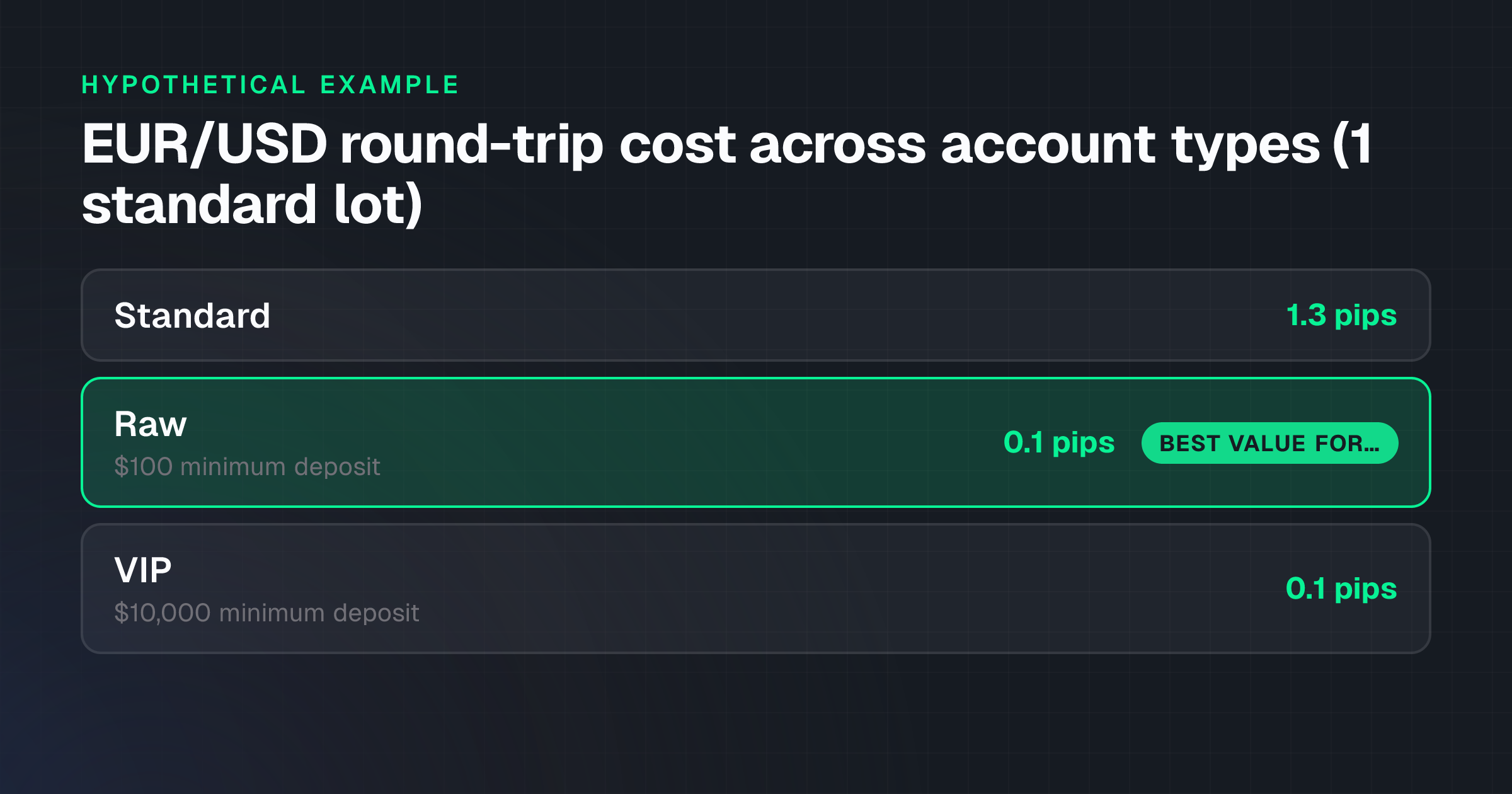
This example is educational and hypothetical. It shows how costs differ when trading the same pair on different account types.
Scenario: You buy 1 standard lot of EUR/USD and close the position within minutes.
Standard Account:
- Spread: 1.3 pips
- Commission: $0
- Total cost in pips: 1.3 pips
- Total cost in USD (assuming EUR/USD at 1.09): 1.3 pips × $100 per pip = $130
Raw Account:
- Spread: 0.1 pips (typical during active hours)
- Commission: $7 per lot round-trip
- Total cost in pips: 0.1 pips = $10
- Total cost in USD: $10 (spread) + $7 (commission) = $17
VIP Account:
- Spread: 0.1 pips
- Commission: $4 per lot round-trip
- Total cost in pips: 0.1 pips = $10
- Total cost in USD: $10 (spread) + $4 (commission) = $14
In this example, a Raw account costs $17 per round-trip on EUR/USD, while a Standard account costs $130. The Raw account is significantly cheaper for frequent traders. However, if you held the position overnight or traded only once per week, Standard might be adequate and require no account fees.
Spreads from 0.0 pips across 130+ instruments. Open Account
Costs and practical constraints: account minimums, session times and pair availability
Choosing a pair and account type involves practical trade-offs beyond spreads.
Minimum deposits lock up capital. Standard accounts require $25 minimum; Raw accounts require $100; VIP accounts require $10,000. If you have $500 to trade, you can't use a VIP account.
Liquidity varies by session. Major pairs like EUR/USD are most liquid during the London and New York session overlap (16:00-20:00 UTC), when spreads tighten and volume surges. Trading the same pair outside peak hours or during Asian sessions may result in wider spreads and slower execution. Minor pairs like EUR/GBP are most active during European hours. Trading exotic pairs during off-peak times can result in spreads two to three times wider than during peak liquidity.
Trading volume also affects execution. During economic announcements or market gaps, spreads can widen suddenly regardless of account type, and your order may execute at a worse price than expected (slippage). This isn't a NextTrade issue; it occurs across all brokers during volatile market conditions.
Position size constraints apply if you use leverage. NextTrade offers leverage up to 1:1000, which increases your market exposure but also accelerates losses. High leverage magnifies the impact of spreads and commissions on your account.
Compare spreads, commissions and overnight financing charges across account types before deciding.
Risks and limitations: slippage, overnight financing and low-liquidity pitfalls
Slippage occurs when your order executes at a different price than expected, typically during volatile market conditions. If you place a market order to buy EUR/USD at 1.0900 but the order fills at 1.0905, you've experienced 5 pips of slippage. Slippage is worse during economic news releases, market gaps, or when trading low-liquidity pairs.
Overnight financing (swap fees) applies if you hold a position past the daily close. If you hold EUR/USD long and interest rates favour the trade, you may receive a credit; if rates work against you, you pay a charge. For swing traders and position traders, these fees can accumulate significantly. NextTrade offers swap-free accounts for traders whose faith prohibits earning or paying interest on overnight positions.
Low liquidity creates wider spreads and slower execution. Trading exotic pairs during Asian sessions or minor pairs outside European hours means fewer counterparties and wider market spreads. Your order may sit unfilled longer, and you can't exit quickly if the trade moves against you.
Leverage amplifies losses. Using 1:1000 leverage means a 1 pip move against you represents a 10% loss of a $10,000 account. Spreads, commissions and slippage are charged on your leveraged position size, not your actual capital, so costs scale up rapidly.
Unexpected volatility widens spreads across all pairs. Geopolitical events, central bank announcements and economic data surprises cause sudden, temporary spread widening. A pair that normally trades at 1.3 pip spread may spike to 5-10 pips during a major announcement.
Common misunderstandings: fixed spreads, best pairs and strategy-pair fit
Myth: "Tight spreads guarantee profitable trades." A tight spread reduces your entry cost but doesn't predict market direction. You can lose money on a pair with 0.0 pip spreads if the market moves against your position. Spreads are costs, not edge.
Myth: "All forex pairs move the same way." They don't. EUR/USD is driven by US and European economic data; USD/JPY moves with risk sentiment and interest rate differentials; GBP/USD responds to UK political and economic events. Pair behaviour differs, so strategy must match pair characteristics.
Myth: "I should always trade the pair with the tightest spread." Not necessarily. If you scalp, tight spreads matter enormously. If you swing trade and hold for days, a 2 pip difference in spread is negligible compared to your expected profit. If you day trade with a $500 account and 100:1 leverage, even 1 pip difference in spread can make or break profitability.
Myth: "Exotic pairs are always bad." They're not. If you hold positions long-term and are comfortable with wider spreads, exotics may offer better risk-reward for specific strategies. However, during illiquid hours, exotic spreads can become prohibitively wide.
Myth: "I need to understand all 40+ pairs to trade." You don't. Most retail traders focus on 3-5 pairs. Understanding a few pairs deeply is better than dabbling in many. Start with a major pair like EUR/USD or GBP/USD, master your strategy, then expand.
Practical checklist: matching pairs to your strategy and account
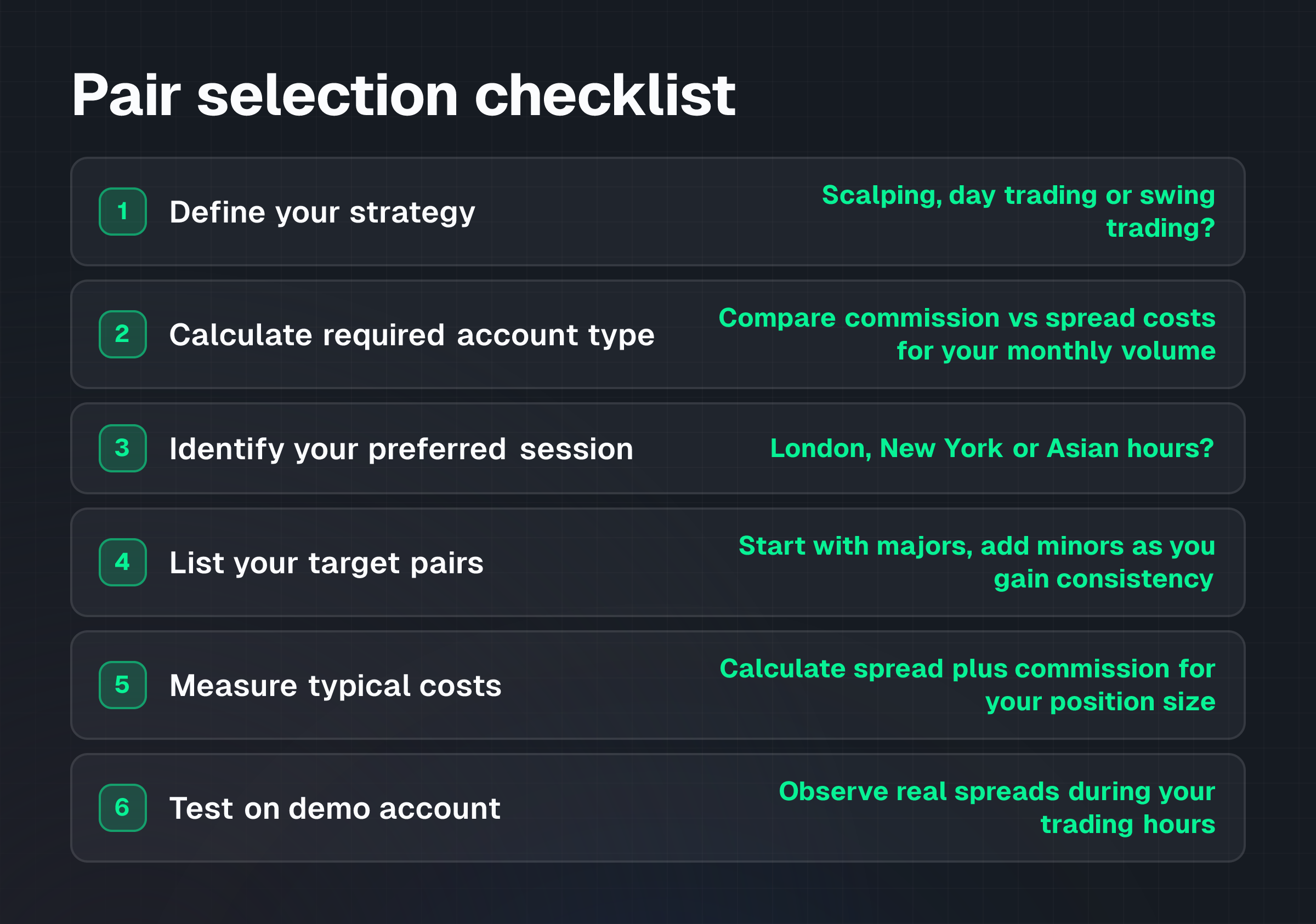
Before choosing a pair, work through this checklist:
- Define your strategy. Are you scalping (holding seconds to minutes), day trading (holding hours), or swing trading (holding days to weeks)?
- Calculate required account type. How many round-trip trades do you expect per month? If more than 10, calculate whether Raw or VIP commissions beat Standard spreads.
- Identify your preferred session. Do you trade during London hours, New York hours, or Asian sessions? Choose pairs that are liquid during those hours.
- List your target pairs. Major pairs (EUR/USD, GBP/USD, USD/JPY) suit most strategies. Minor pairs (EUR/GBP, EUR/JPY) work for specific setups. Avoid exotics until you have consistent profitability.
- Measure typical spread and commission cost. Use the worked example calculation above for your planned position size and strategy frequency.
- Test on a demo account. Open a demo account on MetaTrader 5 or TradeLocker to observe real spreads and execution during your preferred trading hours before risking real capital.
- Review overnight financing rates. If you hold positions overnight, check swap fees on your target pairs. They vary by currency and account type.
- Set position size rules. Never risk more than 1-2% of your account on a single trade, and use stop-loss orders to limit losses if the market moves against you.
Frequently asked questions
What spread should I expect on major vs. minor vs. exotic pairs?
Major pairs like EUR/USD typically trade at the tightest spreads: 1.3 pips on a Standard account or from 0.0 pips plus commission on Raw and VIP. Minor pairs are usually 0.5-1.5 pips wider. Exotic pairs can be 2-5 pips wider than majors, especially during low-liquidity hours. Spreads vary in real-time based on market conditions.
Why do spreads widen during economic news releases?
Economic announcements (interest rate decisions, employment data, GDP reports) cause sudden price spikes and uncertainty. Market makers widen spreads temporarily to protect against rapid directional moves. A major announcement can cause spreads to widen from 1.3 pips to 5-10 pips within seconds. This affects all account types equally.
Is a Raw account always cheaper than Standard if I trade frequently?
Not always. On EUR/USD, Raw charges $7 per lot round-trip plus 0.1 pips spread (roughly $17 total per lot). Standard charges 1.3 pips (roughly $130 per lot). Raw is much cheaper for frequent traders. But if you trade only once per week and hold positions for hours, the $7 commission per lot may not justify the account. Calculate your expected monthly trades and total cost.
Can I trade exotic pairs profitably on NextTrade?
Yes, but be aware of wider spreads and lower liquidity. Exotic pairs are suitable if you hold positions long-term, so the wider spread is less relevant per trade. However, exit timing is harder; you may face slippage if you try to close quickly. Start with majors and minors before trading exotics.
What is negative balance protection?
Negative balance protection prevents your account from going below zero if a rapid market move causes your losses to exceed your account balance. NextTrade provides this on retail accounts, so you can't lose more than your deposit. Professional traders and some jurisdictions don't receive this protection.
How does leverage affect my effective spread cost?
Leverage doesn't change the spread itself, but it increases the dollar cost. If you buy 10 lots of EUR/USD with 10:1 leverage on a 1.3 pip spread, your spread cost is 10 × $130 = $1,300, not $130. Leverage amplifies both gains and losses, so manage position size carefully.
Next step
You now understand how spreads, liquidity and account types interact. The next step depends on your stage:
- If you're new to forex, start by reading Forex and CFD trading, explained in plain English to solidify foundational concepts.
- If you're ready to narrow your pair choices, use How to Choose Forex Pairs for Your Trading Strategy to align pairs with your specific approach.
- If you want to compare the cost of different accounts for your expected trading volume, review Raw Spread vs Standard Account: Which Costs Less? to model your likely expenses.
- When you're ready to test your strategy, open an account with NextTrade using a demo account first to observe real spreads and execution without risk.
Risk warning: CFDs are complex instruments and carry a high risk of losing money rapidly due to leverage. Retail investor accounts with this broker lose money when trading CFDs. You should consider whether you understand how CFDs work and whether you can afford to take the high risk of losing your money. Past performance does not guarantee future results.
TagsTrading EducationNextTrade forex spreadsforex liquiditymajor currency pairsforex trading costs