
How to Choose Forex Pairs for Your Trading Strategy
Published Updated
By NextTrade Editorial

Choose currency pairs based on three factors: your trading strategy, available capital, and market session timing. Major pairs like EUR/USD and GBP/USD offer tight spreads and high liquidity, making them suitable for most retail traders. Minor pairs such as EUR/JPY provide moderate liquidity and regional economic exposure. Exotic pairs like USD/TRY carry wider spreads and higher volatility, requiring more capital and experience. Match the pair's characteristics to your risk tolerance, trading frequency, and the hours you plan to trade.
Retail traders face a practical choice. The forex market offers over 71 instruments, but not all suit every trader's circumstances. This guide explains how to select pairs that align with your strategy, costs, and capital constraints.
What the term means: Currency pair categories
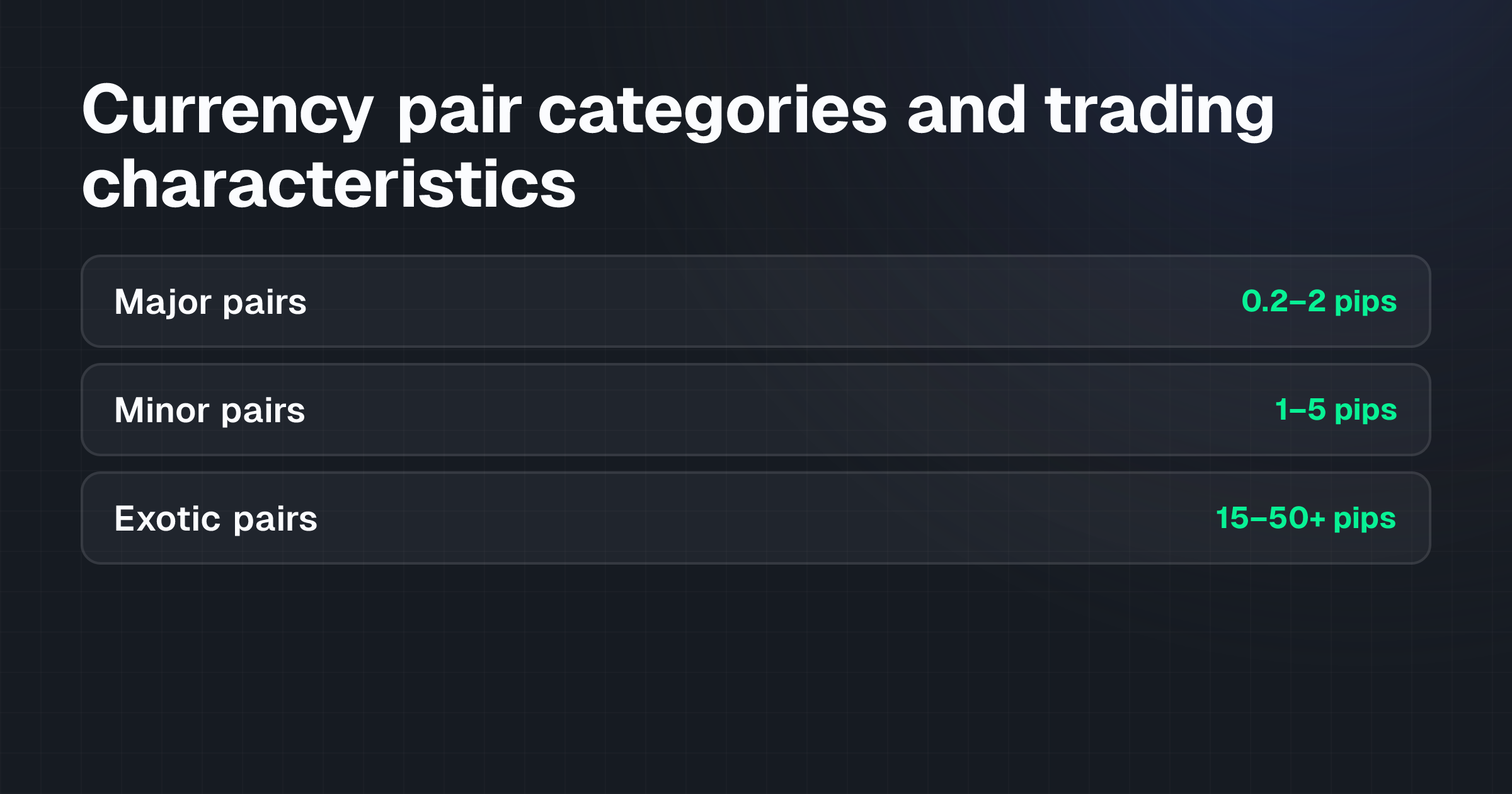
A currency pair represents two currencies traded against each other. The first currency (the base) is quoted in units of the second currency (the quote). EUR/USD means the cost of one euro in US dollars. Pairs are grouped into three broad categories based on the currencies they contain and their trading characteristics.
Major pairs
Major pairs consist of the US dollar paired with one of the world's largest economies: EUR/USD, USD/JPY, GBP/USD, USD/CHF, USD/CAD, AUD/USD, and NZD/USD. These pairs dominate global trading volume. They feature the highest liquidity.
High liquidity means many buyers and sellers are active simultaneously, resulting in tighter spreads, the difference between the bid (sell) and ask (buy) prices. EUR/USD on a Raw Account at NextTrade Broker carries a spread of 0.2 pips, one of the tightest available.
Minor pairs (cross pairs)
Minor pairs exclude the US dollar but link two major currencies. Examples include EUR/JPY, GBP/AUD, and EUR/GBP. These pairs reflect economic relationships and regional dynamics between two developed economies. They offer moderate liquidity and wider spreads than major pairs, typically ranging from 1 to 5 pips depending on market conditions and the broker. USD/JPY on a Standard Account at NextTrade, for instance, carries a 2-pip spread.
Exotic pairs
Exotic pairs pair a major currency with one from a smaller or developing economy. USD/TRY (US dollar to Turkish lira) or EUR/ZAR (euro to South African rand) are examples. Exotic pairs have lower trading volume, wider spreads, and significantly higher volatility. These characteristics reflect lower liquidity and higher risk for liquidity providers. Exotic pairs often react sharply to local economic news, geopolitical events, or central bank decisions, making them unpredictable for retail traders with limited capital.
How it works: Selecting a pair for your strategy
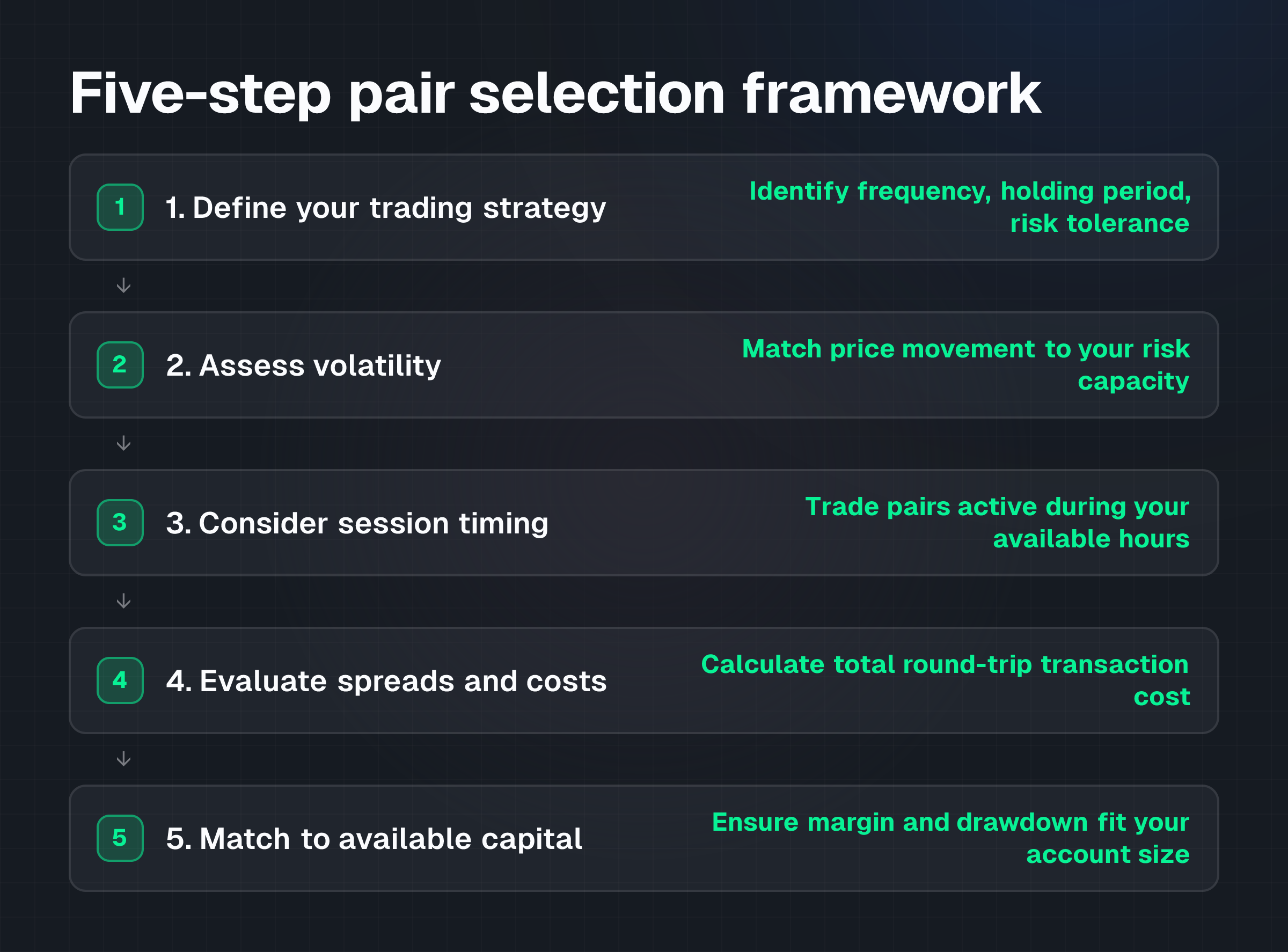
Pair selection is a decision framework built on four core criteria: volatility, session timing, trading costs, and available capital.
Step 1: Define your trading strategy
Different trading approaches require different pair profiles. Day traders executing dozens of trades per day need pairs with high liquidity, tight spreads, and consistent price action during active sessions. Swing traders holding positions over days or weeks can tolerate slightly wider spreads if the pair offers clear directional trends. Long-term position traders may prioritize economic fundamentals over short-term volatility.
Your risk tolerance also matters. Low-risk traders should focus on major pairs with predictable volatility. Higher-risk traders with experience and capital reserves might explore minors and exotics.
Step 2: Assess volatility
Volatility describes the degree of price movement over time. High volatility means prices change rapidly and significantly, offering profit potential but increased risk of rapid losses.
Research by Jain and Sahu (2018) found that major currency pairs exhibit lower volatility than exotic pairs, making them more suitable for traders new to forex or seeking stable price movements. Volatility clustering, identified in research by Taylor and Allen (1992), is common in forex markets: periods of high volatility tend to follow other high-volatility periods, while calm periods cluster together. Traders should adapt their approach based on current market conditions rather than assuming static volatility.
Step 3: Consider session timing
Currency pairs are most actively traded when the financial centers involved are open. According to "The Foreign Exchange Market" by Mark (2001), trading volume and liquidity for specific pairs peak when the trading hours of the relevant countries overlap. EUR/USD is most active during the London-New York overlap, roughly 12:00-17:00 UTC. AUD/JPY peaks during Sydney-Tokyo overlap hours.
Trading a pair outside its active session often results in wider spreads and choppier, harder-to-read price action.
Step 4: Evaluate spreads and costs
Spreads are your primary transaction cost. A tighter spread means lower cost per trade. Major pairs consistently have the tightest spreads due to high liquidity. Minor pairs carry wider spreads (typically 1-5 pips). Exotic pairs carry the widest spreads due to low liquidity and higher risk for market makers.
For frequent traders, wider spreads erode profits quickly. For traders executing a few positions per week, spread width matters less than for scalpers taking many small trades.
Step 5: Match pair choice to available capital
Your capital determines the position size you can comfortably trade and the margin required. NextTrade Broker offers leverage up to 1:1000, which is extremely high.
While high leverage amplifies market exposure, it also amplifies potential losses. Regulatory bodies including the Commodity Futures Trading Commission (CFTC) frequently highlight that leverage increases both the speed and scale of losses. Traders with smaller capital must use tighter risk controls, especially when trading volatile pairs. Exotic pairs demand more capital than majors to weather normal price swings without triggering margin calls.
Worked example: Comparing three pairs
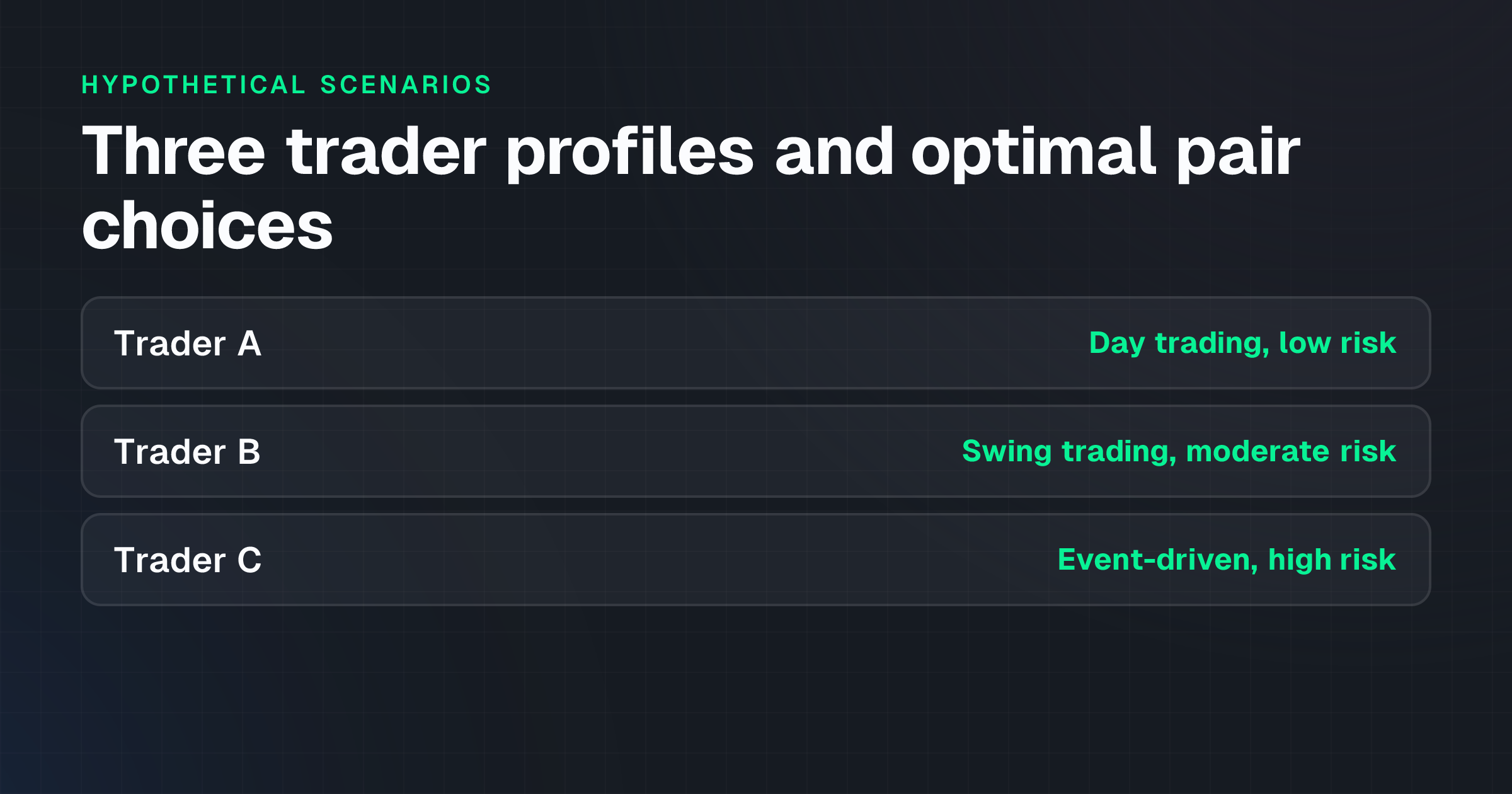
This example is hypothetical and educational. It illustrates how pair characteristics affect trading decisions.
Scenario: Three retail traders each have $5,000 USD to trade.
Trader A: Day trader, 2 hours daily during London-New York overlap, low risk tolerance.
- Best fit: EUR/USD (major pair)
- Spread: 0.2 pips (Raw Account)
- Session: Active 12:00-17:00 UTC
- Cost per 1 standard lot (100,000 units): 0.2 pips × $10 per pip = $2
- Why suitable: Tight spread minimizes transaction cost, high liquidity ensures smooth execution, abundant economic data supports technical analysis
Trader B: Swing trader, holds positions 3-7 days, moderate risk tolerance.
- Best fit: GBP/AUD (minor pair)
- Characteristics: Moderate liquidity, volatility reflects both UK and Australian economic conditions, widish spreads (approx. 3-5 pips typical, not quoted at NextTrade specifically)
- Cost per 1 standard lot: Approximately 3-5 pips × $10 per pip = $30-50
- Why suitable: Wide enough spreads to absorb transaction cost across multi-day trades, economic divergence between economies creates trending opportunities
Trader C: Experienced trader with strong geopolitical knowledge, $5,000 capital, high risk tolerance.
- Best fit: USD/TRY (exotic pair)
- Characteristics: High volatility, very wide spreads (exact spread not specified at NextTrade, but exotic pairs typically 15-50+ pips), reacts sharply to Turkish monetary policy and political events
- Cost per 1 standard lot: Potentially 20+ pips × $10 per pip = $200+
- Position size needed to manage risk: Given the width of spreads and volatility, this trader would likely trade micro-lots (0.01 standard lot) to keep drawdown risk within acceptable limits
These examples show that the "best" pair depends entirely on the trader's approach, available capital, and risk tolerance. No single pair suits all traders.
Costs and practical constraints: What to budget for
Spreads are only one cost. Overnight financing (swap fees for holding positions across sessions), commissions on certain account types, and slippage (execution at worse prices than quoted during volatile news events) also reduce profitability.
NextTrade Broker structures costs as follows:
- Raw Accounts: Very tight spreads (e.g., EUR/USD at 0.2 pips) with per-trade commissions
- Standard Accounts: Slightly wider spreads with no per-transaction commission
- Exotic pairs: Incur wider spreads and potential additional commissions (referenced in the fee structure as exotic_spread fees)
Three Account Types. One Broker. details the specific cost structure for each account type.
For practical purposes, traders should calculate total round-trip cost (spread + commission) before entering a position. A trader executing 20 trades per month in EUR/USD at 0.2-pip spreads pays far less in transaction costs than one trading USD/TRY at 30+ pips, even if the USD/TRY trade is more volatile. Budget accordingly based on your trading frequency and chosen pairs.
Risks and limitations: Why pair selection matters to risk management
Liquidity risk
Trading low-liquidity pairs during off-peak hours or around news events can result in slippage, execution at prices significantly worse than quoted. On exotic pairs, a large order may exhaust available liquidity at the quoted price, forcing execution at worse prices or partial fills.
This widens your effective spread and increases losses.
Volatility risk
Exotic pairs can move 5-10% in a single day based on unexpected news. Even major pairs can experience volatile spikes during high-impact data releases or central bank announcements.
If you use high leverage, such moves can trigger margin calls before you have time to react. Major pairs are less prone to extreme intraday swings, though they aren't immune.
Spread cost accumulation
Trading pairs with wide spreads frequently erodes profitability quickly. Exotic pair spreads of 30+ pips mean that a trade entering at ask and exiting at bid loses 30 pips before price movement is even considered. For a scalper aiming for 5-10 pip profits, wide spreads make profitability very difficult.
Over-leverage risk
NextTrade's maximum leverage of 1:1000 is extraordinarily high. Traders tempted to use extreme leverage on volatile exotic pairs can lose their entire account in minutes if price moves against them.
Starting with modest leverage and increasing it only after demonstrating consistent risk management is a practical approach.
Common misunderstandings: What traders often get wrong
Misunderstanding 1: "Exotic pairs offer the best profit potential."
Exotic pairs do offer larger price swings, but larger swings cut both ways. The wider spreads and lower liquidity mean that executing trades at your intended prices is harder, and the transaction costs alone can wipe out small moves. A 2% move in USD/TRY might sound attractive, but a 30-pip spread and unpredictable execution can eliminate that advantage.
Misunderstanding 2: "I should trade the most volatile pair available."
Higher volatility appeals to traders seeking quick profits, but it also increases the risk of rapid, substantial losses. Volatility clustering means that once volatility begins, it persists, so a volatile pair can cost you capital before you recognize the risk. Matching volatility to your strategy and risk tolerance matters far more than chasing the most volatile asset.
Misunderstanding 3: "Major pairs are boring and unprofitable."
Major pairs move less in percentage terms but offer tight spreads, predictable liquidity, and lower risk of slippage. Profitability depends on strategy, not volatility alone.
A trader executing a clear 2% weekly gain on EUR/USD with major-pair spreads will outperform one losing 50% chasing exotic-pair moves.
Misunderstanding 4: "I should trade all pairs at once."
Spreading capital across many pairs dilutes focus and increases operational complexity. Most retail traders perform better specializing in 2-4 pairs they know well rather than monitoring 10 or more.
Misunderstanding 5: "Session timing doesn't matter if I use high leverage."
High leverage makes session timing even more critical. Trading a pair outside its active session means wider spreads, less predictable price action, and less liquidity to absorb your order. Combining off-peak trading with high leverage is a common route to rapid losses.
Practical checklist: Steps to choose your first pair
- Define your intended trading style (day trading, swing trading, position trading) and estimate how many hours per week you'll monitor positions
- State your risk tolerance (conservative, moderate, aggressive) and your available trading capital
- Identify which market sessions align with your schedule (e.g., London-New York overlap, Tokyo-Sydney overlap, US morning)
- List major pairs active during your preferred session (e.g., EUR/USD, GBP/USD for London-New York; AUD/JPY for Tokyo-Sydney)
- Compare spreads and transaction costs for your account type at your broker
- Calculate your intended position size and verify you have sufficient capital to withstand a 2% adverse move without margin call
- Paper-trade (simulate without real money) for at least 20 trades to assess how the pair's volatility and liquidity suit your strategy
- Once live trading begins, focus on one pair until you accumulate consistent results; add a second pair only once you understand the first thoroughly
- Review your pair selection quarterly; if results are poor, revisit this checklist rather than blaming market conditions
Step-by-Step TradingGuides. provides detailed walkthroughs for executing trades on the platforms available at NextTrade.
FAQs
What spread should I expect on different pair types?
Major pairs typically trade at 0.5-2 pips, with highly liquid pairs like EUR/USD even tighter. Minor pairs range from 1-5 pips. Exotic pairs often exceed 15 pips and can widen significantly during news events or low-activity periods. Exact spreads depend on your broker, account type, and market conditions.
Should I trade during multiple market sessions?
Trading across sessions is possible, but liquidity is highest during overlaps (e.g., London-New York 12:00-17:00 UTC). Outside overlaps, spreads widen and price action becomes choppier. New traders should focus on one active session and specialize in pairs most liquid during that time.
How much capital do I need to trade exotics?
There's no fixed minimum, but exotics demand more capital per trade than majors because wider spreads and higher volatility require larger position sizes to make meaningful returns and absorb normal price swings. A trader with $5,000 can trade major pairs; the same trader trading exotics should prepare for faster drawdown risk and consider smaller position sizes.
Can I profit from major pairs if they move less than exotics?
Yes. Profitability depends on strategy execution, not volatility.
A trader profiting 1-2% weekly on EUR/USD using tight stops and consistent discipline will likely outperform one losing capital on exotic pair volatility swings. Consistency matters more than dramatic price moves.
What happens if I trade a pair outside its active session?
Spreads widen, liquidity drops, and price action becomes less predictable and harder to read. Orders may not fill at quoted prices. Your effective transaction cost increases, and the pair's typical correlation patterns may break down. For retail traders, this worsens profitability; beginners should avoid it entirely.
How does leverage affect pair selection?
High leverage (like NextTrade's 1:1000 maximum) amplifies both gains and losses. Trading volatile exotic pairs on high leverage increases the speed at which you can lose capital. Most successful retail traders use modest leverage (1:50 to 1:100) with clear risk rules, especially when trading pairs outside the major-pair category.
Next step
Understanding pair characteristics is the foundation of a trading plan, but execution requires learning how to enter, size, and exit positions. Multi-Platform Access. One Account. Your Choice. describes the trading platforms available for different workflows. The choice of platform, combined with the pair you select, shapes your daily trading experience and your ability to implement your strategy consistently.
Risk Warning (Forex/CFDs): Forex and CFD trading carry substantial risk of loss. Leverage amplifies both profits and losses. Past performance doesn't guarantee future results. Most retail traders lose money. Ensure you understand how leverage, margin calls, and slippage work before opening a live account. Check the current product terms and your local regulations before trading. This article is educational and doesn't constitute investment advice, a recommendation to trade, or an offer of financial services.
TagsTrading Educationprop tradingprop firms