
Raw Spread vs Standard Account: Which Costs Less?
Published Updated
By NextTrade Editorial
Whether a Raw Spread account or a Standard account costs less depends on your trading frequency and position size. Standard accounts simplify pricing by embedding the broker's fee into a wider spread, with no separate commission. Raw Spread accounts separate the market spread from a fixed $7 USD round-trip commission per lot, which can be cheaper for high-volume traders but adds a per-trade cost. Raw isn't automatically cheaper in every scenario; the break-even point varies by instrument, spread width, and how often you trade.
This guide compares the two pricing models so you can align your account choice with your trading style and capital.
Quick answer
A Standard account charges all trading costs via spread alone. You pay a wider spread and no separate commission.
A Raw Spread account charges you a narrower spread plus a fixed commission per round trip (entry and exit). Neither is universally cheaper. The choice depends on how many trades you execute, how large each position is, and which instruments you trade. For frequent traders executing large positions, Raw Spread accounts often reduce total costs. For occasional traders or those using smaller sizes, Standard accounts may be simpler and potentially cheaper.
Standard versus Raw at a glance
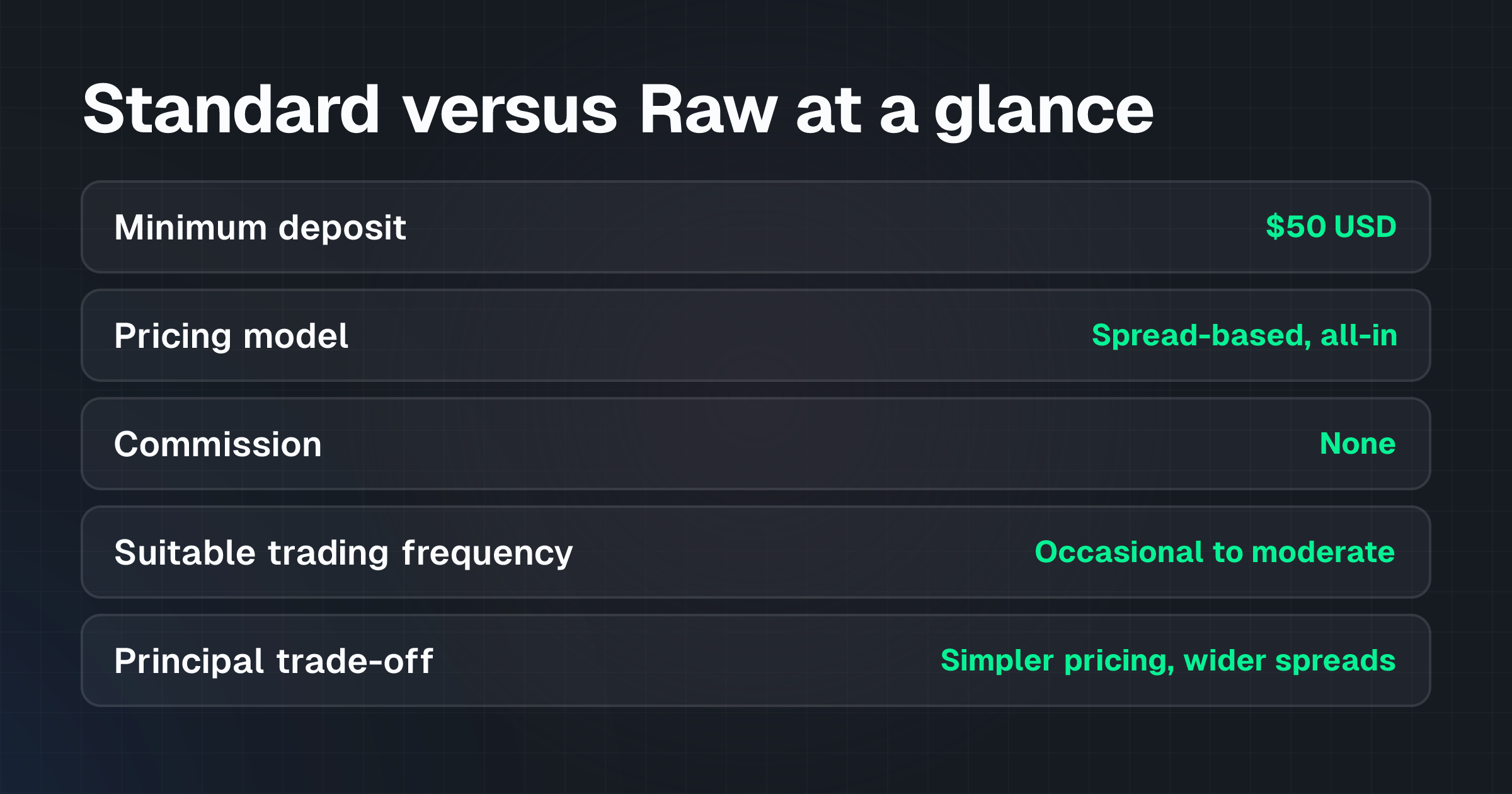
| Feature | Standard Account | Raw Spread Account |
|---|---|---|
| Minimum deposit | $50 USD | $100 USD |
| Pricing model | Spread-based, all-in | Raw spread + commission |
| Commission | None | $7 USD per lot round-trip |
| Suitable trading frequency | Occasional to moderate | Active, multiple trades daily |
| Principal trade-off | Simpler pricing, wider spreads | Narrower spreads, per-trade commission |
Standard accounts bundle all trading costs into the spread. The broker widens the spread beyond the raw market price to cover its operating costs, technology, and risk management. You see one price, the spread, and pay no separate commission.
Raw Spread accounts separate market pricing from broker pricing. You receive the tightest available market spread (sometimes as low as 0.0 pips) but pay a fixed commission each time you round trip a position. NextTrade charges $7 USD per standard lot on a round-trip basis for forex, metals, and energies. Check 131 instruments. Raw spreads. One account. to confirm availability and typical spread ranges on your preferred instruments.
How to calculate the total cost
Understanding the full cost of a trade is essential for comparing account types. Use this formula:
Total Trading Cost = Spread Cost + Round-Trip Commission + Any Applicable Overnight Financing
Spread Cost: Multiply the spread width (in pips) by the pip value of your position size. If EUR/USD has a 1.5 pip spread and you trade 1 standard lot (100,000 units), the pip value is $10 per pip. Your spread cost is $15 (1.5 pips × $10/pip).
Round-Trip Commission: This applies on Raw Spread accounts only. It's a fixed fee per lot. For NextTrade Raw accounts, this is $7 USD per standard lot for a complete round trip.
Overnight Financing (Swaps): These charges apply if you hold a position past the end of the trading day. Swap rates vary by instrument, position direction, and interest rate differentials. They can be positive or negative and apply equally to both Standard and Raw Spread accounts. Check the current product terms for swap rates on specific instruments before opening a position.
Worked comparison
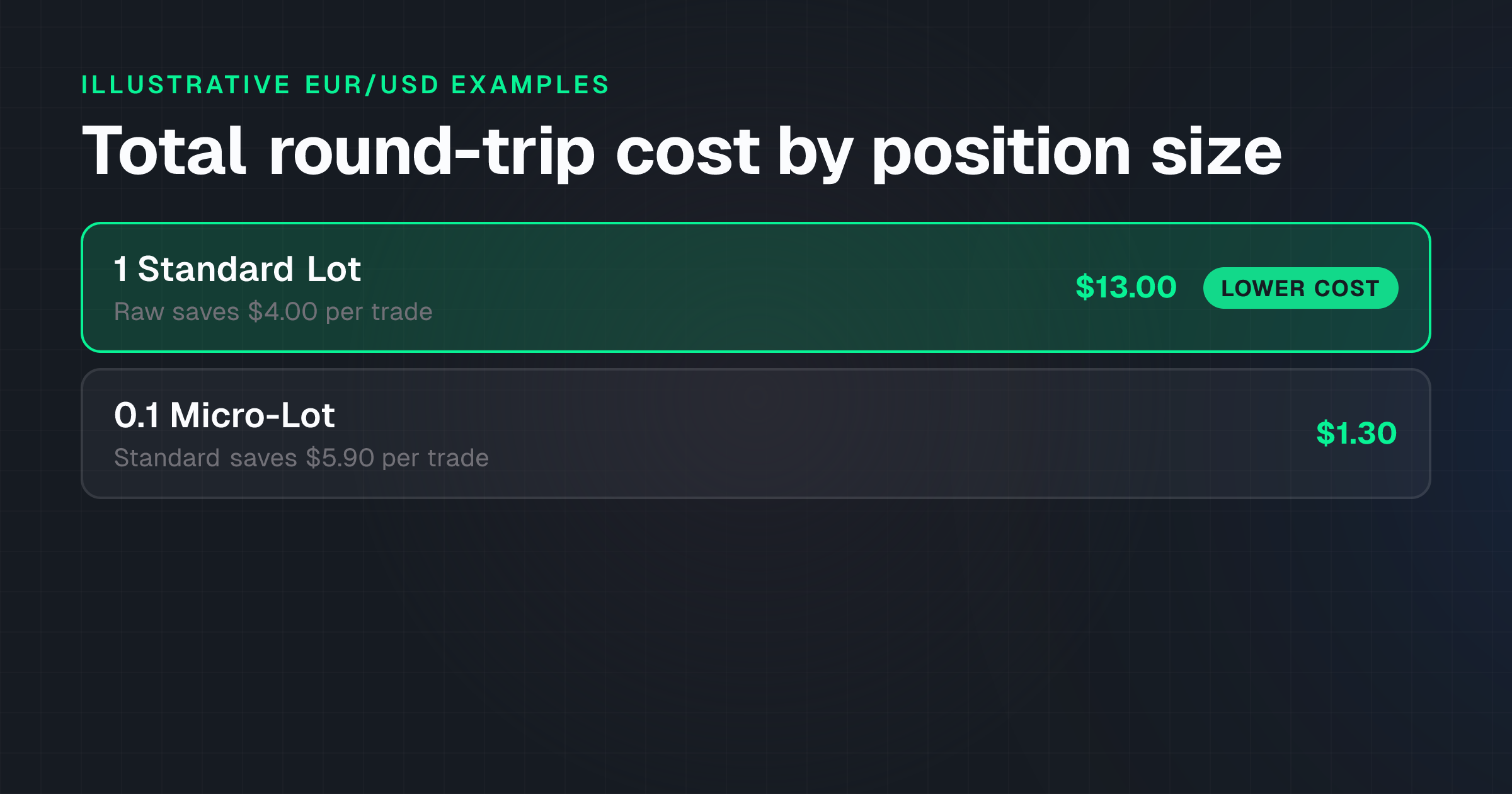
The following examples illustrate how to compare costs at different position sizes. These spreads are illustrative and educational; they don't represent NextTrade's live or average spreads. Spreads are variable and depend on market conditions.
Scenario: 1 Standard Lot of EUR/USD
Standard Account:
- Illustrative spread: 1.3 pips
- Commission: $0 (none)
- Spread cost: 1.3 pips × $10/pip = $13.00
- Total round-trip cost (excluding swaps): $13.00
Raw Spread Account:
- Illustrative raw spread: 0.2 pips
- Commission: $7.00 per lot round-trip
- Spread cost: 0.2 pips × $10/pip = $2.00
- Total round-trip cost (excluding swaps): $2.00 + $7.00 = $9.00
In this example, the Raw Spread account saves $4.00 per trade.
Scenario: 0.1 Micro-Lot of EUR/USD
Standard Account:
- Illustrative spread: 1.3 pips
- Commission: $0
- Spread cost: 1.3 pips × $1/pip (micro-lot) = $1.30
- Total round-trip cost: $1.30
Raw Spread Account:
- Illustrative raw spread: 0.2 pips
- Commission: $7.00 per lot round-trip (applies to full or micro-lots)
- Spread cost: 0.2 pips × $1/pip = $0.20
- Total round-trip cost: $0.20 + $7.00 = $7.20
The Standard account is cheaper by $5.90 because the fixed $7.00 commission outweighs the spread savings at a small position size.
Understanding Break-Even
The break-even point occurs when the spread cost difference equals the commission. If a Standard account spread is 1.3 pips and a Raw Spread spread is 0.2 pips on a $10/pip instrument, the difference is 1.1 pips = $11.00. Since $11.00 exceeds the $7.00 commission, Raw Spread becomes cheaper at 1 standard lot. At micro-lots, the $7.00 commission becomes disproportionately large.
Which account may suit frequent traders?
For traders executing one or two trades per week, the total commission cost remains modest. A trader making 50 round-trip trades per month on a Standard account pays nothing in commission; the same trader on a Raw Spread account pays $350 USD (50 trades × $7 per lot).
However, if the Raw Spread account saves $4 per trade through tighter spreads, that trader saves $200 (50 trades × $4 savings), resulting in a net cost of $150 additional. But small cost differences accumulate. Over a month, tighter spreads can offset the commission burden when position sizes are substantial, typically one standard lot or more per trade.
Transaction frequency makes these differences compound. Lower per-trade costs can encourage more frequent trading, but increased trading frequency doesn't improve profitability. It can increase slippage, emotion-driven decisions, and overall transaction costs if trade quality declines. Frequent trading isn't advisable without a tested strategy and disciplined risk management.
Which account may suit newer or occasional traders?
Standard accounts offer simpler pricing. You see the spread, you pay the spread, and that's the transaction cost (excluding swaps). No mental math for commissions, no second line item to track. This transparency matters when you're learning to calculate position sizes, set stop-losses, and manage Forex Risk Management: Position Sizing and Stop-Losses.
The $50 USD minimum deposit is half that of the Raw Spread account, making it more accessible for traders with limited starting capital. Smaller positions (micro or mini lots) make fixed commissions less attractive. If you're trading 0.01 or 0.1 lots, the $7.00 commission becomes a disproportionately large percentage of capital traded.
Risk management matters more than account type. Tighter spreads or lower commissions don't reduce leverage risk; position sizing and stop-losses do. Guides for your first deposit and first trade. walks through the setup process.
Questions to ask before choosing
Instruments: Which asset classes do you trade? Verify that both account types support your preferred instruments and review typical spread ranges.
Position size: Do you typically trade micro, mini, or standard lots? Use this to estimate whether fixed commissions will be attractive. Larger positions (standard lots or multiple lots) make the fixed commission a smaller percentage of total capital traded, increasing the likelihood that raw spreads remain cheaper overall.
Trade frequency: How many round-trip trades do you execute per month? Calculate accumulated commission costs across a typical month.
Holding period: Do you hold positions overnight? If so, review overnight financing (swap) rates for both account types. Swaps are separate from spread and commission costs and depend on the instrument, position direction, and rollover date.
Available margin: Confirm you meet the minimum deposit. Standard requires $50 USD; Raw requires $100 USD. Review Three accounts. From 0.0 pips. One broker. for full feature sets.
Final verdict
Raw Spread accounts reduce total costs when position size and trade frequency are high enough to offset the fixed commission. Standard accounts simplify pricing and may be cheaper for small or infrequent trades. Neither is universally cheaper. Calculate total costs for a typical trade: (spread in pips × pip value) + (commission per lot if Raw). Apply this to your average position size and monthly trade count. The account with the lower total is more cost-effective for your style.
Spreads are variable; they widen during low liquidity, high volatility, or news events. A Raw Spread account offers tighter market spreads in normal conditions, but during extreme market moves, execution costs can still spike. Spread width affects transaction cost, not market risk. A tighter spread reduces cost but doesn't protect against adverse price movements, leverage risk, or slippage.
Both account types carry leverage up to 1:1000. Higher leverage increases potential gains but also increases the speed and scale of potential losses. Tighter spreads or lower commissions don't reduce leverage risk; risk management through position sizing and stop-losses remains essential. Review MetaTrader 5 vs TradeLocker: Which Platform Should You Use? to understand how platform choice aligns with your workflow.
Trading CFDs and using leverage carries substantial risk of loss, including the full loss of capital. These concepts are educational and don't constitute investment advice or a recommendation to trade.
TagsTrading Educationprop tradingprop firms