
EUR/USD vs GBP/USD: Which Pair Suits Your Trading Style?
Published
By NextTrade Editorial

EUR/USD and GBP/USD are the two most liquid currency pairs in forex markets. EUR/USD is generally the better choice for traders seeking tighter spreads and lower costs, while GBP/USD suits those comfortable with higher volatility and willing to pay wider spreads. The decision depends on your trading style, time commitment, strategy type and risk tolerance. This article compares both pairs across volatility, trading sessions, economic drivers and spread costs to help you choose between them.
Quick answer: Which pair fits your trading style
EUR/USD offers the tightest spreads due to its unparalleled liquidity, making it cost-effective for frequent traders and scalpers. GBP/USD exhibits higher volatility, creating larger price swings and wider spreads, which can suit swing traders and news traders but demands stronger risk management.
Neither pair is inherently "better." Your choice should reflect your strategy, capital and how much time you can dedicate to monitoring positions.
What the term means: Currency pairs and liquidity
A currency pair is an exchange rate quotation of two different currencies. EUR/USD, for example, expresses how many US dollars it costs to buy one euro. GBP/USD shows the US dollar cost of one British pound.
Major currency pairs are the most frequently traded globally and typically involve the US dollar. Both EUR/USD and GBP/USD qualify as majors because of their high trading volumes and central role in forex markets.
Liquidity refers to the ease with which an asset can be converted to cash without significantly affecting its market price. Higher liquidity generally produces tighter spreads (lower trading costs) and better order execution. A spread is the difference between the bid price (what buyers offer) and the ask price (what sellers demand). It's a direct trading cost.
Volatility is the degree of variation in a trading price series over time. High volatility means prices change dramatically over short periods, offering larger profit potential but also larger risk. Low volatility produces more gradual, predictable price movements.
How it works: Comparing the pairs on key metrics
Liquidity and spread costs
EUR/USD holds the highest liquidity among all currency pairs. According to NextTrade's pricing analysis, EUR/USD carries a liquidity rating of "Highest" with spreads from 0.1 to 0.3 pips on ECN/STP accounts and 0.5 to 1.2 pips on Market Maker accounts.
GBP/USD, rated "High" for liquidity, shows wider spreads: 0.4 to 0.8 pips on ECN/STP accounts and 1.0 to 2.0 pips on Market Maker accounts.
The cost difference matters over time. If you execute 100 trades per month, tighter spreads on EUR/USD accumulate into significantly lower total transaction costs compared to GBP/USD.
Volatility and price movement
GBP/USD generally exhibits higher volatility than EUR/USD. The wider spread ranges listed above reflect this: brokers widen spreads on more volatile pairs to manage their own risk exposure.
Higher volatility creates larger daily price ranges. This can generate bigger profits on successful trades but also larger losses on unsuccessful ones.
EUR/USD, by contrast, moves more gradually. This stability suits traders using mechanical strategies or those with limited time to monitor positions, as price swings are less abrupt.
Trading session hours
Both pairs are most active during the overlap of the European (London) and North American (New York) trading sessions, roughly 8 AM to 12 PM EST. During this window, both pairs experience peak liquidity and tightest spreads.
GBP/USD tends to exhibit pronounced volatility spikes during UK economic data releases and Bank of England announcements. EUR/USD similarly reacts to European Central Bank decisions and eurozone economic data, but the movements are generally less dramatic relative to the pair's typical range.
Economic drivers
EUR/USD is influenced by two major economic centres: the eurozone and the United States.
Eurozone drivers include European Central Bank (ECB) interest rate decisions, eurozone inflation reports and GDP figures, and political stability within EU member states.
US drivers include Federal Reserve interest rate decisions, Non-Farm Payrolls employment data, US inflation reports and geopolitical events.
GBP/USD responds to UK and US factors. UK drivers include Bank of England interest rate decisions, UK inflation, GDP and employment data, and political developments such as elections and policy changes. US drivers mirror those affecting EUR/USD.
Both pairs react to broader geopolitical events affecting either region, but GBP/USD can experience sharper moves on UK-specific news such as Bank of England policy surprises or Brexit-related announcements.
Worked example: Comparing trading costs
This example is hypothetical and for educational purposes only. It illustrates how spread differences accumulate and does not represent an actual trade or recommendation.
Suppose a trader executes 50 round-trip trades per month on a Standard account (no commission) at an average position size of 1 lot (100,000 units of base currency).
EUR/USD costs:
- Average spread: 0.8 pips
- Cost per round-trip trade: 0.8 pips × $10 per pip per lot = $8
- Monthly spread cost: 50 trades × $8 = $400
GBP/USD costs:
- Average spread: 1.5 pips
- Cost per round-trip trade: 1.5 pips × $10 per pip per lot = $15
- Monthly spread cost: 50 trades × $15 = $750
Difference: $350 per month (or $4,200 annually) on this hypothetical trading volume.
On a Raw account with 0.0 pips spreads and $7 per lot round-trip commission, the same 50 trades cost $350 in commissions, regardless of pair. Traders executing very high volumes may find Raw or VIP accounts more cost-effective than Standard accounts, where spreads vary by pair.
Spreads from 0.0 pips across 130+ instruments. Open Account
Costs and practical constraints: Beyond spreads
Spread costs are just one component of trading expenses.
Commission: NextTrade offers three account types. Standard accounts charge no commission and have floating spreads that fluctuate based on market conditions. Raw accounts (minimum $100 deposit) feature spreads starting at 0.0 pips with a round-trip commission of $7 per lot on forex. VIP accounts (minimum $10,000 deposit) provide spreads from 0.0 pips with a round-trip commission of $4 per lot. The tier of a trader's account has a notable impact on overall trading costs.
Overnight financing (swaps): Holding positions across the daily market close incurs swap charges or credits, depending on interest rate differentials between the two currencies. GBP/USD and EUR/USD can have different swap rates, influencing the cost of longer-term positions.
Slippage: This occurs when your order executes at a different price than expected, commonly during volatile market moves or low-liquidity periods. EUR/USD's higher liquidity typically produces less slippage than GBP/USD during normal trading hours.
Funding constraints: Both pairs trade on MetaTrader 5 and TradeLocker at NextTrade, supporting scalping and hedging. The choice of platform may influence trading speed and execution quality, though pricing remains identical across both platforms at NextTrade.
Risks and limitations: Volatility and execution
Higher volatility in GBP/USD
GBP/USD's greater price swings can trigger stop-loss orders more easily if they're placed too close to current prices. A trader must use wider stops, accepting larger potential losses per trade, or risk being stopped out by normal market noise before the trade idea develops.
Economic data risk
Both pairs react sharply to scheduled economic releases. EUR/USD can gap significantly on ECB announcements; GBP/USD can spike on Bank of England decisions or UK employment data. Trading immediately before or during data releases without appropriate stop-loss protection (see stop-loss placement in forex: strategy guide) exposes accounts to rapid, large losses.
Leverage amplifies losses
Leverage is available at NextTrade, but it increases both profit potential and the risk of rapid losses. An adverse price move against a highly leveraged position can lead to significant account depletion.
Lower leverage, such as 1:10 or 1:20, reduces catastrophic risk even if it reduces profit on winning trades.
Negative balance protection
NextTrade offers negative balance protection on retail accounts, meaning you can't lose more than your deposit. However, this protection applies after a loss occurs and may not prevent severe account drawdowns.
Common misunderstandings: What traders often get wrong
"EUR/USD is always better because it has lower spreads."
Lower spreads reduce transaction costs, but they don't guarantee profitability. A trader selecting the wrong strategy or ignoring risk management can lose money on either pair regardless of spreads. The best pair is the one that aligns with your strategy, not the one with the cheapest entry cost.
"Higher volatility means higher profits."
Volatility creates larger price moves in both directions. While large moves can generate profits, they equally create larger losses if your analysis is wrong. Higher volatility requires stronger discipline and tighter stop-losses, not looser ones.
"I should trade both pairs to diversify."
EUR/USD and GBP/USD are highly correlated. They often move in the same direction because both pairs involve the US dollar. Trading both simultaneously doesn't reduce portfolio risk the way diversifying across unrelated assets does. It can actually amplify losses if both pairs move against your positions at once.
"Economic data affects all traders equally."
Large data releases create sharp price spikes, but execution quality varies. Traders on less liquid venues or without proper order management may experience slippage during these moments, paying de facto wider spreads than their stated account spread.
Practical checklist: Choosing between EUR/USD and GBP/USD
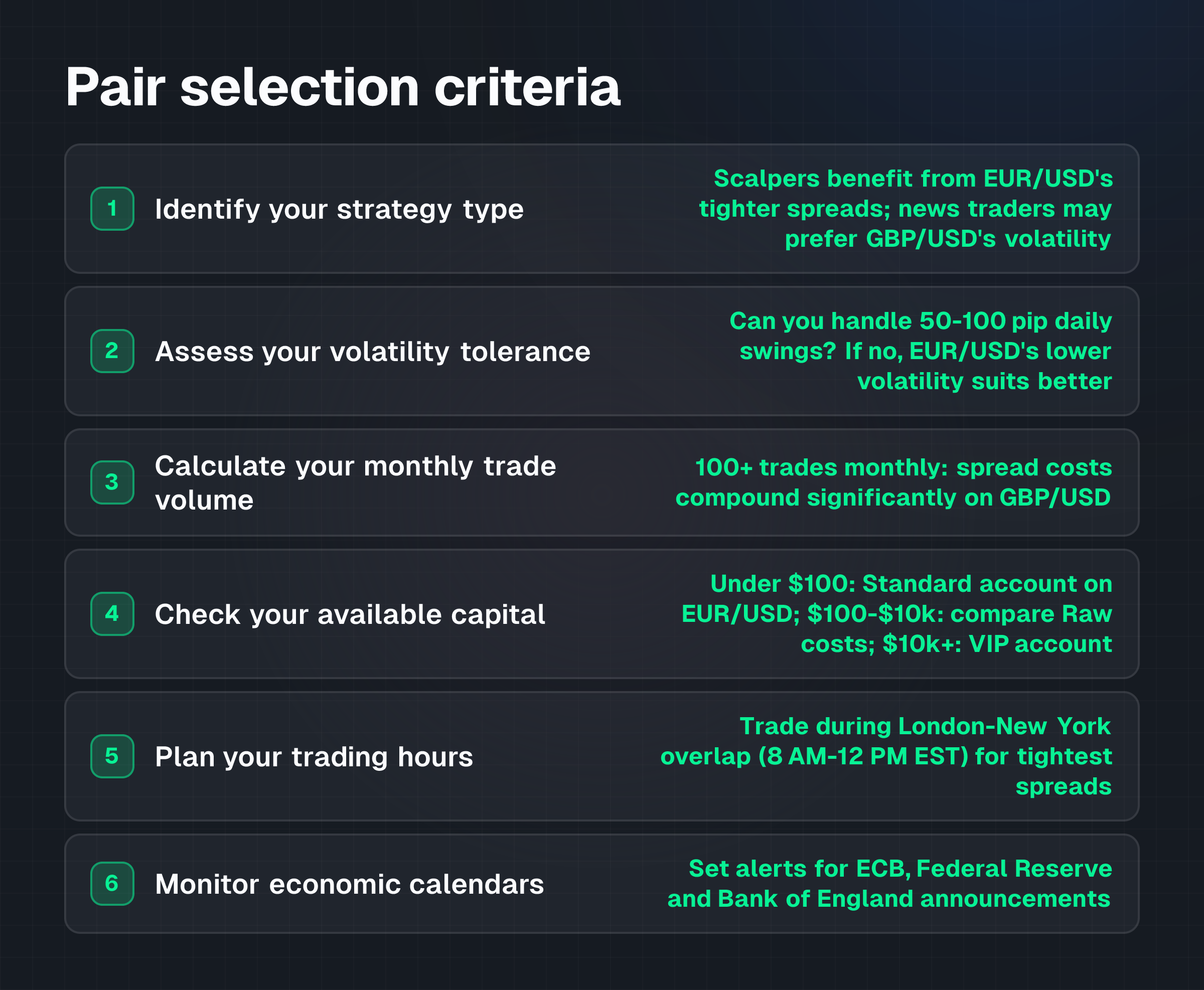
Use this checklist to align your choice with your trading profile:
-
Identify your strategy type. Do you scalp (many small trades per day), swing trade (hold for days to weeks), or trade on news releases? Scalpers benefit from EUR/USD's tighter spreads; news traders may accept GBP/USD's volatility as opportunity.
-
Assess your volatility tolerance. Can you handle 50-100 pip daily swings without panic-closing positions? If yes, GBP/USD is manageable. If no, EUR/USD's lower volatility may suit you better.
-
Calculate your monthly trade volume. If you execute 100+ trades monthly, spread costs compound significantly. Choose EUR/USD or migrate to a Raw/VIP account to minimize costs.
-
Check your available capital. If you have under $100, use a Standard account on EUR/USD for cost predictability. If you have $100 to $10,000, compare Raw account commissions against spreads. At $10,000+, a VIP account may deliver the lowest total cost.
-
Plan your trading hours. Trade during the London-New York overlap (8 AM-12 PM EST) for both pairs' tightest spreads. Avoid trading either pair during overnight or Asian sessions unless you accept wider spreads.
-
Monitor economic calendars. Set alerts for ECB, Federal Reserve and Bank of England announcements. Avoid trading into data releases unless news trading is your explicit strategy.
-
Set appropriate stop-losses. Account for the pair's typical volatility. EUR/USD may need 20-30 pip stops; GBP/USD may require 40-60 pip stops for equivalent reliability.
Frequently asked questions
What is the difference between a pip and a spread?
A pip (point in percentage) is the smallest price increment a currency pair can move. For EUR/USD and GBP/USD quoted to four decimal places, one pip equals 0.0001.
A spread is the total cost to enter and exit a trade, measured in pips. A 0.8 pip spread means you're immediately 0.8 pips underwater the moment you open a position.
Why is EUR/USD more liquid than GBP/USD?
EUR/USD is the most traded pair globally because the eurozone and US represent the world's largest and most stable economic centres. The sheer trading volume creates tighter spreads and faster execution. GBP/USD is also highly liquid but attracts fewer total transactions, resulting in slightly wider spreads.
Can I trade GBP/USD during Asian market hours?
Yes, but spreads widen significantly outside the London-New York overlap. Asian session liquidity in GBP/USD is lower, meaning market makers widen their spreads to protect themselves. You can trade it, but execution quality and costs worsen during Asia-focused hours.
Does higher leverage help me trade GBP/USD more profitably?
No. Higher leverage doesn't improve profitability; it only increases the amount of capital at risk. A 50 pip loss on 1:100 leverage costs 1% of your account. The same 50 pip loss on 1:1000 leverage costs 10% of your account. Profitability depends on your strategy and risk management, not leverage.
Should I choose a pair based on recent price patterns?
Recent price action doesn't predict future performance. A pair that moved strongly last week may consolidate this week or reverse.
Choose your pair based on your strategy, costs and risk tolerance, not on whether it "looks bullish" or "looks bearish." Candlestick patterns and technical signals should inform entry timing, not the choice of which pair to trade.
How do I know if my stop-loss is too tight for GBP/USD?
If your stop-loss triggers repeatedly on minor price swings without the broader trend reversing, it's too tight. GBP/USD typically has daily ranges of 100-150 pips during active sessions. A stop-loss of 20-30 pips may be too tight for swing trading but appropriate for scalping. Test your stop-loss distance against historical volatility and the strategy's expected holding period.
Next step
Understanding the mechanics of EUR/USD and GBP/USD is the foundation. Your next step depends on where you are in your trading journey.
If you're new to forex, read How to Choose Forex Pairs for Your Trading Strategy to explore a broader framework for pair selection beyond these two.
If you want to evaluate account types and their cost impact, compare Raw Spread vs Standard Account: Which Costs Less? to determine which account structure matches your trading volume.
If you're ready to explore specific trading approaches, learn Forex Trading Strategies: Types, Examples and Risks to see how different strategies perform across different pairs.
If you're choosing a platform, MetaTrader 5 vs TradeLocker: Which Platform Should You Use? breaks down the practical differences between the two systems available at NextTrade.
Demo accounts are available at no cost and with no deposit required, allowing you to test either pair on either platform before committing real capital.
CFDs are complex instruments and carry a high risk of losing money rapidly due to leverage. Retail accounts have negative balance protection. You should consider whether you understand how CFDs work and whether you can afford to take the high risk of losing your money. Past performance does not guarantee future results.
This article is for educational and informational purposes only. It does not constitute financial advice, a personal recommendation or an offer to buy or sell any financial instrument. Trading and investing carry risks, including potential loss of principal. Always conduct your own research and consult a qualified financial adviser if appropriate for your circumstances.
TagsTrading EducationEUR/USD vs GBP/USDcurrency pair comparisonforex trading pairsspread costs