

Stop-loss placement is one of the most practical decisions a forex trader makes, yet it's often approached with guesswork rather than logic. A stop-loss order instructs your broker to close a losing trade once the price reaches a specific level, capping your loss on that trade. The key question isn't whether to use one, but where to place it, far enough away to avoid being shaken out by normal market movement, yet close enough to protect your capital if the trade logic fails. The answer depends on your entry reason, the current volatility of the pair, and your acceptable risk per trade.
This guide explains how to place stop-losses systematically, using market structure and volatility as your guides rather than arbitrary price levels or fixed pip distances. It covers the decision steps, common pitfalls, and how trading costs affect your effective stop-loss distance.
Quick answer: where to place stop-losses based on entry logic and volatility
Place your stop-loss just beyond the price level that would invalidate your reason for entering the trade.
For a long entry, this usually means placing it below a support level or below a recent swing low; for a short entry, above a resistance level or a recent swing high. The exact distance depends on recent market volatility: higher volatility requires a wider stop to avoid noise, while lower volatility allows a tighter one.
Before setting the stop distance, define your maximum acceptable loss per trade, usually 1-2% of your trading capital. Then calculate your position size so that if the stop-loss is triggered, you lose no more than that amount. This ties stop placement directly to position sizing rather than treating them as separate decisions.
What the term means: stop-loss as a capital preservation order
A stop-loss order is an instruction to your broker to buy or sell a security once it reaches a predetermined price, with the goal of limiting an investor's loss on a security position. In forex trading, a stop-loss on a long position is placed below your entry price; on a short position, it's placed above.
The order serves two purposes. Capital preservation means you prevent a small losing trade from becoming a large one due to negligence or emotion. Risk definition means you know exactly how much you stand to lose before you enter the trade, which allows you to calculate position size and compare the expected loss to the expected profit.
Stop-losses aren't guarantees. In fast-moving markets, during news events, or when prices gap overnight, execution can occur at a worse price than your specified level. This gap between the intended stop price and the actual execution price is called slippage, and it's a real cost to factor into your trading plan.
How it works: alignment with entry logic and volatility adjustment
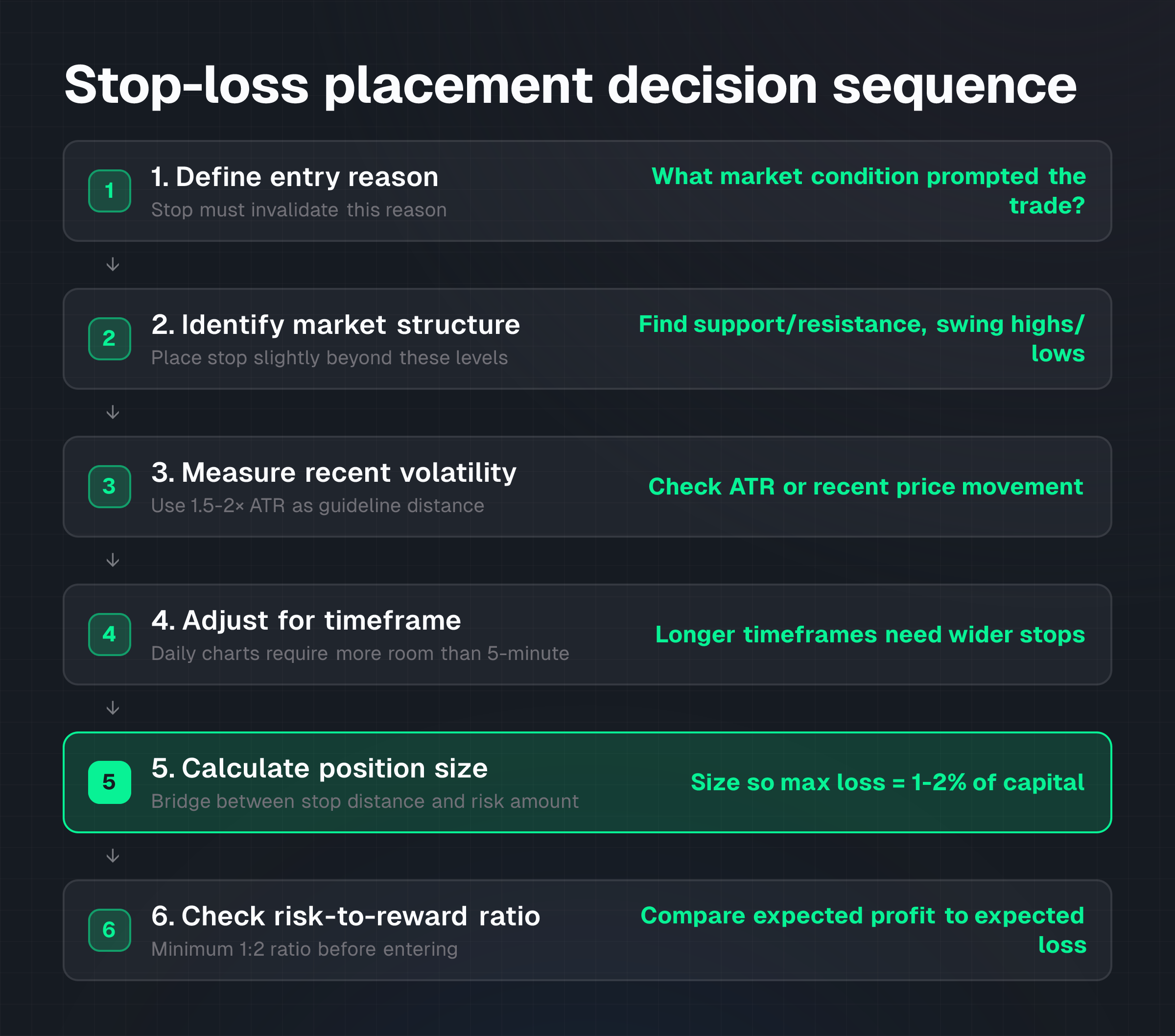
Stop-loss placement follows a logical sequence:
Define your entry reason. What specific market condition or pattern prompted you to enter this trade? Your stop-loss should invalidate that reason. If you entered a long trade because price bounced off a support level, your stop belongs below that support, not at an arbitrary level.
Identify market structure. Look for support and resistance levels, trend lines, and chart patterns. For a long entry, place your stop beyond the nearest support level. For a short entry, place it beyond the nearest resistance. Placing the stop exactly at these levels is risky, because institutional traders often probe just beyond them; place your stop slightly past them instead.
Measure recent volatility. Volatility is the degree of variation in price over time. Higher volatility means price moves further in normal trading; lower volatility means tighter movement. A common approach is to use the Average True Range (ATR), a volatility indicator. You might place your stop 1.5 to 2 times the current ATR value away from your entry. This adapts your stop to current market conditions rather than using a fixed pip distance for all trades.
Adjust for timeframe. A trade on a daily chart encounters different volatility than a trade on a 5-minute chart. Longer timeframes generally require wider stops because price moves further before the trade thesis is confirmed or rejected.
Calculate position size. Once your stop distance is set, calculate how many units or lots you can trade so that your maximum loss equals your predefined risk amount (usually 1-2% of account capital). This is the critical bridge between stop-loss and position sizing.
Check the risk-to-reward ratio. Before entering, compare your expected profit target to your expected loss at the stop. A common guideline is a minimum 1:2 ratio: if you risk $100, you should expect to make at least $200. Trades with an unfavourable ratio aren't worth the capital committed.
Worked example: EUR/USD long entry with stop placement
This example is hypothetical and for educational purposes only.
Assume you decide to enter a long position on EUR/USD after price bounces off a support level at 1.0850. Your entry order fills at 1.0870.
Entry reason: Price bounced off support at 1.0850, so this level is the logical failure point for your trade.
Stop placement: You place your stop 25 pips below the support level, at 1.0825. This gives price room to pull back slightly (noise) without stopping you out, but it invalidates your entry logic if price decisively breaks support.
Volatility check: You check the current ATR on EUR/USD. Suppose ATR is 45 pips. Your 25-pip stop is roughly 0.55 times ATR, which is reasonably tight for a bounce trade but not reckless. It reflects your confidence in the support level.
Position size calculation: You have a $10,000 account and accept a maximum 2% loss, or $200 per trade. The distance from entry (1.0870) to stop (1.0825) is 45 pips. On a micro lot (0.01 of a standard lot), each pip is worth $0.10. To lose exactly $200: $200 ÷ (45 pips × $0.10) = 4.44 micro lots. You round down to 4 micro lots for a $180 max loss.
Profit target and ratio: You place a profit target at 1.0950, which is 80 pips away. Your risk is 45 pips; your reward is 80 pips. The risk-to-reward ratio is 45:80, or roughly 1:1.78. This meets your minimum 1:2 guideline (barely) and is acceptable.
Trading cost factor: NextTrade's Raw account incurs a charge for forex trading. While the specific cost may vary, it is generally low enough that it does not significantly impact your overall risk. Therefore, it remains a minor consideration in your decision-making process.
Assumptions: This example assumes no slippage, stable volatility, and that the support level holds as expected. Real trading may differ.
Spreads from 0.0 pips across 130+ instruments. Open Account
Costs and practical constraints: how trading costs affect stop-loss strategy
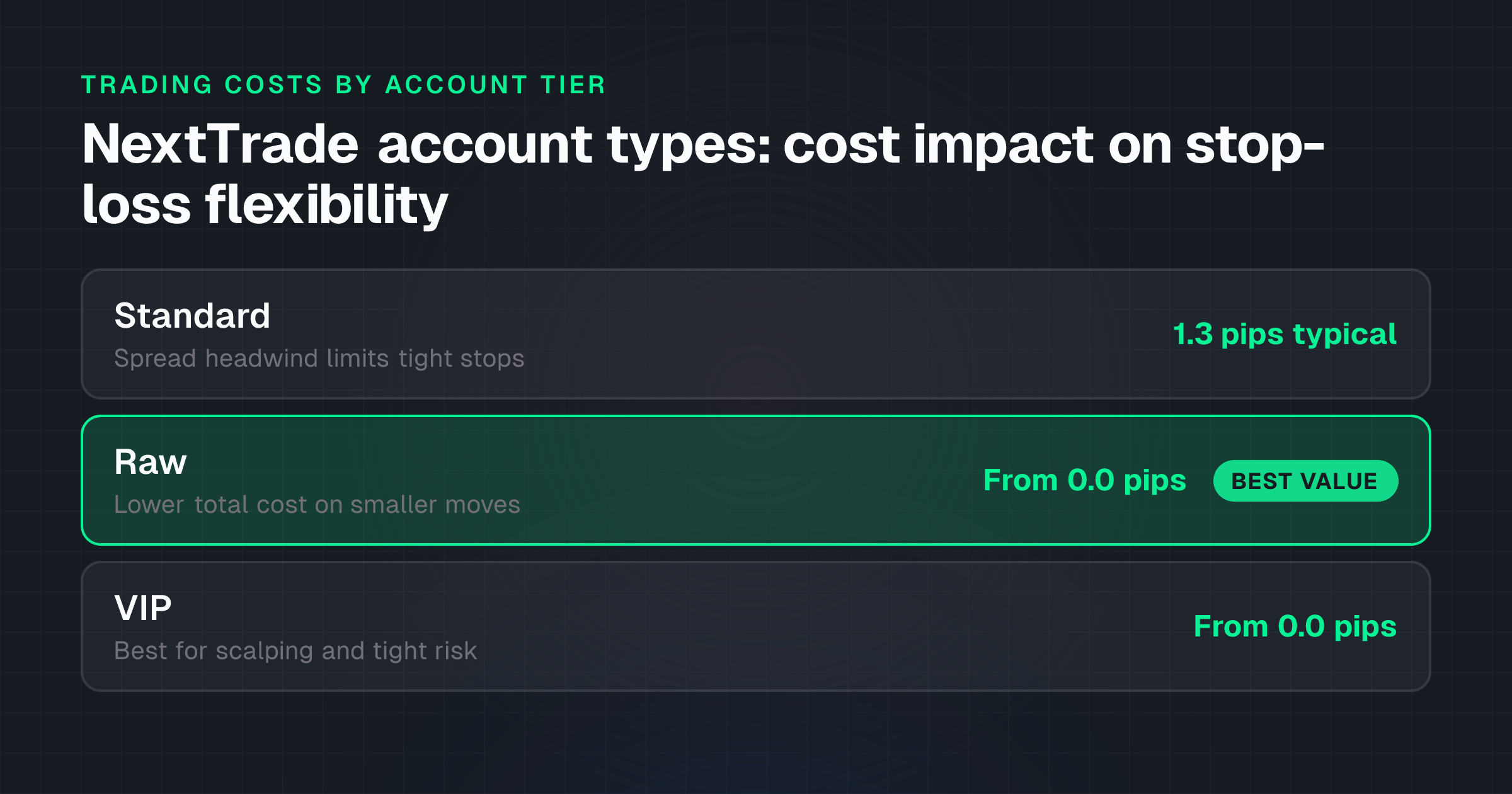
Stop-loss placement exists within the real cost structure of trading. Understanding these costs influences where you place your stop and how tight or wide you can afford to go.
Spread cost: When you enter a trade, you pay the spread (the gap between bid and ask prices). This cost is incurred right at the entry point and creates a headwind that must be overcome before any profit can be realized.
Commission structure: Different account types feature varying commission models. A Standard account at NextTrade has no commission but wider spreads. A Raw account charges spreads starting from 0.0 pips along with a round-trip commission on forex. A VIP account also charges spreads from 0.0 pips but has a lower round-trip commission. The tighter spreads and reduced commissions on Raw and VIP accounts allow traders to place tighter stops and capitalize on smaller price movements, as long as trade volume is adequate to cover the commission costs.
Position sizing constraint: If your stop-loss distance is very wide, and your account is small, your position size becomes so small that commissions and spread cost eat a large percentage of your risk. For example, if you risk $50 on a 200-pip stop on a micro lot, commissions and spread easily consume half your risk. This means very wide stops are sometimes impractical for small accounts, forcing you to either accept a larger percentage stop distance or trade pairs with lower volatility.
Slippage and gap risk: In volatile or illiquid market conditions, your stop-loss may execute at a worse price than intended. Slippage in Forex Trading: Causes and Controls explains this in detail. During news releases, overnight gaps, or fast-moving trends, your 50-pip stop might fill at 60 or 70 pips away. Planning for this by placing your stop a few pips wider than strictly necessary can help offset partial slippage.
Risks and limitations: what stop-losses cannot protect against
Stop-losses are a tool, not a guarantee.
Understanding what they can't do is as important as knowing what they can.
Gap risk: If a currency pair gaps overnight or over a weekend due to geopolitical news or economic data, your stop-loss may not execute at your specified price. Instead, the market may open well beyond your stop level, and your trade fills at that worse price. Your actual loss can be significantly larger than planned.
Slippage in fast markets: During volatile periods, spreads widen and liquidity thins. Your stop-loss order may be executed at a price substantially worse than the level you set. This is especially likely during central bank announcements, employment data releases, or sudden market moves.
Emotional override: The most common risk is trader emotion. After entering a trade, if price approaches your stop-loss, the pain of an impending loss often leads traders to move the stop further away, remove it entirely, or hold and hope for a reversal. Each of these actions defeats the purpose of the stop-loss and often results in losses far larger than originally planned.
Partial protection only: A stop-loss protects a single trade but doesn't protect your overall account. If you place multiple trades simultaneously, and several hit their stops in the same session, your total account loss may exceed your comfort level. This is why Position sizing for forex trading: the math emphasizes sizing each trade relative to account equity.
Trailing stops and reversals: Trailing stops automatically adjust upward as your trade moves in your favour, locking in profit. However, in choppy markets, a trailing stop can be triggered by a temporary pullback, closing a profitable trade prematurely. Trailing stops work best in strong trends, not in ranging markets.
Common misunderstandings: mistakes that lead to poor stop placement
Several persistent misunderstandings lead traders to place stops poorly.
Placing stops at round numbers: Many traders place stops at levels like 1.0800 or 1.0900, assuming these are natural support or resistance. In reality, institutional traders and algorithms often target these round numbers to trigger retail stops. A slightly more irregular level, such as 1.0823, is often safer because it's less likely to be actively targeted.
Fixed pip stops for all pairs: Using the same stop distance (e.g., 50 pips) for all currency pairs ignores volatility differences. EUR/USD and USD/JPY have different average moves. A 50-pip stop on EUR/USD is reasonable; the same 50-pip stop on a volatile emerging-market pair might be constantly triggered by noise. Volatility-based stops (using ATR) adapt to each pair.
Ignoring the entry logic: Some traders set stops by habit or convention rather than by reference to the trade setup. If you entered because of a bounce off support, your stop should be below that support. If you entered because of a breakout above resistance, your stop should be below the breakout level. Your stop must invalidate the reason you entered.
Treating stop placement as separate from position sizing: A common error is deciding on a stop distance first, then choosing a position size arbitrarily. This inverts the proper sequence. First define your maximum acceptable loss per trade; then set a stop-loss distance that reflects market structure and volatility; then calculate position size to match your risk limit to that stop distance.
Confusing tight stops with protection: A very tight stop (e.g., 5 pips) feels protective but is often whipsawed by noise, resulting in frequent small losses and accumulated costs. A tighter stop isn't always better; it must align with your entry logic and current volatility. Technical Analysis Strategies in Forex Trading explores how to identify support and resistance levels that are robust enough to base your stop on.
Practical checklist: step-by-step stop-loss placement
Before entering any trade, work through this checklist:
Define your maximum acceptable loss per trade. Choose 1-2% of your account equity and stick to it. If your account is $10,000, your per-trade max loss is $100-200. Document this.
Identify your entry reason clearly. Write it down. What price level, pattern, or indicator prompted this entry? Your stop must invalidate this reason.
Locate the logical failure point on the chart. For a long entry, find the support level below your entry; for a short entry, the resistance above. Check whether the level is round (e.g., 1.0800) and, if so, consider placing your stop a few pips past it.
Check current volatility. Look at the ATR for the pair and timeframe. Is volatility elevated due to recent news, or is the market calm? Adjust your stop distance proportionally.
Set your stop-loss price. Place it at or slightly beyond the logical failure point, adjusted for volatility.
Calculate the pip distance from entry to stop.
Calculate your position size. Divide your maximum loss by the pip distance (accounting for the value per pip of your chosen lot size) to determine position size. If your lot size is a micro lot (0.01), each pip is worth $0.10; adjust accordingly for your account currency and lot size.
Identify a profit target. Choose a level where you expect resistance or where you're willing to take profit. Calculate the pip distance to your target.
Check your risk-to-reward ratio. Ensure your potential profit is at least equal to your potential loss (1:1 minimum; 1:2 preferred). If the ratio is unfavourable, don't enter.
Account for commissions. If trading on a Raw or VIP account at NextTrade, factor commission cost into your decision. Confirm that your expected profit exceeds commissions and spread cost.
Enter the trade with your stop and target orders placed simultaneously. Don't leave either unplaced.
Frequently asked questions
What is the difference between a stop-loss and a profit target?
A stop-loss closes your trade at a loss if the market moves against you. A profit target closes your trade at a profit if the market moves in your favour. Both are preset prices that remove emotion from exit decisions. Placing both simultaneously when you enter ensures you have a plan for both outcomes before price moves.
Can I move my stop-loss after I enter the trade?
Technically yes, but moving your stop further away (to give the trade more room) almost always leads to larger losses. Moving it closer to lock in a small gain is acceptable if your trade thesis has changed. The best practice is to place your stop correctly on entry and leave it alone unless market conditions fundamentally alter your reason for being in the trade.
How does slippage affect my stop-loss?
Slippage is the gap between your intended stop price and the actual execution price. In fast or illiquid markets, your 50-pip stop might fill at 60 pips. To account for this risk, place your stop a few pips wider than your bare minimum to absorb minor slippage. Large gaps (e.g., overnight news events) can exceed any reasonable buffer.
Should I use a trailing stop?
A trailing stop automatically adjusts upward as your trade moves in your favour, locking in gains. It works well in strong trends but can trigger prematurely in choppy markets. Use trailing stops selectively, not on every trade. They're more useful on longer timeframes or when price has already moved significantly in your favour.
What if the stop-loss distance required by volatility is too wide for my account?
If the logical stop distance is 150 pips but your account size means this would risk more than 2% per trade, you have two choices: trade a smaller position size that fits your risk limit, or don't trade this pair or setup. Forcing a trade into your account by using an inadequately tight stop usually results in losses due to whipsaws. It's better to skip the trade.
How does trading cost affect where I place my stop?
Higher spreads and commissions effectively widen your true cost per trade. If you trade a Raw account with a $7 per lot round-trip commission on a 50-pip stop, the commission cost reduces your true profit margin. This may push you toward slightly wider stops (to justify the fixed cost) or toward trading only the highest-conviction setups. Understand your account's cost structure before deciding on stop placement.
Next step
Stop-loss placement is one half of the risk management equation. The other half is position sizing: scaling your lot size to match your stop distance and your per-trade risk limit. These two decisions must work together.
Read Position sizing for forex trading: the math next to learn how to calculate the exact lot size that keeps your losses within your defined risk per trade. Then explore Leverage Limits in Forex: How They Protect Your Account to understand how leverage amplifies both your gains and your losses, and why managing leverage is inseparable from managing stop-losses.
If you're ready to apply these concepts in a live environment, you can open a demo account with NextTrade at no cost to practice stop-loss placement and position sizing on real market data without risking capital.
Risk disclosure: CFDs are complex instruments and carry a high risk of losing money rapidly due to leverage. Between 74-89% of retail investor accounts lose money when trading CFDs. You should consider whether you understand how CFDs work and whether you can afford to take the high risk of losing your money. Past performance is not indicative of future results.
TagsTrading Educationstop-loss placement forexforex stop-loss strategystop-loss order forexposition sizing forex