
Position sizing is the process of calculating how many units of a currency pair to trade based on account balance, risk tolerance, and stop-loss distance. The goal is to limit capital at risk on any single trade. Without a disciplined sizing approach, even a few losing trades can deplete an account quickly. This guide explains the calculation, the assumptions behind it, and the practical costs and risks involved.
Position sizing protects capital by ensuring losses remain manageable relative to account size. It's not a profit tool. It's a capital preservation tool. Traders who skip this step or apply it inconsistently tend to experience larger drawdowns and faster account erosion.
Quick answer: the formula and a single-step overview
Position size is calculated using the formula:
Number of lots = Risk per trade (in currency) ÷ (Stop-loss distance in pips × Pip value per standard lot)
To use this:
- Set a maximum dollar (or base currency) amount you'll risk on one trade. Educational trading resources commonly cite risking no more than 1-2% of account balance per trade.
- Measure the distance in pips from your entry price to your stop-loss level.
- Look up or calculate the pip value for your currency pair at standard lot size (typically $10 per pip for major pairs in a USD account).
- Divide your risk amount by the product of pips and pip value. The result is your position size in standard lots.
Convert the result to mini lots (0.1 standard lots) or micro lots (0.01 standard lots) as needed, or calculate the exact number of units. The next sections explain each step in detail.
What the term means: position sizing and core definitions
Position sizing is the act of determining the number of units (or lots) of a currency pair to trade on a single position. It's part of broader risk management, which is the practice of identifying, assessing, and controlling threats to capital.
Key terms
Account Balance: The total capital available in a trading account.
Risk Tolerance (or Risk Per Trade): The maximum percentage or fixed amount of capital a trader is willing to lose on a single trade if the stop-loss is hit. Educational trading resources commonly cite risking no more than 1-2% of account balance per trade, though no universally agreed-upon figure exists.
Stop-Loss (SL): An order placed to automatically close a position if the price reaches a specified level, limiting potential loss on that trade.
Pip (Point in Percentage): A standard unit of measurement for currency pair price changes. For most pairs (EUR/USD, GBP/USD, etc.), a pip is the fourth decimal place (0.0001). For JPY pairs (USD/JPY, EUR/JPY), it's typically the second decimal place (0.01).
Pip Value: The monetary value of one pip for a specific currency pair and lot size. This depends on the quoted currency, the lot size, and the account's base currency.
Lot Size: A standardized unit of trade volume in forex.
- Standard lot: 100,000 units of the base currency
- Mini lot: 10,000 units of the base currency
- Micro lot: 1,000 units of the base currency
Leverage: The use of borrowed capital to increase market exposure. Leverage increases market exposure, but it also increases the speed and scale of potential losses. NextTrade Broker offers leverage up to 1:1000.
Margin: The amount of capital required to open and maintain a leveraged position.
How it works: the five-step calculation process
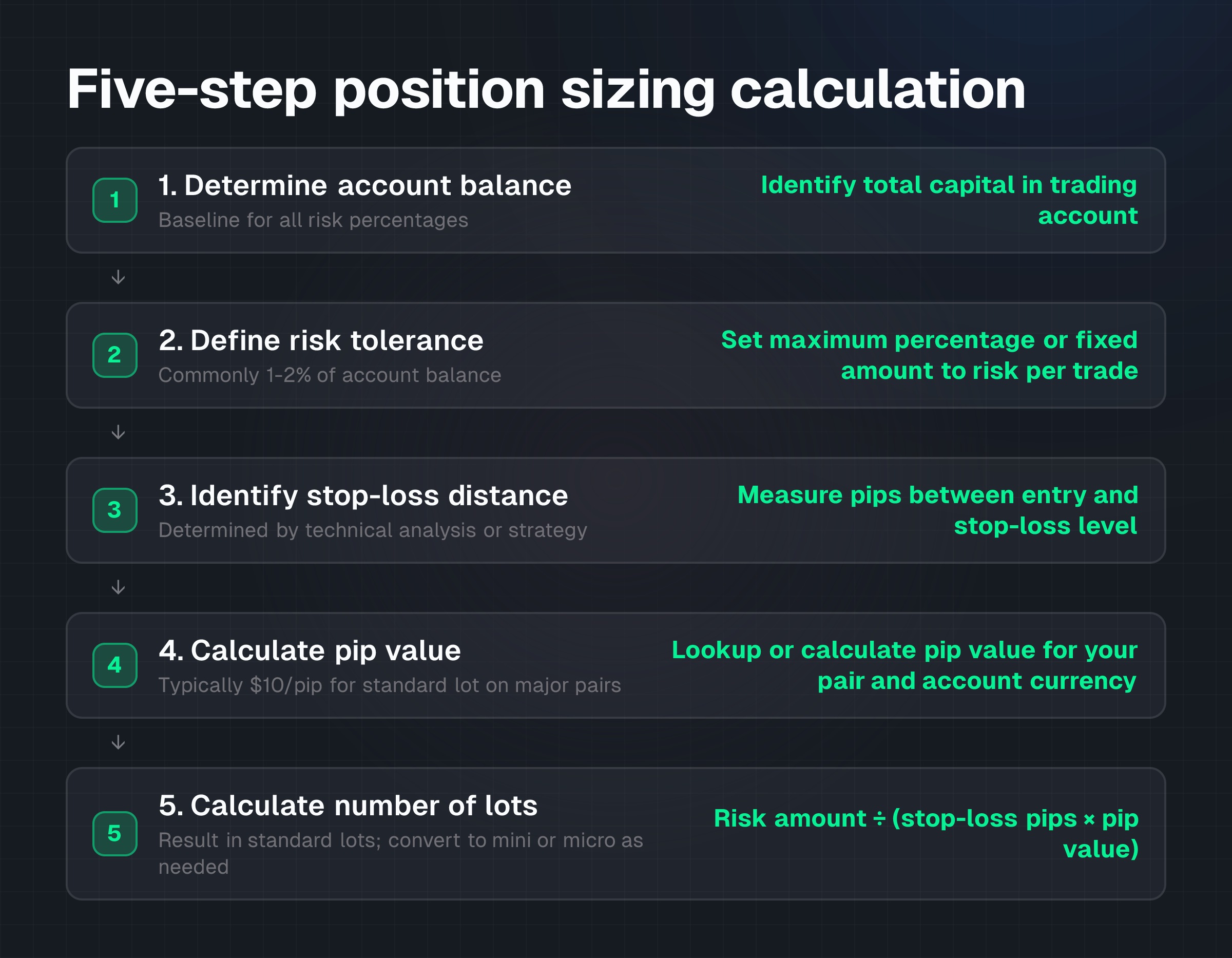
Position sizing follows a consistent five-step process. Each step builds on the previous one, and all five must be completed to arrive at a valid position size.
Step 1: Determine your account balance
Identify the total capital currently in the trading account. This is the baseline from which all risk percentages are calculated. If the account balance changes (due to deposits, withdrawals, or prior trade results), repeat the calculation.
Step 2: Define your risk tolerance
Decide on the maximum percentage or fixed amount of capital you're willing to risk on a single trade. The 1-2% guideline is a market observation across educational resources, not a universal rule or guarantee of safety.
For example, if account balance is $10,000 and you choose 1% risk tolerance, your maximum dollar risk per trade is $100. If you choose 2%, it's $200.
Record this as a fixed dollar amount for each trade, not as a percentage. This ensures consistency and simplifies the next calculations.
Step 3: Identify your stop-loss distance
For the specific trade you're planning, measure the distance in pips between your intended entry price and your stop-loss level. This distance is typically determined by technical analysis, chart structure, or your trading strategy, but it's not set by position sizing.
For example, if you plan to enter EUR/USD at 1.0950 and place a stop-loss at 1.0900, the distance is 50 pips.
Step 4: Calculate the pip value
Pip value depends on the currency pair, the lot size, and the account's base currency. For a USD-denominated account (the most common scenario):
- For pairs where USD is the quote currency (EUR/USD, GBP/USD, etc.): Pip value is approximately $10 per pip for a standard lot, $1 for a mini lot, and $0.10 for a micro lot.
- For pairs where USD is the base currency (USD/JPY, USD/CAD, etc.): The calculation differs; consult your broker's pip value table or use their calculator.
- For non-USD pairs (EUR/GBP, AUD/JPY, etc.): A precise calculation requires the current exchange rates and conversion between the pair's quote currency and your account currency.
Most brokers publish a pip value reference or provide a built-in calculator. If calculating manually, the formula involves the lot size, the pip size (0.0001 or 0.01 depending on the pair), and the current exchange rate.
Step 5: Calculate the number of lots
Using the formula introduced above:
Number of lots = Risk per trade (in currency) ÷ (Stop-loss distance in pips × Pip value per standard lot)
The result is the position size in standard lots. Convert to mini or micro lots by multiplying by 10 (for mini) or 100 (for micro), or request your platform to handle fractional lot sizes.
Worked example: a complete calculation
The following example is hypothetical and educational. It demonstrates the calculation and does not represent a recommendation to place a trade.
Setup
- Account balance: $10,000
- Risk tolerance: 1% of account balance
- Currency pair: EUR/USD
- Entry price: 1.0950
- Stop-loss price: 1.0900
- Stop-loss distance: 50 pips
- Pip value (standard lot, USD account): $10 per pip
- Account base currency: USD
Calculation
Step 1: Account balance is $10,000.
Step 2: Risk tolerance is 1%, so maximum risk per trade = $10,000 × 0.01 = $100.
Step 3: Stop-loss distance is 50 pips (1.0950 entry minus 1.0900 stop-loss).
Step 4: Pip value for EUR/USD on a standard lot is $10 per pip.
Step 5: Number of standard lots = $100 ÷ (50 pips × $10/pip) Number of standard lots = $100 ÷ $500 Number of standard lots = 0.2 standard lots
0.2 standard lots equals 2 mini lots or 20,000 units of EUR.
What this means
If the stop-loss is hit, the trader loses $100 (1% of the $10,000 account), regardless of the spread or slippage at the moment the stop-loss executes. If the trade moves in the trader's favour by 50 pips (to 1.1000), the gain is also $100. If it moves 100 pips in the trader's favour, the gain is $200.
This position size holds the loss constant while allowing profits to scale with favourable price movement.
Costs and practical constraints: spread, commission, and account type
Calculating position size assumes a clean entry and exit at specified prices. Real trading involves costs that reduce profitability or increase effective losses. These include spread, commission, and slippage.
Spread and commission at NextTrade Broker
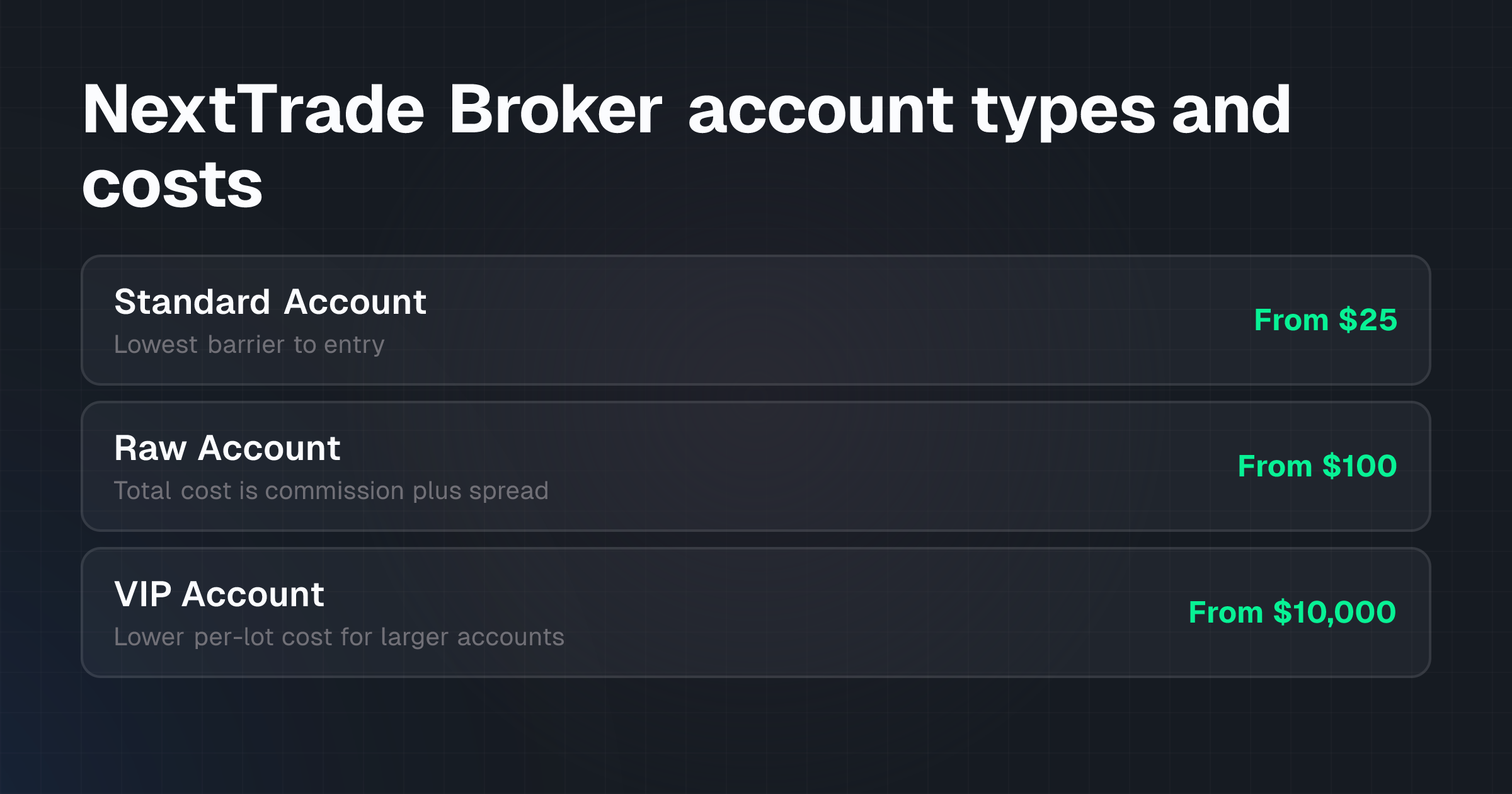
NextTrade Broker offers three account types, each with different cost structures:
Standard Account (from $25 minimum deposit):
- No commission
- Variable spreads (higher than Raw or VIP accounts)
- Lowest barrier to entry
Raw Account (from $100 minimum deposit):
- Spreads from 0.0 pips
- Commission: $6-7 per lot round trip
- Total cost per round trip is commission plus spread
VIP Account (from $10,000 minimum deposit):
- Spreads from 0.0 pips
- Commission: $4 per lot round trip
- Lower per-lot cost for larger accounts
Impact on position sizing
Spread and commission reduce the effective profit range on a trade. A 50 pip stop-loss may become a 50.3 pip loss after the spread widens at entry. Commission on a round-trip trade further reduces net profit.
When calculating position size, traders may either:
- Accept the calculated size and factor spread/commission into profitability expectations, or
- Reduce the position size slightly to account for these costs, treating them as an additional hidden stop-loss.
Neither approach is obligatory, but accounting for costs prevents overestimating profit potential.
Leverage and margin requirements
Position sizing determines the number of units traded, but leverage affects the margin (collateral) required to hold that position. At NextTrade Broker's maximum leverage of 1:1000, a 0.2 standard lot position on EUR/USD requires approximately $200 in margin (or less, depending on the pair and current exchange rates).
The calculated position size must not consume so much margin that a normal market fluctuation triggers a margin call. Check your account margin requirements and ensure the position size leaves a buffer.
Risks and limitations: when position sizing fails to protect capital
Position sizing is a safeguard, not a guarantee. Several risks and limitations apply.
Stop-loss may not execute at the specified price
If market volatility is extreme or the pair is illiquid, a stop-loss order may execute significantly beyond the intended stop level. This is called slippage. A 50 pip stop-loss could become a 75 or 100 pip loss in choppy conditions, multiplying your loss beyond the calculated amount. See Slippage in Forex Trading: Causes and Controls for a detailed explanation.
Leverage magnifies losses
At high leverage, a small adverse price movement can wipe out the account quickly. Position sizing alone doesn't prevent this if leverage is misused. A trader using 1:1000 leverage must be especially disciplined about position size, because the speed of loss can exceed the trader's ability to react.
Over-leveraging on a single position
If a trader uses up most available margin on one position, even a minor slippage or spread spike can trigger a margin call and force liquidation at unfavourable prices.
Drawdown risk across multiple trades
Position sizing controls the loss on a single trade, but consecutive losses on many trades erode the account faster. A string of ten 1% losses (each correctly sized) reduces the account by approximately 10%, and recovery requires larger winning trades to regain that capital.
Emotional deviation from the plan
Traders often deviate from their calculated position size due to fear of missing out or desire to recover losses quickly. Skipping the sizing calculation or adjusting the size mid-trade introduces uncontrolled risk.
Common misunderstandings: what position sizing is not
It's not a profit maximiser
Position sizing doesn't increase win rates or improve trade quality. It only limits how much can be lost on each trade. Profitability depends on the trade setup, entry and exit strategy, and market conditions, not on sizing discipline alone.
It's not a guarantee against ruin
Even correctly sized positions can lead to account loss if leverage is excessive, strategy is flawed, or markets move violently. Position sizing is one layer of capital preservation, not the complete answer.
It's not "one size fits all"
The 1-2% guideline is a common observation, not a rule. Different traders, strategies, and market conditions may justify different risk percentages. Scalpers may use smaller sizes; swing traders may tolerate larger sizes. The calculation method remains the same; only the risk percentage changes.
It doesn't account for correlation or portfolio risk
If a trader opens multiple positions in correlated pairs (e.g., EUR/USD and GBP/USD both moving in the same direction), the combined account risk may exceed the per-trade risk limit. Position sizing typically applies to individual trades, not to overall portfolio exposure.
Practical checklist: before entering a trade
Before executing any trade, confirm the following:
- Account balance has been noted and is up to date.
- Risk per trade has been set (e.g., 1% of account).
- Entry price and stop-loss level have been identified from the chart or strategy.
- Stop-loss distance has been measured in pips.
- Pip value for this pair has been confirmed (check the broker's pip value reference or use their calculator).
- Position size has been calculated using the formula: Risk ÷ (Pips × Pip value).
- Position size has been converted to the correct lot denomination (standard, mini, or micro) for the platform.
- Margin required for the position has been checked against available margin (with a buffer).
- Spread and commission for this pair and account type have been noted.
- Stop-loss order will be placed immediately upon trade entry (not left for later).
- The calculated size matches the order size entered into the platform.
Frequently asked questions
What risk percentage should I use?
Educational trading resources commonly cite 1-2% of account balance per trade. This is a market observation, not a universal rule. Some traders use 0.5% for higher volatility; others use 2% or slightly higher if they have high confidence in their strategy. The percentage depends on your overall trading plan, strategy, account size, and risk tolerance. Start conservatively and adjust only after testing your strategy over time.
How do I calculate pip value if my account currency isn't USD?
Pip value depends on the account's base currency and the currency pair. For a USD account, most brokers publish pip values (typically $10 per pip for standard lots on major pairs). For other base currencies (EUR, GBP, etc.), the calculation is similar but uses that currency's exchange rate. Most modern platforms include a pip value calculator or display it in the ticket. If uncertain, ask your broker.
What if my stop-loss distance is very large?
If your technical setup requires a stop-loss 200 pips away, the calculated position size will be smaller to keep the dollar risk constant. This is correct. A larger stop-loss distance means less precision in your trade setup, so the sizing will naturally reduce to protect the account. Don't ignore this signal; it may indicate that the trade setup is poor or your entry isn't clean.
Can I use fractional lot sizes?
Yes. Most platforms allow orders in fractional lots (e.g., 0.2 standard lots, or 0.15 mini lots). Some platforms require whole micro lots. Check your broker's order specifications. If your calculation yields 0.2 standard lots and your platform requires whole micro lots, round to the nearest whole micro lot (0.2 standard = 20 micro lots, which is exact in this case).
Why do I need to check margin if I've already sized the position?
Position size (in units or lots) and margin requirement are related but separate. Margin is the collateral your broker holds; position size is the number of units you trade. High leverage means small margin for large positions, and vice versa. Checking margin ensures you don't consume all available account funds, leaving no buffer for drawdown or other positions.
Does position sizing guarantee I won't lose money on this trade?
No. Position sizing limits the maximum loss per trade, assuming the stop-loss executes at the intended price. Slippage, gaps, and extreme volatility can cause larger losses. Position sizing also doesn't improve your win rate or ensure profitability over time. It only protects capital by keeping losses manageable on each individual trade.
Next step
Understanding position sizing is foundational to capital preservation in forex trading. The next step is to apply it consistently on every trade, then monitor how your trades perform over a series of 50 or more executions to see whether your sizing, stop-loss strategy, and entry logic work together.
To practise without risking real capital, open a free demo account and test your position sizing calculations on simulated trades. Most demo environments replicate real spread and commission costs, so the exercise remains realistic.
Risk warning: CFDs are complex instruments and carry a high risk of losing money rapidly due to leverage. Retail accounts at NextTrade Broker have negative balance protection. However, a significant proportion of retail investor accounts lose money when trading CFDs. You should not risk money you cannot afford to lose. Before trading, ensure you understand how CFDs, leverage, and position sizing work. Past performance does not indicate future results. This article is educational material and does not constitute investment advice or a recommendation to open an account, deposit funds, or place a trade.
TagsTrading Educationposition sizing forexforex position size calculatorrisk per tradepip value calculation