
Forex Risk Management: Position Sizing and Stop-Losses
Published Updated
By NextTrade Editorial
Risk Management for Retail Forex Traders: Framework, Rules and Discipline
Most aspiring forex traders obsess over finding profitable trades while ignoring the one thing that determines whether they'll still have an account in six months: risk management. A single unchecked loss can erase weeks of careful gains. Risk management is the systematic process of identifying, assessing and controlling potential financial losses to preserve capital and ensure long-term trading viability. For retail forex traders, this isn't optional, it's the primary factor separating surviving accounts from blown ones.
This article explains what risk management means in forex, how it works in practice, and why the framework matters more than any individual trade. The guidance applies to traders using any platform or leverage level, though it becomes especially critical when trading with high leverage, such as the 1:1000 available through some brokers.
Quick answer: What risk management means for forex traders
Risk management is disciplined application of rules to limit losses, protect account capital and prevent catastrophic drawdowns. The core rule is simple: never risk more than a fixed percentage of your total trading capital on any single trade, typically 1% to 2%.
This percentage-based approach ensures that even a string of losses won't deplete your account faster than you can recover. It removes the temptation to chase losses by increasing position size. Without these guardrails, high leverage and emotional trading create the conditions for rapid account failure.
What the term means: Capital preservation and risk-reward structure
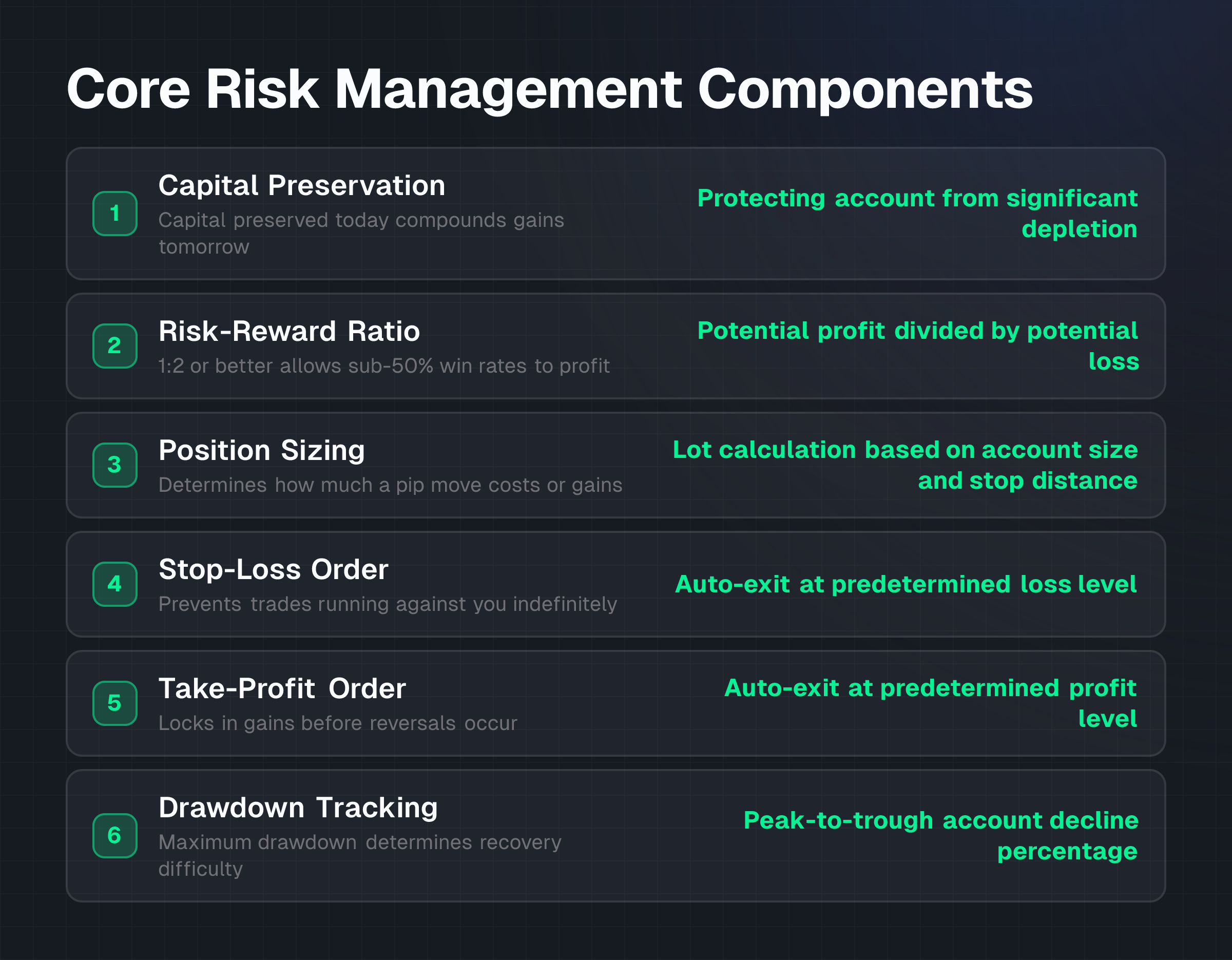
Risk management in forex consists of several interconnected definitions and measurements:
Capital Preservation: The primary goal is protecting a trading account from significant depletion. Capital preserved today is capital available to trade tomorrow and to compound gains over time.
Risk-Reward Ratio: The relationship between potential profit and potential loss on a trade. A 1:2 ratio means you risk $100 to make $200; a 1:3 ratio means you risk $100 to make $300. Calculate it by dividing potential profit by potential loss. Ratios of 1:2 or better ensure that even a winning rate below 50% can produce net profits over time.
Position Sizing: The calculation of appropriate units (lots) to trade based on account size, risk tolerance and stop-loss distance. Position size determines how many pips or currency units you control, and therefore how much a move of any given size will gain or cost.
Stop-Loss Order: An order placed with a broker to sell an asset once it reaches a certain price, limiting potential losses on a trade. Without one, a trade can run against you indefinitely, eroding the entire account.
Take-Profit Order: An order placed to close a position once it reaches a certain profit level, locking in gains and removing the risk of a reversal.
Drawdown: The peak-to-trough decline in an account during a specific period. Maximum drawdown is the largest percentage drop from the highest balance reached. Current drawdown is where the account sits now relative to that peak. Drawdowns are inevitable; the goal is keeping them within limits that allow recovery.
Margin Call: A broker's demand for additional funds to bring the account up to minimum maintenance margin. A margin call occurs when losses reduce your account balance so far that you no longer have enough capital to support your open positions. If you can't deposit more funds, the broker will close positions to recover what's owed.
Leverage in relation to risk: Leverage amplifies both gains and losses. A 1:100 leverage means $1,000 controls $100,000 of exposure. At 1:1000, $1,000 controls $1,000,000 of exposure. The higher the leverage, the smaller a price move needs to be to wipe out your entire deposit. High leverage without strict risk controls is the leading cause of rapid account failure in retail forex.
How it works: The five-step risk management process
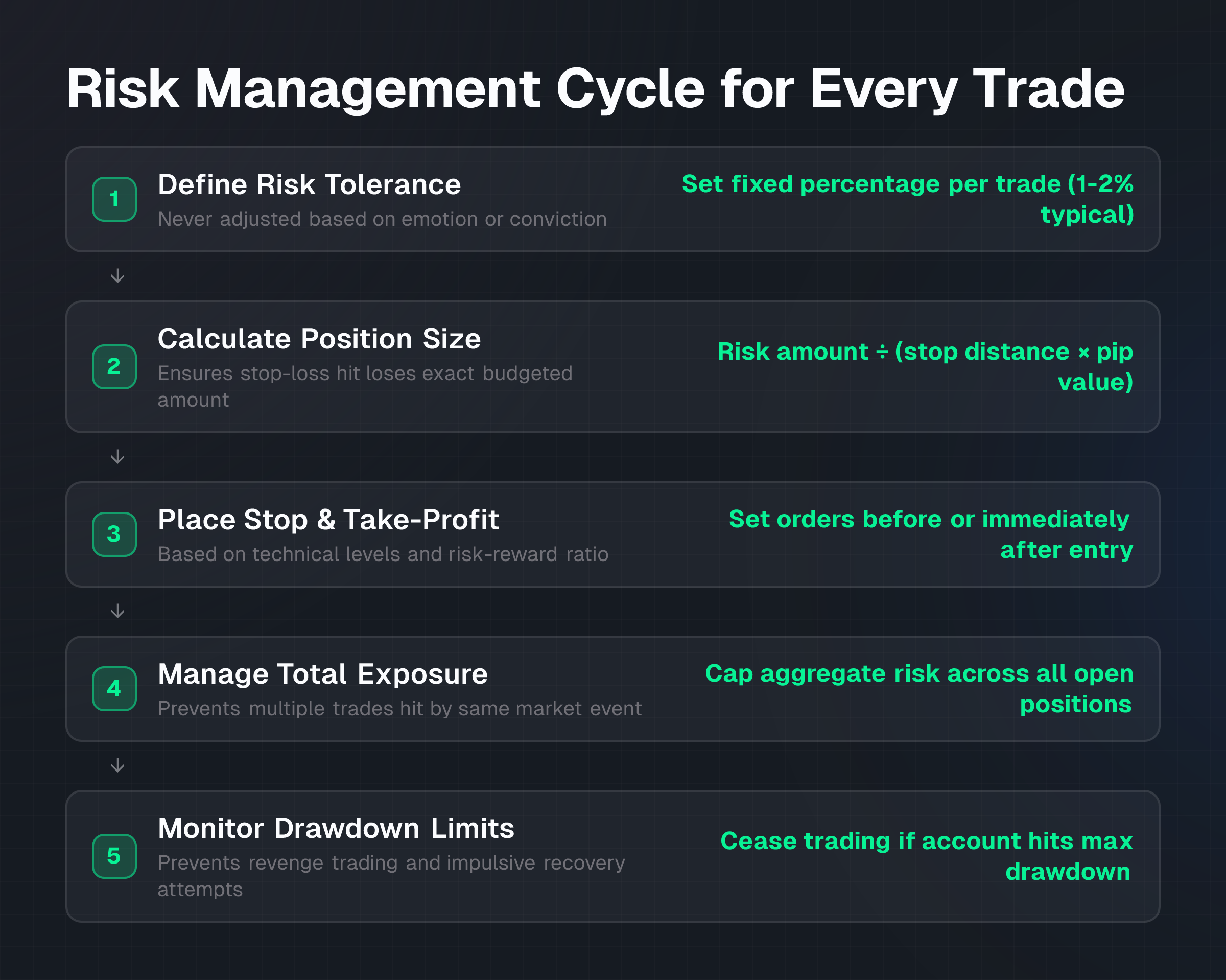
Risk management isn't a single action but a repeating cycle applied to every trade:
1. Define Your Risk Tolerance
Decide what percentage of your total trading capital you're comfortable losing on a single trade. A common standard recommendation is 1% to 2% per trade. This means:
- If your account is $10,000, a 1% risk equals $100 per trade.
- If your account is $50,000, a 1% risk equals $500 per trade.
This percentage should be determined before you open any position and written into your trading plan. It's not adjusted based on emotion, conviction or recent losses.
2. Calculate Position Size
Once you know your risk percentage and the distance to your stop-loss, you can calculate the correct position size:
- Identify the monetary value of your risk (e.g., 1% of $10,000 = $100).
- Determine your stop-loss distance in pips for the specific trade setup.
- Look up the pip value for the currency pair (this varies by pair and lot size).
- Divide the monetary risk by the pip value to find the correct lot size.
The formula is: Position size (in lots) = (Risk amount in dollars) / (Stop-loss distance in pips × Pip value per lot)
This calculation ensures that if your stop-loss is hit, you lose exactly the amount you budgeted. No more.
3. Place Stop-Loss and Take-Profit Orders
Stop-loss and take-profit orders should be placed before or immediately after entering a trade. They shouldn't be moved once placed (except under carefully considered circumstances, never to increase risk).
- Stop-loss placement should be based on technical support or resistance levels, volatility metrics or moving averages, not arbitrary pip counts.
- Take-profit placement should align with your risk-reward ratio. If you risk 20 pips, a 1:2 ratio means targeting 40 pips of profit.
4. Manage Overall Account Exposure
Don't open trades in isolation. Keep track of all open positions and limit the total percentage of your account at risk across all open trades. For example, if you risk 1% per trade, you might cap total open risk at 3% to 5% of your account. This protects you if multiple trades are hit by the same market event (such as a news release) and prevents over-leverage in aggregate.
5. Monitor Drawdown Limits
Define a maximum permissible drawdown for your account (for example, 10% or 20%). If your account reaches this limit, cease trading until you can re-evaluate your strategy and emotional state. This rule prevents the "revenge trading" trap, where losses trigger impulsive trading aimed at recovering losses quickly.
Worked example: Calculating position size with risk management
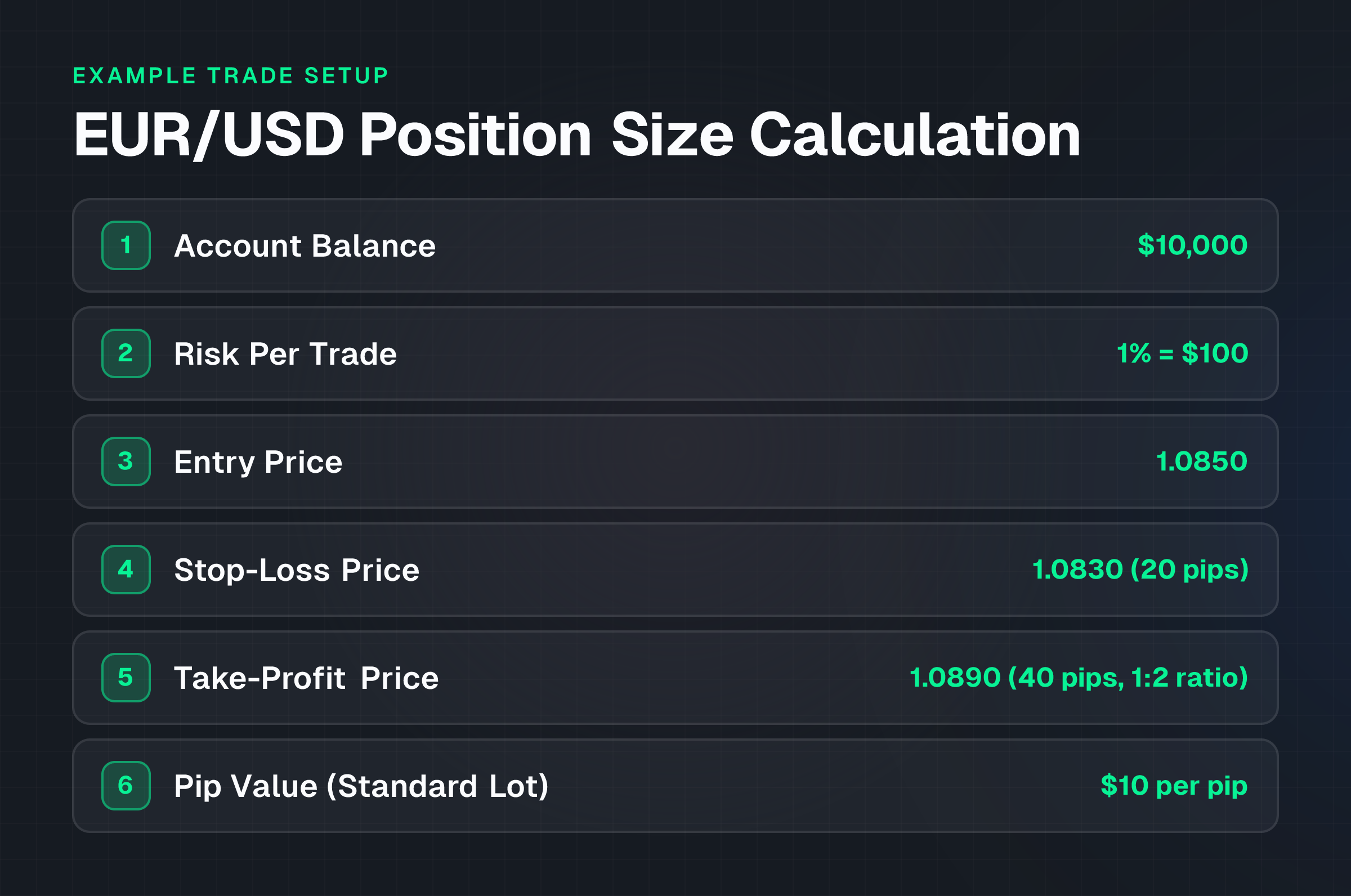
This example illustrates the calculation. It's not a recommendation to place a trade.
Setup:
- Account balance: $10,000
- Risk per trade: 1% ($100)
- Trading EUR/USD
- Entry point: 1.0850
- Stop-loss point: 1.0830 (20 pips away)
- Target take-profit: 1.0890 (40 pips away, a 1:2 risk-reward ratio)
Calculation: For EUR/USD, one standard lot (100,000 units) generates $10 profit per pip. To find the correct position size:
- Risk amount: $100
- Stop-loss distance: 20 pips
- Pip value per standard lot: $10
- Position size = $100 / (20 pips × $10) = $100 / $200 = 0.5 standard lots
Trade execution:
- Entry: 0.5 lots at 1.0850
- Stop-loss: 0.5 lots at 1.0830 (loss if hit = 20 pips × $5 per pip = $100, exactly your budgeted risk)
- Take-profit: 0.5 lots at 1.0890 (profit if hit = 40 pips × $5 per pip = $200, a 1:2 ratio)
If the stop-loss is hit, you lose $100 and your account falls to $9,900. If the take-profit is hit, you gain $200 and your account rises to $10,200. Your capital is preserved in the first case and grows in the second, and in both cases the outcome is known in advance.
Costs and practical constraints: Spreads, slippage and overnight fees
Risk management calculations assume your stop-loss will execute at the price you set. In practice, three costs can widen your actual loss:
Spread: The difference between the bid and ask price. A typical EUR/USD spread might be 1-2 pips. This cost is paid when you enter and when you exit, reducing your effective profit or widening your effective loss by that amount.
Slippage: The difference between the price at which you expect to exit and the price at which you actually exit. During high volatility or low liquidity, slippage can be 1-5 pips or more, especially on stop-loss orders. In extreme market conditions (such as overnight gaps or news release spikes), slippage can be much larger, causing your stop-loss to execute at a much worse price than intended.
Overnight Financing (Swap): If you hold a position across the daily 5 p.m. New York close, your broker charges or credits a small fee based on the interest rate difference between the two currencies. For some pairs and positions, this can add up to meaningful cost or profit over days or weeks.
Practical constraint: When calculating position size, add 2-5 pips to your stop-loss distance to account for slippage and spread. This increases your actual risk slightly, ensuring the calculation reflects reality rather than theory. If your stop-loss is 20 pips away and you add 3 pips for slippage, recalculate position size using 23 pips instead of 20.
Risks and limitations: Gap risk, emotional pressure and execution failures
Gap Risk and Overnight Events
Stop-loss orders are designed to exit at a specific price, but they can't execute at that price if the market never trades there. Overnight gaps (when the market opens at a price far from the previous close) or gap risk during low-liquidity sessions can cause a stop-loss to execute at a much worse price, resulting in a loss larger than you budgeted. News releases and central bank announcements can trigger gaps of 50 pips or more in seconds.
Emotional Pressure to Abandon the Plan
Even traders with written risk rules often abandon them under pressure. Fear of missing out can push traders to increase position size beyond the plan. Frustration after losses can trigger revenge trading, where traders take oversized, unplanned positions to recover losses quickly. These choices override the risk framework and cause account failure.
Execution Failures and Slippage
Brokers may experience technical failures or liquidity gaps that prevent stop-loss orders from executing at the intended price. During extreme volatility, even limit orders may not execute at all. Relying entirely on a single stop-loss order without a backup plan (such as closing the trade manually if the market moves unexpectedly) can lead to uncontrolled losses.
Over-Leveraging Across Multiple Positions
A trader might follow the 1% rule on each individual trade but then open 10 trades simultaneously, creating 10% total exposure. If a market-wide event (such as a sharp currency movement or equities sell-off) hits all positions at once, the account can be wiped out despite the individual position sizes being "correct".
Common misunderstandings: Risk management does not guarantee profit
"If I Follow the Rules, I Will Profit"
Risk management preserves capital; it doesn't create profitable trades. A trader with perfect risk discipline will still lose money if their trading strategy or analysis is flawed. Risk management ensures that losses are controlled and the account survives long enough to improve or exit. It's a survival tool, not a profit tool.
"Tight Stops Mean I Won't Get Stopped Out"
Wrong.
Tight stop-loss orders are more likely to be hit by normal price fluctuations, not less. A 5-pip stop on a volatile pair will be triggered by ordinary intraday noise far more often than a 25-pip stop. The goal isn't to avoid stops altogether but to place them where they make analytical sense and then size the position so that the loss is acceptable.
"High Leverage and Small Stops Cancel Out the Risk"
High leverage (such as 1:1000) magnifies both profits and losses. Using 1:1000 leverage with a 1-pip stop-loss on a $1,000 account means a 1-pip move costs $100, a 10% loss. The speed and magnitude of account depletion at extreme leverage are difficult to control emotionally, even with stops in place.
"I Don't Need a Plan If I'm Just Testing"
Practicing without a written plan teaches bad habits. Once a trader transitions to real money, the absence of a framework makes emotion-driven decisions more likely. The trading plan and risk rules should be identical in demo and live trading so the trader internalizes discipline before real capital is at stake.
Practical checklist: Before you open a live forex account
Before funding and trading a forex account, confirm the following:
- Account size is known. You've deposited a specific amount and won't add more for this trading period.
- Risk per trade is written down. You've chosen a percentage (typically 1-2%) and won't vary it based on emotion or recent results.
- Stop-loss and take-profit rules are documented. You've written rules for where stops should be placed (e.g., below support, or 2× ATR) and what risk-reward ratios are acceptable (e.g., minimum 1:2).
- Position sizing formula is calculated and verified. You've tested your position sizing formula with at least three example trades to ensure the math is correct.
- Total open risk limit is set. You've decided the maximum percentage of your account at risk across all open trades at once (e.g., 3%, 5%, 10%).
- Drawdown limit is set. You've decided at what percentage drawdown you'll stop trading and re-evaluate (e.g., 10%, 20%).
- Trading journal template is ready. You've set up a spreadsheet or app to log every trade: entry, exit, stop, target, actual result and emotional state.
- Broker and platform are verified. You've checked that the broker offers negative balance protection, segregated client funds and reliable stop-loss execution. Understand the spreads, commissions and swap rates for the pairs you plan to trade.
- Platform is tested in demo. You've executed at least 10 trades in a demo account on the same platform you'll use live, so the process is familiar and mechanical.
- No trades are entered without a stop and target. You've decided that you won't open a position unless both orders are placed simultaneously or within 30 seconds of entry.
Frequently asked questions
What percentage should I risk per trade?
The most commonly recommended range is 1% to 2% of your total trading capital per trade. At 1%, a losing trade reduces a $10,000 account by $100. At 2%, it reduces it by $200. The lower percentage is more conservative and allows more losing trades before the account is depleted; the higher percentage allows faster account growth but also faster drawdowns. Choose based on your emotional tolerance and the volatility of the market you're trading.
Can I use a stop-loss percentage instead of pips?
Yes. Instead of setting a stop 20 pips away, you can set it 2% away from your entry price. The calculation works the same: divide your dollar risk by the percentage loss to find the correct position size. Percentage stops are sometimes clearer for traders who think in terms of account risk rather than market price levels.
What happens to my stop-loss during a gap or news release?
Your stop-loss order will execute, but likely at a much worse price than you set. Market orders execute at the best available price at the moment of execution. If the market gaps over your stop price, the order fills at the first price available after the gap. This can mean a loss 50-200 pips larger than planned. This is gap risk, and it can't be eliminated entirely; it can only be managed by staying aware of high-impact news and considering whether to close positions before the announcement.
How do I know if my broker will honour my stop-loss?
Check the broker's terms for stop-loss protection and slippage policies. Look for brokers that offer negative balance protection (so you can't lose more than your deposit) and client fund segregation (so your money is held separately from the broker's operating capital). Read recent user reviews and regulatory announcements. NextTrade, for example, offers negative balance protection and segregated client funds. Regulatory bodies in the EU and UK publish warnings about brokers with poor execution practices.
Is risk management the same for all currency pairs?
The principle is the same, but the pip value and typical volatility differ. EUR/USD and GBP/USD are less volatile than exotic pairs like USD/ZAR or USD/TRY. Adjust your stop-loss distance to match the pair's typical movement, then calculate position size based on that distance. A 20-pip stop on EUR/USD might be a 50-pip stop on an exotic pair to avoid being stopped out by normal noise.
Should I move my stop-loss if the trade is winning?
Moving a stop-loss tighter (closer to entry) to lock in profit is called a trailing stop and is acceptable. Moving a stop-loss further away (increasing risk) is not; it violates the risk framework and shouldn't be done. If a trade is profitable and you want to close it partially, close a portion at your target and let the remainder run with a tighter stop. Don't increase the maximum loss.
Next step
Risk management is a framework, not a destination. Understanding the rules is the first step; applying them consistently is the second. Begin by calculating the correct position size for your account and stop-loss distance, then execute at least 10 trades in a demo account using these rules before committing real capital.
Log every trade, the entry, exit, stop, target and what you were thinking when you entered. Over weeks and months, a pattern will emerge: you'll see which types of setups have better odds, which mistakes repeat, and what conditions make you most likely to break the rules. That feedback loop is what transforms risk management from theory into habit.
Explore trading guides and platform tutorials to deepen your understanding of execution, order types and risk controls on the platform you choose. The mechanics of entry and exit matter less than the discipline behind them.
Risk Warning: CFD and leveraged forex trading carry substantial risk, including the possible loss of your entire deposit. Past performance is not a guarantee of future results. Before trading, ensure you understand the risks and have read the terms and conditions of your chosen broker. Only trade with capital you can afford to lose.
TagsTrading Educationprop tradingprop firms