
Leverage limits in forex protect your trading account by capping the maximum borrowed capital you can deploy relative to your own funds. These limits, set by financial regulators, restrict how much market exposure a single trade can create. Understanding leverage limits helps you manage risk, avoid rapid account depletion, and stay compliant with the rules that apply in your jurisdiction. This article covers how leverage works, what limits apply by region, and the safeguards designed to prevent losses that exceed your account balance.
Quick answer: How leverage limits protect your account
Leverage lets you control larger positions with smaller capital.
A 1:100 leverage ratio allows you to control $100,000 worth of currency with $1,000 of your own money. This amplifies potential gains but equally amplifies potential losses. Regulatory leverage limits cap how much leverage brokers can offer retail traders, depending on asset class and region. Major currency pairs typically cap at 30:1 in Europe, Australia and the UK, while US traders face a 50:1 limit on major pairs. Lower leverage limits prevent traders from taking on exposure they can't manage, and negative balance protection ensures you can't owe money to your broker if a trade moves sharply against you.
What the feature is
Leverage is borrowed capital used to increase position size.
Margin is the collateral you deposit and maintain to hold that position. It's not a fee. It's a minimum equity threshold your account must sustain.
When you open a leveraged trade, your broker requires you to hold a percentage of the position value as margin. If you trade 1 standard lot of EUR/USD (100,000 units) with 1:30 leverage, your broker holds $3,333 of your account balance as margin for that trade. The rest of your capital remains available for other positions or to absorb losses.
A margin call alerts you that account equity has fallen below the maintenance level. A stop-out level is the point at which your broker automatically closes positions to prevent further losses. Negative balance protection is a safeguard, often mandated by regulators, that guarantees your account can't drop below zero even if market movements exceed your margin.
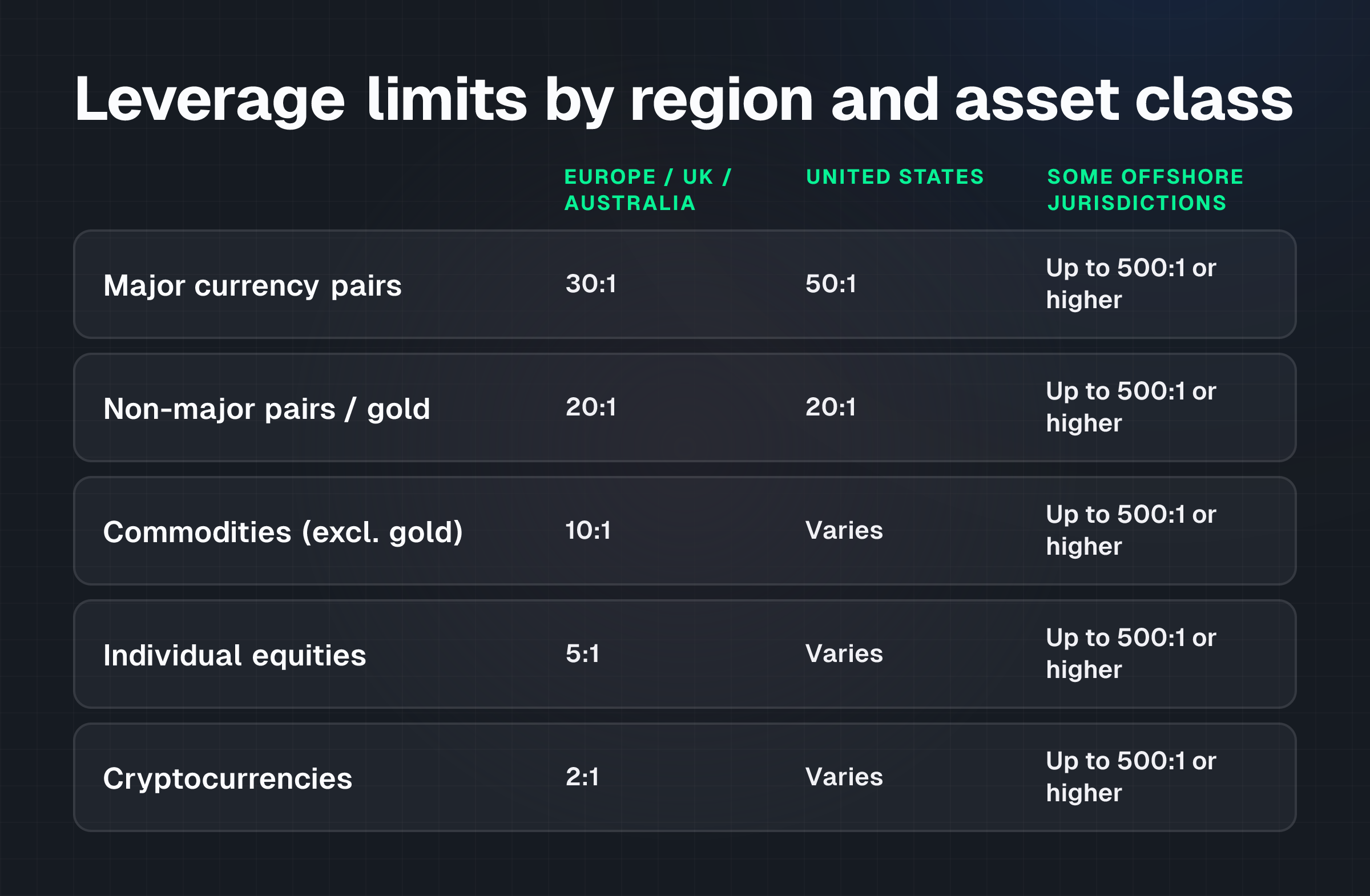
Regulatory leverage limits vary by region and asset class. The European Securities and Markets Authority (ESMA) caps leverage at 30:1 for major currency pairs, 20:1 for non-major pairs and gold, 10:1 for commodities excluding gold, 5:1 for individual equities, and 2:1 for cryptocurrencies. The UK Financial Conduct Authority (FCA) applies the same limits. The US National Futures Association (NFA) and Commodity Futures Trading Commission (CFTC) set limits at 50:1 for major pairs and 20:1 for non-major pairs. Australia's ASIC follows ESMA's framework. Some less regulated jurisdictions permit leverage of 500:1 or higher, though this carries substantially elevated risk.
The problem it addresses
Leverage amplifies both gains and losses.
A small price movement can result in rapid account depletion if leverage is too high or position sizing isn't controlled. Retail traders who don't understand margin requirements often open positions too large for their account balance, triggering margin calls and forced liquidations at unfavorable prices.
Unmanaged leverage exposure creates several risks. A trader may not realize how much capital a single trade requires until they're already in the position. Sudden market volatility can close a position at a loss before the trader has time to react. Without negative balance protection, traders could theoretically owe money beyond their initial deposit if markets gap sharply.
Regulatory leverage limits and negative balance protection address these problems by constraining maximum exposure any single account can take on, and by capping losses at the account balance. This protects traders from catastrophic losses and debt liability while still allowing profitable trading strategies. Forex Risk Management: Position Sizing and Stop-Losses covers practical strategies for controlling risk independently of leverage settings.
How the workflow works
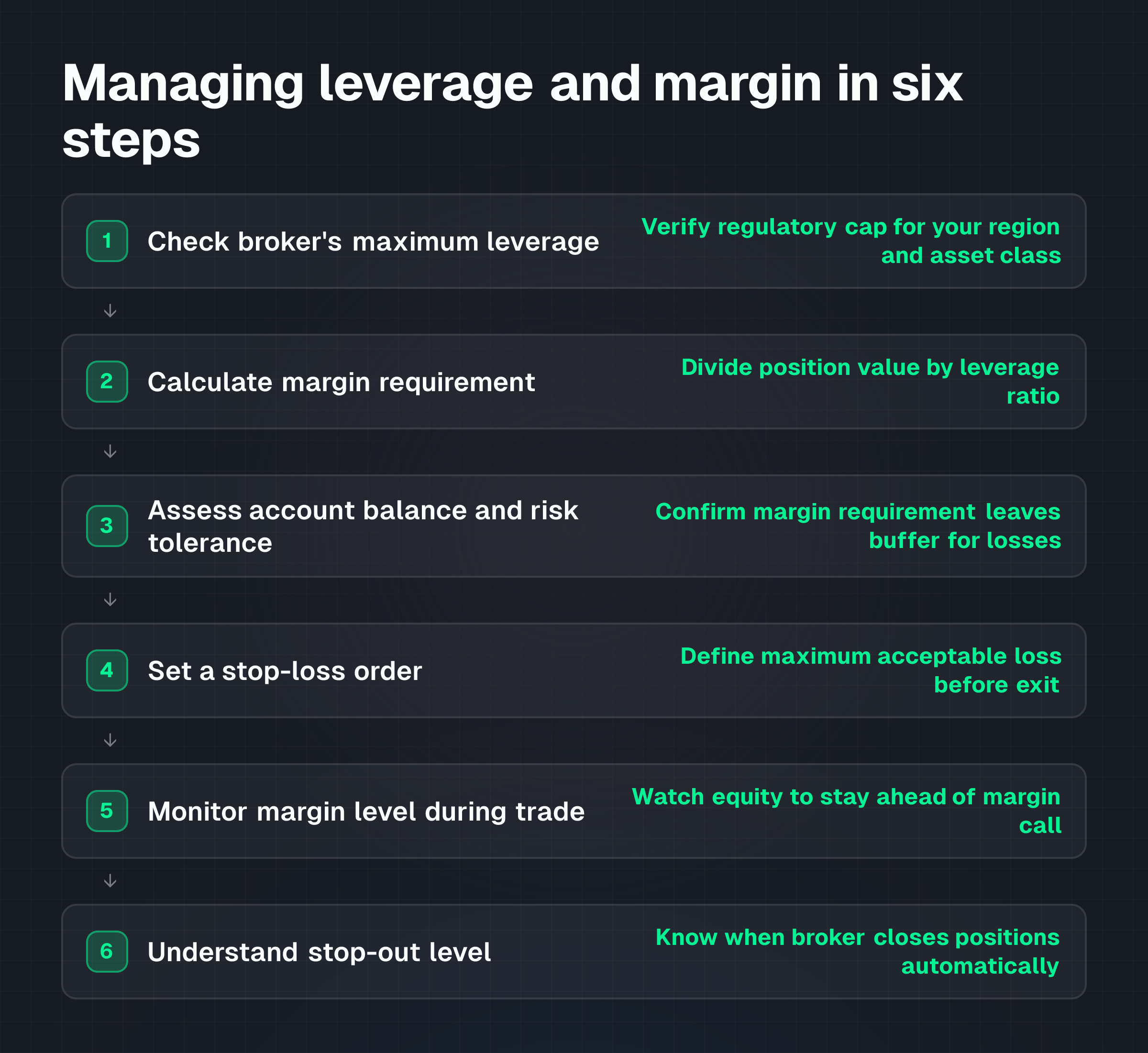
Understanding your broker's leverage and margin requirements involves several steps.
Check your broker's maximum leverage. Three accounts. From 0.0 pips. One broker. explains the available account structures, including leverage configurations that reach 1:1000, an extremely high ratio that requires disciplined risk management. Brokers in regulated regions (Europe, UK, Australia, US) offer lower caps.
Calculate margin for your intended position size. Divide the position value by the leverage ratio to find the margin required. If you want to trade $100,000 notional at 1:30 leverage, you need $3,333 in margin. At 1:500 leverage, you need only $200.
Assess your account balance and risk tolerance. Confirm that the margin requirement doesn't exceed your account balance, and that you have sufficient equity remaining to absorb potential losses without triggering a margin call.
Set a stop-loss order. Define the maximum loss you'll accept before exiting the trade. This step is independent of leverage but becomes critical when leverage is high.
Monitor your margin level during the trade. As the price moves, your account equity changes. If your equity falls close to the maintenance margin level, you'll receive a margin call. Close positions or deposit additional funds before a stop-out is triggered.
Understand the stop-out level. If your equity falls below your broker's stop-out threshold (often expressed as a percentage of required margin), the broker closes your open positions automatically to prevent further losses.
Negative balance protection works passively. If a trade moves so sharply that your losses exceed your account balance before your broker can execute a stop-out, the broker absorbs the loss rather than billing you for it. NextTrade provides negative balance protection, so your account equity can't fall below zero.
Who it may suit
Leverage limits and margin requirements are relevant to any trader using borrowed capital.
Traders in regulated regions (Europe, UK, Australia, US) operate under government-imposed leverage caps and must work within those constraints. Guides for your first deposit and first trade. walks through account funding and order placement.
Traders with small accounts (under $5,000) benefit most from leverage because it allows them to open meaningful positions. They also face the highest risk of margin calls if they don't size positions carefully. Experienced traders who use tight stop-losses and robust position-sizing frameworks can use higher leverage without proportionally increasing risk. Automated trading strategies (EAs and custom algorithms, which NextTrade permits) can enforce predefined risk rules systematically. Forex Trading Strategies: Types, Examples and Risks explains how different strategic approaches interact with leverage.
Traders who don't yet understand margin calculations, who haven't defined a risk management plan, or who trade without stop-losses should avoid high leverage regardless of what their broker permits.
Costs, conditions and eligibility
Margin itself isn't a cost. It's a minimum balance your broker holds to secure your leveraged position.
You don't pay a fee to use margin; margin is collateral. Negative balance protection is typically offered by brokers in regulated jurisdictions and is often required by law. NextTrade provides negative balance protection to all funded traders.
Leverage availability depends on your location and the asset you're trading. If you're in Europe, the UK, or Australia, your broker must cap leverage at the levels set by ESMA, FCA, or ASIC respectively. If you're in the US, leverage is capped by the NFA and CFTC. If your broker is based in a less regulated jurisdiction, leverage may be higher, but your legal protections may be fewer.
To use leverage at a broker, you typically must complete account verification, deposit a minimum balance (often $25 or higher), and accept the broker's terms of service. 131 instruments. Raw spreads. One account. covers the available asset classes and the margin requirements tied to each.
Risks and limitations
Leverage amplifies losses as much as gains.
A 50-pip move on 1 standard lot EUR/USD with 1:500 leverage can result in a $500 loss on a $1,000 account, wiping out 50% of your capital. The same move with 1:30 leverage would represent a much smaller loss in percentage terms, but the position itself would be smaller.
Over-leveraging is the most common mistake. Taking on too much leverage relative to account size makes an account hypersensitive to small price movements. Market volatility further compounds this risk; high leverage during volatile periods can trigger stop-outs in seconds.
Margin calls disrupt trading. If your equity falls below the maintenance margin, you must deposit additional funds or close positions immediately. This forces you to exit trades at inopportune times and can lock in losses.
Negative balance protection doesn't prevent losses; it only prevents debt. If your trade moves sharply against you, you still lose money; the broker simply ensures you can't owe more than your account balance.
Regulatory leverage limits differ by region. A trader moving between jurisdictions may find different leverage available for the same asset, requiring portfolio adjustments. How to Choose Forex Pairs for Your Trading Strategy discusses how pair selection interacts with margin requirements and volatility.
What remains uncertain
Published research doesn't quantify the direct impact of regulatory leverage limits on retail trader loss reduction.
No comprehensive data set is available comparing trader outcomes before and after leverage caps were implemented. The comparison does not cover the percentage of traders who experience margin calls or stop-outs in different leverage environments, so the true prevalence of these events remains unknown.
Regulatory frameworks remain dynamic. Specific dates and thresholds can change, and traders should verify the current rules for their jurisdiction before opening positions.
Evidence and disclosures
This article draws on regulatory guidance published by the European Securities and Markets Authority (ESMA), the UK Financial Conduct Authority (FCA), the US National Futures Association (NFA), the Commodity Futures Trading Commission (CFTC), and the Australian Securities and Investments Commission (ASIC).
The leverage limits, margin definitions, and negative balance protection safeguards cited are based on official regulatory announcements and broker disclosures. NextTrade offers leverage up to 1:1000 and provides negative balance protection. The firm routes liquidity through IC Markets, Pepperstone, IG Markets, and Capital.com, and offers three account types with commissions and spreads detailed separately. All regulatory and product terms should be verified on the official NextTrade website before opening an account.
Trading CFDs and leveraged forex carries substantial risk, including the potential loss of your entire deposit. Leverage amplifies both profits and losses. Past market behaviour doesn't predict future results.
Next step
Review the leverage and margin rules that apply to your jurisdiction and preferred asset class.
Calculate the margin required for a position size you're considering, and confirm that your account balance comfortably exceeds that requirement with buffer for losses. Define a stop-loss level before opening any trade, and monitor your account equity during trades to stay ahead of margin calls.
MetaTrader 5 and TradeLocker. One account, one price. explains the platforms through which you can place trades and manage margin in real time.
Risk Warning: CFD and leveraged forex trading carries substantial risk of loss. You may lose all capital deployed in your account. Leverage amplifies both gains and losses. Margin calls and stop-outs can result in forced position closure at unfavourable prices. Past performance doesn't guarantee future results. Trade only with capital you can afford to lose, and understand the margin and leverage terms of your broker before opening positions. This material is for general information only and isn't financial advice.
TagsProduct Feature Explainerleverage limits forexforex margin requirementsnegative balance protectionregulatory leverage caps