
How to Evaluate a Forex Strategy: Drawdown, Costs and Testing
Published
By NextTrade Editorial

Evaluating risk when selecting a trading strategy begins with understanding your personal risk tolerance: the maximum percentage of capital you're willing to lose on a single trade or across your account. Every strategy carries inherent risks shaped by its leverage use, holding periods, market conditions and historical drawdowns. Before committing real capital, assess the strategy's past performance through backtesting, calculate its total trading costs (spreads, commissions, overnight financing), and test it in a live market environment using a demo account. This structured evaluation helps align your strategy choice with both market realities and your financial capacity for loss.
Quick answer: understanding strategy risk
A trading strategy's risk profile depends on how it uses leverage, how often it trades, the market conditions it targets, and its historical peak-to-trough losses (drawdowns).
Risk evaluation isn't about predicting future returns. Past market behaviour does not establish what will happen next. Instead, it's about understanding what could go wrong, calculating the costs of execution, and ensuring the strategy matches your risk tolerance and capital.
What the term means: defining key risk concepts
Risk management is the process of identifying, assessing and controlling threats to your trading capital. It's not risk elimination; it's active decision-making about how much exposure you can afford and how to control it.
Risk tolerance is your personal willingness to accept potential losses in exchange for potential gains. This varies by individual financial situation, investment goals and emotional capacity for drawdowns.
A trading strategy is a systematic approach to making buy and sell decisions in the forex market. Strategies differ in their time horizons (scalping minutes versus holding days), their triggers (technical signals, fundamental factors, price patterns), and the market conditions they exploit (trending, range-bound, high-volatility).
Leverage is the use of borrowed capital to increase your market exposure. NextTrade offers leverage up to 1:1000 on major forex on MetaTrader 5 and 1:500 on TradeLocker. While leverage can amplify gains, it also increases the speed and scale of potential losses.
Volatility measures the degree of price variation over time. High volatility creates larger price swings and faster account drawdowns if positions move against you.
A drawdown is the peak-to-trough decline of your account value during a specific period. Understanding a strategy's historical maximum drawdown tells you the worst decline it experienced in past conditions.
Stop-loss and take-profit orders are predefined exit levels.
A stop-loss limits your loss on a position; a take-profit closes a winning trade at a target level. Both enforce discipline and prevent emotional decisions.
Backtesting applies a strategy to historical data to understand how it performed across past market conditions. Forward testing (or paper trading) runs the same strategy in live market conditions using virtual money, without risking real capital.
Trading costs reduce your net returns. These include spreads (the difference between bid and ask price), commissions, overnight financing (swap costs) if you hold positions past the trading day, and slippage (the difference between your expected execution price and the actual price).
How it works: the six-step evaluation process
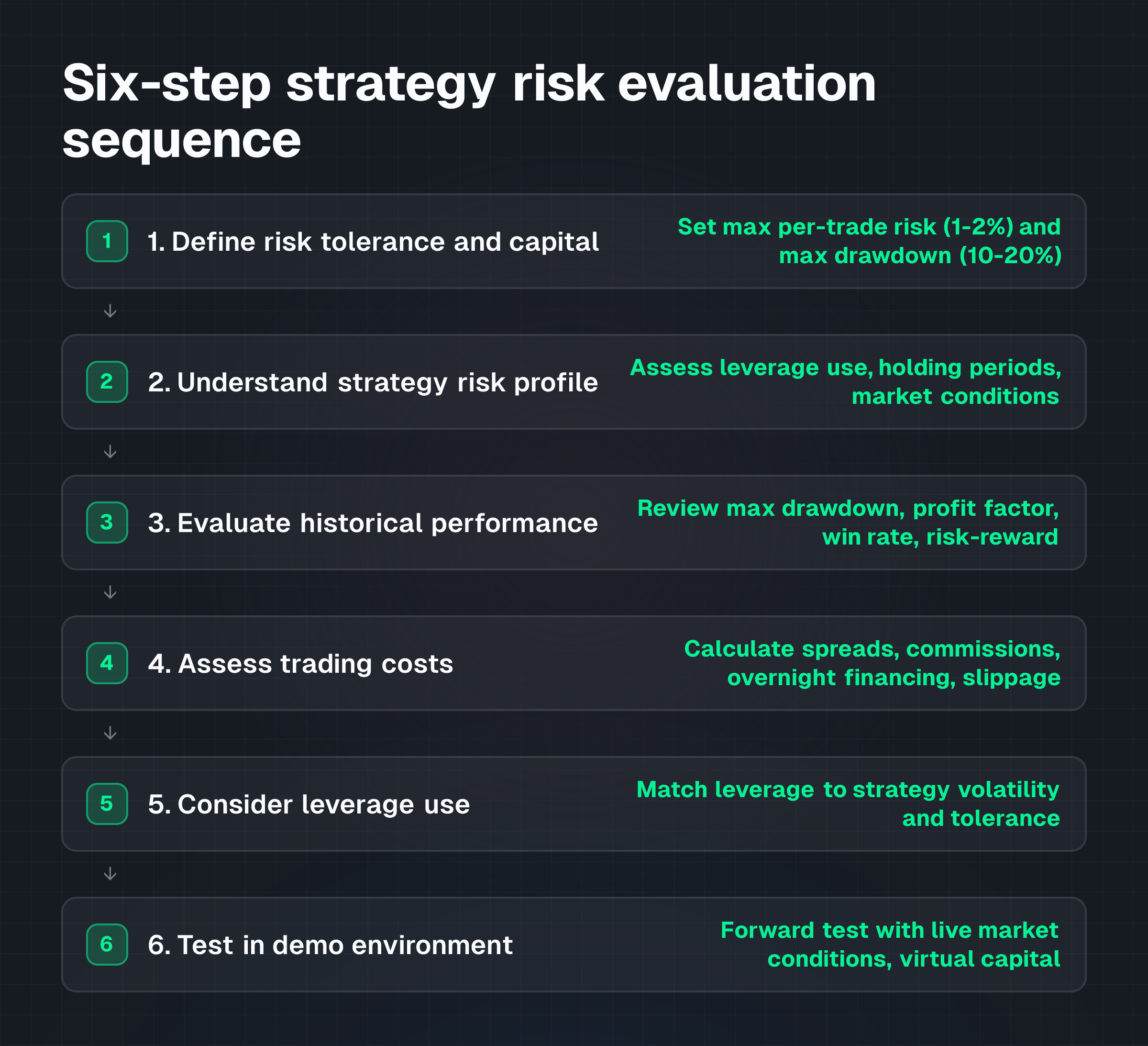
Evaluating a strategy's risk involves a structured sequence. Each step informs the next. Skip any step and you leave gaps in your understanding.
Step 1: Define your risk tolerance and capital
Assess your financial situation honestly. How much capital can you afford to lose without affecting essential expenses? What's your emotional tolerance for account drawdowns?
A common risk parameter is the maximum percentage of your total account you'll risk on a single trade (often 1-2%) and the maximum drawdown you can endure before pausing the strategy (often 10-20%).
Write these down. They're your guardrails.
Step 2: Understand the strategy's inherent risk profile
Research how the strategy actually works.
Does it use high leverage? Does it hold positions overnight or close them intraday? Does it depend on specific market conditions (trends, ranges, breakouts)? What's its win rate and average risk-to-reward ratio?
A scalping strategy that opens and closes 50 trades per day faces different risks than a swing strategy holding positions for days. The scalper is exposed to spread and commission costs on every trade; the swing trader is exposed to overnight financing and larger individual drawdowns if trades move against them.
Step 3: Evaluate historical performance and drawdown
Use backtesting results to see how the strategy performed in past market conditions. Look for:
- Maximum historical drawdown: How far did the account fall from peak to trough?
- Profit factor: Total profits divided by total losses. A ratio above 1.5 suggests the strategy wins more than it loses.
- Win rate: The percentage of trades that close at a profit.
- Average risk-to-reward: The ratio of average loss to average gain per trade.
Past performance does not predict future results, but it shows how the strategy behaved under real market stress.
Step 4: Assess trading costs
Calculate the total cost of executing the strategy. This depends on your account type and trading frequency.
NextTrade offers three account types:
- Standard: No commission, 1.3 pips typical EUR/USD spread. Suitable for lower-frequency traders.
- Raw: $7 per lot round trip on forex, spreads from 0.0 pips. Suitable for frequent traders where lower spreads offset commissions.
- VIP: $4 per lot round trip on forex, spreads from 0.0 pips. Suitable for high-volume traders.
If your strategy trades EUR/USD 100 times per month on the Standard account, you pay spread costs of approximately 130 pips per month in total. On a Raw account trading the same 100 times, you pay 0 pips in spreads but $700 in commission (100 round trips × $7). Which is cheaper depends on your average position size and holding time.
Add overnight financing costs if you hold positions past the trading day end.
Step 5: Consider leverage use
Determine the appropriate leverage for your strategy. Higher leverage amplifies both gains and losses.
If your strategy targets a 2% profit per trade but you use 1:500 leverage on a small account, a single adverse 0.4% market move can wipe out the entire position. Match your leverage to your strategy's volatility and your risk tolerance. Conservative traders might use 1:10 or 1:50 even though higher leverage is available.
Step 6: Test in a demo environment
Before risking real capital, test the strategy on a demo account in live market conditions.
This forward testing reveals whether the strategy performs as expected when real market speed, liquidity and volatility are present, without the emotional pressure of real money.
Worked example: comparing two account types for a scalping strategy
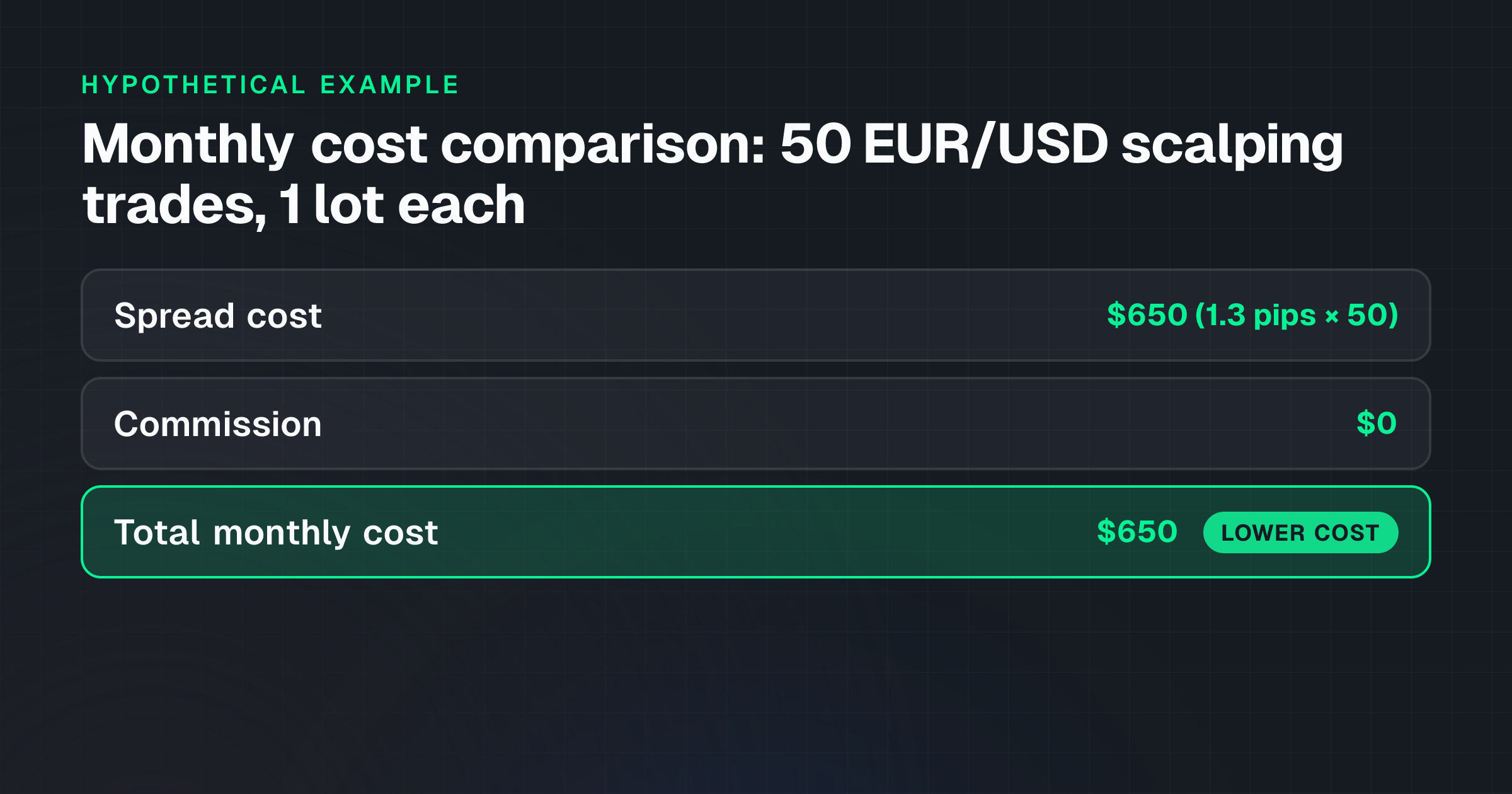
This example is hypothetical and educational. It's not a recommendation to place a trade.
Setup:
- Strategy: scalping EUR/USD, 50 round-trip trades per month
- Average trade size: 1 lot (100,000 units)
- Average hold time: 10 minutes
- Profit target: 10 pips per trade
Standard Account (1.3 pips spread, no commission):
- Spread cost per trade: 1.3 pips × 50 = 65 pips = $650 per month (at 1 pip = $10 per lot on EUR/USD)
- Commission: $0
- Total cost: $650
Raw Account (0.0 pips spread, $7 per lot round trip):
- Spread cost per trade: 0 pips × 50 = 0 pips = $0
- Commission: $7 × 50 = $350 per month
- Total cost: $350
Result: On this strategy, the Raw account saves $300 per month in trading costs. This assumes the spread stays at 0.0 pips consistently, though. If spreads widen during volatile periods or at market open, the actual savings may differ.
If the same strategy were executed once per week instead (fewer than 10 round trips per month), the Standard account might be cheaper because the lower total commission cost wouldn't justify the account minimum of $100 on the Raw account.
This calculation shows why account choice depends on your specific trading frequency and volume.
Spreads from 0.0 pips across 130+ instruments. Open Account
Costs and practical constraints: what reduces your edge
Trading costs reduce your net profit. Each cost must be weighed against the strategy's expected returns.
Spreads are unavoidable. The bid-ask difference is the market maker's cost of providing liquidity. NextTrade's Standard account spreads are wider (1.3 pips typical on EUR/USD) but carry no commission. Raw and VIP accounts offer tighter spreads from 0.0 pips but charge per-lot commissions ($7 for Raw, $4 for VIP on forex).
Commissions apply per trade or per lot. High-frequency strategies pay commission on every trade, so choosing an account with lower commissions (or no commission) can be material. Lower-frequency traders may find commissions negligible and prefer wider-spread, no-commission accounts.
Overnight financing applies if you hold a position past the market close. The cost depends on the interest rate differential between the two currencies and the direction of your trade. If you trade a strategy that holds positions for days or weeks, overnight costs accumulate and can significantly erode profits.
Slippage is the difference between your expected fill price and your actual execution price.
During volatile periods or with large order sizes, slippage can widen. This isn't a fixed cost but a risk: your profit target might be missed by slippage alone.
Account minimums vary. NextTrade's Standard account starts at $25, Raw at $100 and VIP at $10,000. If your strategy works better on a Raw account but you have $500 to risk, you meet the minimum and can proceed. The constraint is capital, not viability.
Risks and limitations: what can go wrong
Every strategy carries irreducible risks.
Market volatility can cause sudden, large price movements that exceed historical patterns. An unexpected economic data release, geopolitical event or market panic can trigger drawdowns larger than any the strategy experienced in backtesting.
Over-leveraging is a primary cause of rapid account losses. Using 1:1000 leverage on a small account means even a 0.1% adverse market move can trigger significant losses or a margin call. Leverage amplifies speed of loss, not just size.
Strategy failure in new market conditions occurs when market regimes shift.
A trend-following strategy that worked for years may fail during a period of choppy, range-bound trading. Past performance does not guarantee future results.
Emotional trading breaks the strategy's discipline. If the strategy says to hold but fear or greed triggers an early exit, you negate the risk management built into the original plan.
Slippage during highly volatile periods can exceed the spread cost and force exits at worse-than-planned prices.
Insufficient testing leaves blind spots. If you backtest a strategy only on the most recent 2 years of data, you may miss how it performed during crisis periods or low-volatility markets.
Common misunderstandings: what traders often get wrong
"If I backtest a strategy and it was profitable, it will be profitable in the future."
Backtesting shows what happened; it doesn't predict what will happen. Market conditions change. A strategy that worked during a bull market may fail during a sideways or bear market. Use backtesting to understand risk and performance pattern, not to forecast profits.
"Higher leverage means higher returns."
Higher leverage means higher market exposure. If you use 1:1000 leverage and make a 1% profit on the trade, you gain 10% on your capital. If you lose 1%, your capital falls 10%. The leverage itself doesn't create profit; it only magnifies the outcome of your trading decisions.
"Wider spreads mean I should switch to a lower-spread account."
Lower spreads aren't always better. If a lower-spread account charges commission, and you trade infrequently, the cumulative cost might be higher than a higher-spread, no-commission account. Run the numbers for your strategy.
"I can ignore overnight financing if I hold for just one day."
Overnight financing applies if you hold past the market close, even by one hour. For multi-day strategies, overnight costs are real and reduce profit. Calculate them before choosing the strategy.
"Drawdown doesn't matter if the strategy is profitable over time."
Drawdowns matter for two reasons: they determine how much capital you need to survive without hitting zero, and they test your emotional tolerance. A strategy with a 50% drawdown is mathematically recoverable (a 100% gain restores the account) but psychologically brutal. Know your drawdown tolerance before you start.
"I don't need to test on a demo because I understand the strategy."
Understanding the theory isn't the same as watching it execute in live market conditions. Demo testing reveals slippage, order fills, margin calls and emotional responses that backtesting can't replicate.
Practical checklist: before you trade a strategy
Use this checklist to ensure you've covered the key evaluation steps:
- Maximum risk per trade (as a % of account) and maximum acceptable drawdown are written down.
- The strategy's time horizon, market conditions and typical leverage have been researched.
- Backtesting results reviewed: maximum drawdown, profit factor, win rate and risk-to-reward ratio.
- Total monthly cost of the strategy (spreads + commission + overnight financing) calculated on the chosen account type.
- This cost is sustainable given the strategy's historical returns.
- An account type (Standard, Raw or VIP) chosen based on trading frequency and costs.
- Predefined stop-loss and take-profit levels set in advance, not during a trade.
- The strategy tested on a demo account for at least 20-30 trades in live market conditions.
- Negative balance protection confirmed as active on the account (NextTrade provides this for retail accounts).
- Comfort with the strategy's historical drawdown confirmed, with capital sufficient to survive it.
Frequently asked questions
Why does past performance not guarantee future results?
Market regimes change. A strategy that profits in trending markets may lose in choppy, sideways markets. Economic conditions, volatility levels and participant behavior shift over time. Backtesting shows what happened under past conditions, not what will happen next. Use it to understand risks and patterns, not to forecast profits.
Which account type should I choose if I'm unsure about my trading frequency?
Start with the Standard account. It has the lowest minimum deposit ($25), no commission, and suits traders who execute fewer than 10-15 trades per week. Once you have experience with your actual trading frequency over several months, you can calculate whether a Raw or VIP account with tighter spreads would reduce total costs. Don't upgrade prematurely.
How much leverage should I use?
Match leverage to your strategy's volatility and your risk tolerance.
If your strategy targets 2% profit per trade and tolerates 1% adverse moves, use leverage that lets a 1% market move equal 1% of your account risk, not 10% or more. Many traders use 1:50 or 1:100 even though higher leverage is available. Conservative leverage preserves capital across drawdowns.
What is the difference between forward testing and live trading?
Forward testing uses virtual money on a demo account in real market conditions. Live trading uses real capital. Forward testing reveals whether the strategy executes as expected, whether you understand order types, position sizing, and market speed. It doesn't perfectly replicate live trading because there's no financial pressure, but it eliminates major surprises before real money is at risk.
How do I know if my strategy's drawdown is acceptable?
Drawdown is acceptable if two conditions are met: you have enough capital to survive it without hitting zero, and you can tolerate the psychological stress. A 20% drawdown is recoverable (a 25% gain restores the account) but requires discipline. If a 20% decline would cause you to abandon the strategy in panic, it's not acceptable for you, regardless of historical profitability.
Do I need to pay overnight financing if I hold a position for less than 24 hours?
Overnight financing applies if you hold past the market close (typically 5 p.m. New York time). Holding for 23 hours or 25 hours both trigger the charge if they cross that cutoff. If your strategy holds positions intraday only and always closes before market close, you avoid overnight financing. Check NextTrade's terms for the exact cutoff time and your account's financing rates.
Next step: test before you commit capital
Evaluating risk isn't a one-time task. It's preparation before trading, not a guarantee during it.
The final step is to test your chosen strategy on a demo account for 20-30 trades in live market conditions. This confirms that the strategy executes as expected, that your position sizing is realistic, and that you understand your platform and account features.
After demo testing, begin live trading with the smallest position size your strategy allows. This lets you verify that your risk calculations match reality and that you can manage the emotional pressure of real capital at risk.
Risk evaluation is uncomfortable because it forces you to confront what could go wrong. But traders who skip this step often discover their gaps only after losses have occurred. Spend time now understanding risk, and you reduce surprises later.
CFDs are complex instruments and carry a high risk of losing money rapidly due to leverage. 70-80% of retail investor accounts lose money when trading CFDs. You should consider whether you understand how CFDs work and whether you can afford to take the high risk of losing your money.
This article is for education and information purposes only. It is not financial advice, and should not be construed as a recommendation to buy, sell or hold any instrument or to open an account with any provider. Seek independent financial advice appropriate to your circumstances before making trading decisions. Past performance is not indicative of future results.
TagsTrading Educationforex strategy risk managementtrading strategy evaluationrisk tolerance forexbacktesting forex strategy