
A drawdown limit is a predetermined maximum percentage decline in your trading account that you will not exceed before pausing or closing positions. The reason drawdown limits matter is mathematical: a 50% loss requires a 100% gain to return to your starting capital. Larger drawdowns become exponentially harder to recover from, which is why setting a limit before trading begins is a core part of capital preservation. This article explains how to set a drawdown limit, why recovery math works the way it does, and how account minimums and leverage affect your chosen threshold.
Quick answer: Why drawdown limits matter
A drawdown is the peak-to-trough decline in your account value during a specific period, expressed as a percentage.
A maximum drawdown (MDD) is the largest percentage drop from a peak before a new peak is achieved. A drawdown limit is the point at which you stop trading and reassess. The critical insight is asymmetry: losses and gains don't cancel at equal percentages. If your $10,000 account drops 50% to $5,000, you need a 100% gain on the remaining $5,000 to return to $10,000. A 25% loss requires a 33.33% gain to recover. A 75% loss requires a 300% gain. This disproportionate effort is why large drawdowns are difficult or impossible to recover from and why a drawdown limit acts as a circuit breaker for capital preservation.
What the feature is
A drawdown limit is a risk management rule you set before trading. It defines the maximum percentage of your capital you'll allow to decline from its peak before you stop opening new positions, close existing ones, or take a trading break.
Drawdown limits are expressed in two main ways:
- Percentage of initial capital: A fixed drawdown of, for example, 20% of your starting account balance. If you start with $10,000, you stop at $8,000.
- Percentage of highest equity peak (trailing drawdown): A dynamic approach where the limit adjusts as your account grows. If your account reaches $15,000 and then drops 15%, your limit triggers at $12,750. Proprietary trading firms often use this method.
Your equity curve, a visual representation of your account balance over time, displays drawdowns and recoveries. Watching this curve helps you spot when you're approaching your limit and when you're recovering.
The problem it addresses
Every trader faces capital preservation challenges. Two specific problems justify setting a drawdown limit:
Capital loss is hard to recover. Once a significant portion of your capital is lost, the mathematical effort required to return to your previous peak becomes severe. Many traders underestimate this recovery math and make emotional decisions, such as over-leveraging or taking excessive risk, to "catch up." A predetermined limit prevents you from entering that spiral.
Psychological impact of large losses. Significant drawdowns often trigger emotional trading: fear, frustration and the urge to take outsized risks to recover quickly.
A drawdown limit acts as an objective stopping point that removes discretion during emotionally charged periods. It forces a pause, allowing for review rather than reactive decision-making. A drawdown limit also integrates with your overall risk management framework. It works alongside position sizing and stop-loss placement to ensure no single trade or sequence of trades can destroy your account.
How the workflow works
Setting and implementing a drawdown limit follows these steps:
Step 1: Choose your limit method
Decide whether you'll use a fixed percentage of your initial capital or a trailing drawdown from your highest peak. Fixed limits are simpler for new traders. Trailing limits reward account growth but are more complex to track.
Step 2: Calculate recovery requirements
Map out the recovery math for your chosen limit. If you set a 20% limit on a $10,000 account, the worst case is a $2,000 loss leaving you with $8,000. You'd need a 25% gain to recover. If you set a 50% limit, you'd need a 100% gain. Write these figures down; they clarify what "recovery" actually means.
Here are the standard recovery multiples:
- 10% drawdown: 11.11% gain needed to recover
- 20% drawdown: 25% gain needed to recover
- 30% drawdown: 42.86% gain needed to recover
- 40% drawdown: 66.67% gain needed to recover
- 50% drawdown: 100% gain needed to recover
- 75% drawdown: 300% gain needed to recover
Step 3: Set your limit based on risk tolerance and strategy
Consider three factors:
- Risk tolerance: How much can you psychologically afford to lose? If a 30% drawdown would cause you to panic and make poor decisions, set your limit lower, perhaps 15%.
- Your trading strategy: Review any historical backtested drawdowns for your strategy. If your system historically experiences 25% drawdowns, set your limit at 35% to allow for variance without constant triggering.
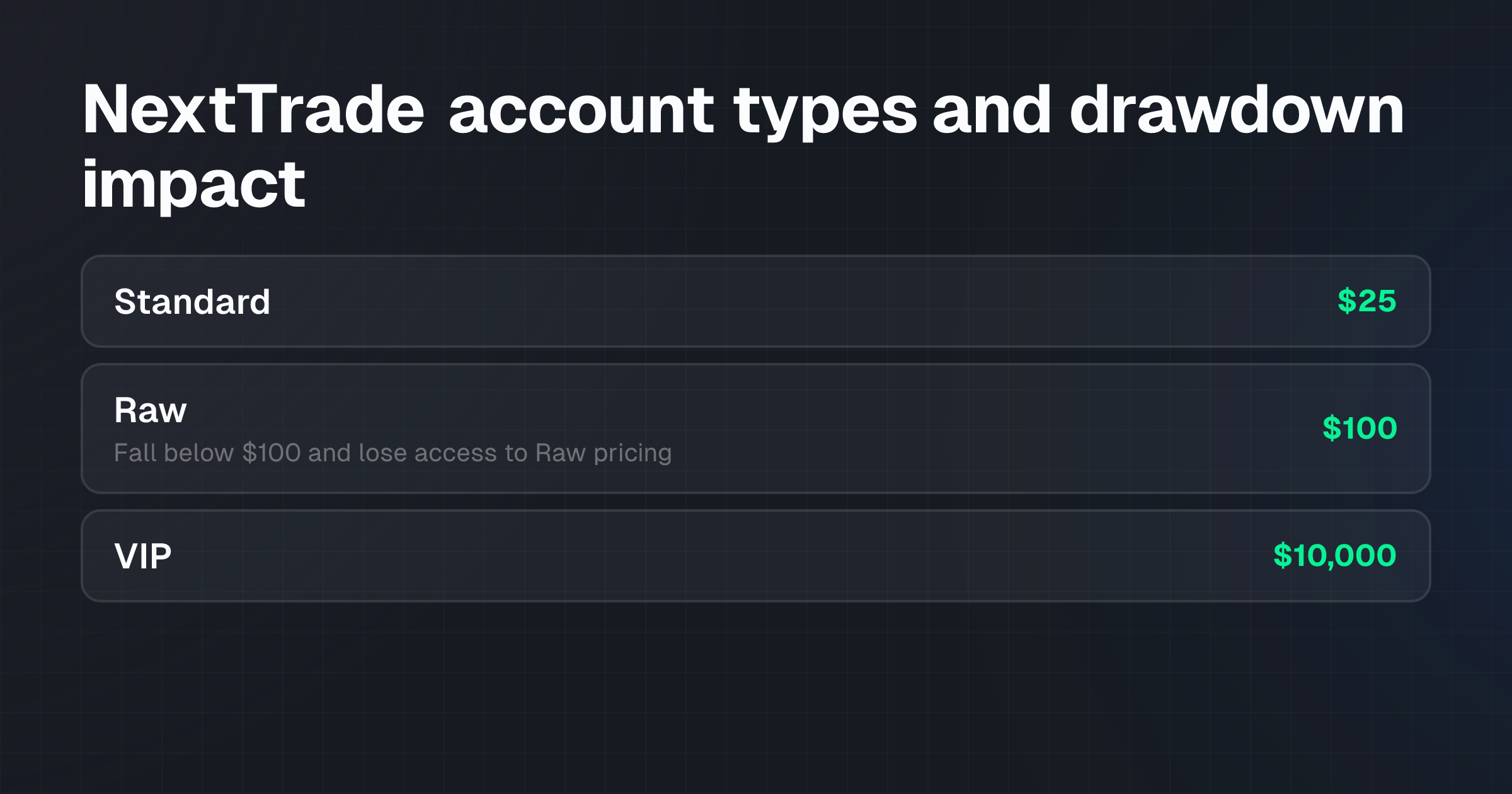
- Account type and minimums: Account minimums matter. NextTrade offers Standard accounts from $25, Raw accounts from $100, and VIP accounts from $10,000. If you open a Raw account with $100 and experience a 50% drawdown, your balance drops to $50, below the Raw account minimum. You'd fall out of access to Raw pricing (spreads from 0.0 pips and commissions from $6-7 per lot round trip). Plan for this boundary.
Step 4: Implement the limit with discipline
Use these tools to enforce adherence:
- Stop-loss orders on individual trades: Don't rely on willpower alone. Place stop-losses that prevent any single trade from consuming a large portion of your allowed drawdown.
- Adjusted position sizing: Size each position so that the maximum loss per trade matches your risk-per-trade plan. If your account is $10,000 and you risk 1% per trade ($100), a 10-trade losing streak costs 10% of your account, well within most drawdown limits.
- Treat the limit as a rule, not a guideline: When your equity touches the limit, stop. Review what happened, why the limit was hit, and whether your strategy or position sizing needs adjustment.
Step 5: Review and adjust regularly
Market conditions change. Your account grows. Your strategy may drift.
Review your drawdown limit quarterly or after significant account changes. If your account doubles, you may adjust your limit to protect the new capital level while allowing for realistic strategy variation.
Spreads from 0.0 pips across 130+ instruments. Open Account
Who it may suit
Drawdown limits are relevant for:
- Retail forex and CFD traders who want to avoid catastrophic losses and preserve capital across multiple trading sessions.
- Traders using leverage (NextTrade offers leverage up to 1:1000 on major forex on MetaTrader 5). Leverage amplifies both gains and losses; a drawdown limit becomes more important when leverage is in use because drawdowns can occur faster.
- Traders new to risk management who need an objective rule to replace emotional decision-making.
- Traders with a defined strategy who can estimate realistic drawdown ranges and set limits accordingly.
Drawdown limits may be less critical for:
- Traders with very small accounts who are already limited by minimum position sizes and minimum lot requirements.
- Traders who actively trade and can monitor positions in real time and react to losses immediately (though a predetermined limit still adds discipline).
Costs conditions and eligibility
Drawdown limits themselves have no direct cost. They're a rule you set for yourself.
However, the account type and leverage you use to trade will determine how quickly you can hit a drawdown limit and what pricing you have access to if your account drops below a certain threshold.
NextTrade account minimums and pricing:
- Standard accounts: Minimum deposit $25, spreads from 1.3 pips, no commission.
- Raw accounts: Minimum deposit $100, spreads from 0.0 pips, commission $6-7 per lot round trip.
- VIP accounts: Minimum deposit $10,000, spreads from 0.0 pips, commission $4 per lot round trip.
If your account drops below an account type's minimum due to a drawdown, you may lose access to that pricing tier. For example, a Raw account holder with $150 who experiences a 40% drawdown ($60 remaining) would fall below the $100 minimum.
Leverage: NextTrade allows leverage up to 1:1000 on major forex pairs on MetaTrader 5. Higher leverage means positions can move into drawdown faster. A drawdown limit becomes a more immediate concern when leverage is high.
Negative balance protection: NextTrade offers negative balance protection for retail accounts, ensuring that your balance remains at zero even if losses surpass your deposit. While this feature enhances safety, it does not replace the necessity for a personal drawdown limit. It helps avoid severe account depletion but does not address the psychological and capital-preservation issues that a drawdown limit effectively manages.
Check the current product terms before opening or funding an account, as conditions may change.
Risks and limitations
Setting limits too wide can lead to large, hard-to-recover losses before the limit triggers. A 60% drawdown limit sounds reasonable until you calculate that recovery requires a 150% gain.
Setting limits too tight may cause you to close winning trades prematurely or avoid entering valid setups out of fear. This can hinder long-term account growth and lead to frustration if the limit is triggered frequently by normal strategy variation.
Ignoring limits is common during winning streaks or when a trader believes the next trade will recover losses. Emotional trading can lead to abandoning the limit entirely, resulting in the capital loss the limit was designed to prevent.
Over-leveraging amplifies drawdowns. A 2% adverse move at 1:100 leverage costs 0.02% of your account. The same move at 1:1000 leverage costs 0.2% of your account. High leverage can cause you to hit your drawdown limit in days rather than months.
Lack of discipline is the most common failure point. A drawdown limit is only effective if you treat it as a hard rule. Many traders set a limit intellectually but override it emotionally when losses begin to accumulate.
Not understanding recovery math leads traders to underestimate the effort required to recover. A trader who loses 40% of their account may expect to recover in a few good trades. In reality, they need a 66.67% gain on the remaining capital, a much steeper climb.
What remains uncertain
This article doesn't cover the following:
- Empirical performance data on specific drawdown limits. No published studies or industry benchmarks on the effectiveness of particular drawdown limits for retail forex traders are included in this research. Guidance here relies on mathematical relationships and general risk management principles rather than performance statistics.
- Optimal drawdown limits by strategy type. While this article mentions that strategy history informs limit-setting, specific recommendations for trend-following, mean-reversion, or scalping strategies aren't covered.
- Psychological profiles and drawdown limits. How individual risk tolerance maps to specific drawdown percentages varies widely and isn't quantified in available sources.
Evidence and disclosures
This article draws on NextTrade's published account structures, leverage policies and negative balance protection disclosures, verified as of 20 November 2026.
The recovery math examples are derived from standard financial formulas. This example explains the calculation and is not a recommendation to place a trade.
CFDs are complex instruments and carry a high risk of losing money rapidly due to leverage. Retail investors lose money when trading CFDs with most providers. You should consider whether you understand how CFDs work and whether you can afford to take the high risk of losing your money.
Next step
If you're opening a NextTrade account, use this framework to set a drawdown limit before your first trade. Write it down. Calculate the recovery percentage for your chosen limit so you understand the real cost of a drawdown. Then build your position sizing and stop-loss strategy to support that limit, ensuring no single trade or sequence of losses can exceed it without warning.
For a complete picture of capital preservation, read the related guides on leverage limits and risk management fundamentals.
TagsProduct Feature Explainerdrawdown limitmaximum drawdownrecovery mathcapital preservation