

A margin call is a warning from your broker that your account equity has dropped to a critical threshold, typically 100% margin level, and you no longer have enough funds to support your open positions at current prices. A stop-out is automatic closure of one or more positions when your margin level falls below a second, lower threshold, often 50%. The difference is straightforward: a margin call alerts you and requires action, while a stop-out is automatic intervention that closes positions without waiting for your response. Grasping how these mechanisms work, along with the formulas for balance, equity, used margin, and free margin, is essential for managing risk in leveraged trading.
This guide explains both concepts using formulas and mechanisms that apply across the industry, with specific focus on how these work at NextTrade.
Quick answer: Margin call vs. stop-out
A margin call triggers when your margin level, calculated as (Equity / Used Margin) × 100%, falls to a broker-set threshold, commonly 100%. At this point, you've got no free margin left to absorb further losses. A stop-out happens when margin level drops below a lower threshold, commonly 50%, and the broker automatically closes open positions.
Neither guarantees execution at an exact price. During volatile market conditions, actual execution price of a stop-out can differ significantly from the theoretical level. That gap is slippage.
What the term means: Balance, equity, used margin, free margin, and margin level
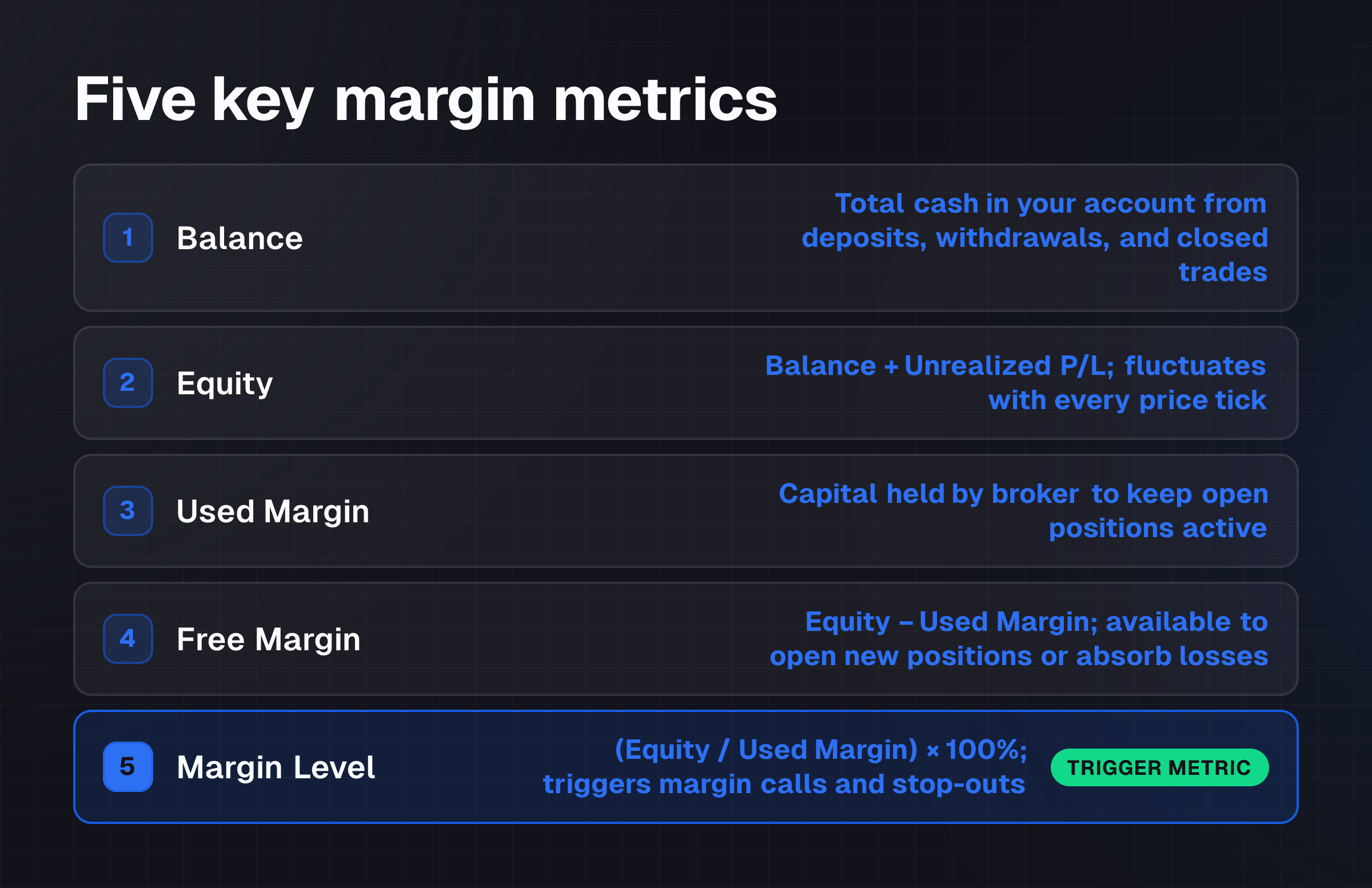
Before tackling margin calls and stop-outs, you need to know five key metrics.
Balance is total cash in your trading account. It reflects deposits, withdrawals, and realized profit or loss from closed positions.
Equity is your account's current total value. It's calculated as Balance + Unrealized Profit/Loss from open positions. Equity fluctuates with every price tick in your open trades.
Used Margin is the capital your broker holds to keep your open positions active. This amount is locked as long as the position remains open and releases only when you close the position.
Free Margin is equity available to open new positions or absorb losses. The formula: Equity − Used Margin. When free margin reaches zero, you can't open new positions.
Margin Level is the metric that triggers both margin calls and stop-outs.
Margin Level = (Equity / Used Margin) × 100%
This percentage tells you how much of your used margin is covered by current equity. Higher margin level means healthier account. The lower it falls, the closer you move toward a margin call or stop-out.
How it works: The sequence of events from price movement to stop-out
When you open a leveraged position, the broker sets aside a portion of your equity as used margin. Remaining equity becomes free margin.
As the market price moves against your position, unrealized loss increases, which reduces equity. As equity falls, both free margin and margin level decline. If margin level reaches the broker's margin call threshold (commonly 100%), you receive a notification. If margin level continues to fall and reaches the stop-out level (commonly 50%), the broker automatically closes positions without waiting for you to act.
Specific thresholds vary by broker. NextTrade offers leverage up to 1:1000 and provides negative balance protection, which means your losses can't exceed your initial deposit. However, the exact margin call percentage and stop-out level at NextTrade should be verified in your account terms or by contacting support, as these are broker-specific.
During highly volatile market conditions, news events or rapid price spikes, stop-out execution may occur at a price substantially different from the theoretical stop-out level. This happens because the broker closes positions in order of priority, often least profitable first, and may execute them at whatever price is available at that moment rather than at a specific target price. Slippage can result in a larger loss than the calculation suggests.
Worked example: How adverse price movement reduces equity and free margin
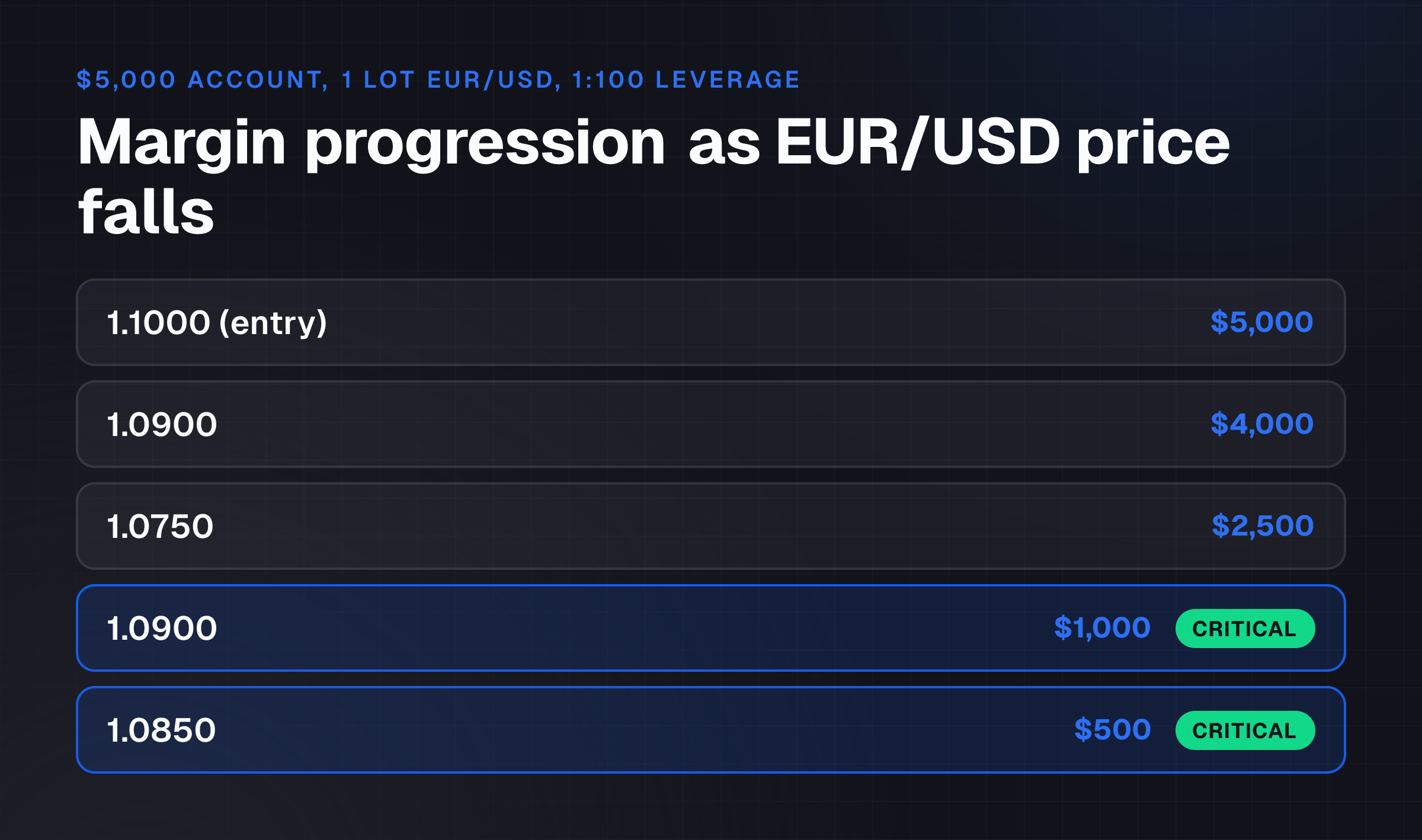
This example is hypothetical and educational. It illustrates the calculations, not a recommendation to trade.
Scenario setup:
- Initial account balance: $5,000
- Position: 1 standard lot (100,000 units) of EUR/USD opened at 1.1000
- Leverage: 1:100 (for clarity; NextTrade offers 1:1000)
- Margin requirement: 1% of notional value = $1,000
Initial state (no adverse movement):
- Balance: $5,000
- Equity: $5,000 (no unrealized P/L yet)
- Used Margin: $1,000
- Free Margin: $5,000 − $1,000 = $4,000
- Margin Level: ($5,000 / $1,000) × 100% = 500%
After EUR/USD falls to 1.0900 (unrealized loss of $1,000):
- Balance: $5,000 (unchanged; only closed trades affect balance)
- Equity: $5,000 − $1,000 = $4,000
- Used Margin: $1,000
- Free Margin: $4,000 − $1,000 = $3,000
- Margin Level: ($4,000 / $1,000) × 100% = 400%
After EUR/USD falls to 1.0750 (unrealized loss of $2,500):
- Balance: $5,000
- Equity: $5,000 − $2,500 = $2,500
- Used Margin: $1,000
- Free Margin: $2,500 − $1,000 = $1,500
- Margin Level: ($2,500 / $1,000) × 100% = 250%
At EUR/USD = 1.0900 (margin call triggered at 100% threshold):
- Balance: $5,000
- Equity: $1,000 (unrealized loss of $4,000)
- Used Margin: $1,000
- Free Margin: $1,000 − $1,000 = $0
- Margin Level: ($1,000 / $1,000) × 100% = 100%
- Action: Broker sends margin call notification. Trader has no free margin.
At EUR/USD = 1.0850 (stop-out triggered at 50% threshold):
- Balance: $5,000
- Equity: $500 (unrealized loss of $4,500)
- Used Margin: $1,000
- Free Margin: $500 − $1,000 = −$500
- Margin Level: ($500 / $1,000) × 100% = 50%
- Action: Broker automatically closes the EUR/USD position to prevent further losses.
The worked example shows how rapidly equity and free margin decline when leverage amplifies a losing trade. It also demonstrates why waiting passively after a margin call is risky; continued adverse movement triggers stop-out quickly.
Costs and practical constraints: Execution risk and volatility limits
A critical practical constraint is execution price uncertainty.
The margin call threshold (commonly 100%) and stop-out level (commonly 50%) are theoretical reference points. During volatile market conditions, news releases, market gaps, or periods of low liquidity, the actual execution price of a stop-out order can be substantially worse than the calculated level.
For example, if your margin level reaches 50% during a quiet market, the broker might close your position at the 50% threshold. But if the same margin level is reached during a news spike or flash crash, the broker may execute your stop-out at 30%, 20%, or even lower if liquidity is constrained and slippage is severe. This can wipe out more of your account than the mathematical model predicts.
NextTrade provides negative balance protection, meaning your liability can't exceed your deposit. Negative balance protection doesn't prevent slippage during stop-out; it only caps your maximum loss after the stop-out executes.
Stop-out doesn't close just one position. The broker closes enough positions, typically starting with the least profitable, to restore the margin level above the stop-out threshold. In multi-position accounts, this can mean losing your intended hedges or long-term holdings without your permission.
Risks and limitations: Why leverage magnifies both losses and margin calls
Leverage amplifies both profit potential and loss potential.
With leverage, a small adverse price movement can eliminate a large percentage of your account equity in minutes. This is why margin calls and stop-outs are common in leveraged trading.
The primary risk is overusing leverage relative to account size. If your position size is too large for your equity, a normal market swing can trigger a margin call. If you then experience a sudden price spike or a gap during illiquidity, stop-out can execute far below your margin level calculation, locking in a larger loss than planned.
A second risk is ignoring the warning. A margin call isn't a suggestion; it signals imminent danger. If you don't respond by closing positions or depositing additional funds, the account remains vulnerable to stop-out if adverse movement continues. Depositing additional funds to keep a losing position open is reactive and doesn't address the root cause: the position size was too large for the account.
A third risk is emotional decision-making during a margin call. Panic can lead to forced actions such as opening additional positions to "recover" losses or increasing leverage, both of which raise risk further. The disciplined response is to either close losing positions or leave the account alone and let the market resolve.
Volatility introduces execution timing risk. During low-liquidity periods, the gap between your intended margin level and actual stop-out price can be severe. News events, market open/close times, and illiquid currency pairs are common triggers for slippage.
Common misunderstandings: What traders often get wrong
Misunderstanding 1: "A margin call closes my positions."
No. A margin call is a notification only. Your broker is telling you that your equity is low and you need to act. If you don't act and the margin level continues to fall, then stop-out closes positions automatically.
Misunderstanding 2: "Stop-out always executes at exactly the stop-out level."
Wrong. Stop-out is a trigger, not a guarantee of execution price. During volatile or illiquid markets, your positions may be closed at a much worse price than the 50% (or whatever threshold applies) suggests. Slippage can be substantial during news releases or market gaps.
Misunderstanding 3: "I can avoid a margin call by depositing more money."
Technically yes, but this doesn't address the underlying problem: your position size is too large for your account and your risk tolerance. Repeatedly depositing funds to keep losing positions open is a cycle that depletes capital faster.
Misunderstanding 4: "Margin call and stop-out are the same thing."
They aren't. Margin call is a warning. Stop-out is automatic closure. They're distinct events, separated by a margin level threshold, and they trigger different outcomes.
Misunderstanding 5: "I have plenty of time after a margin call to decide what to do."
Not necessarily. If you receive a margin call at 100% margin level and the market moves sharply against you, you may reach the stop-out level (commonly 50%) in seconds or minutes. In fast-moving markets, the window between margin call and stop-out can be very narrow.
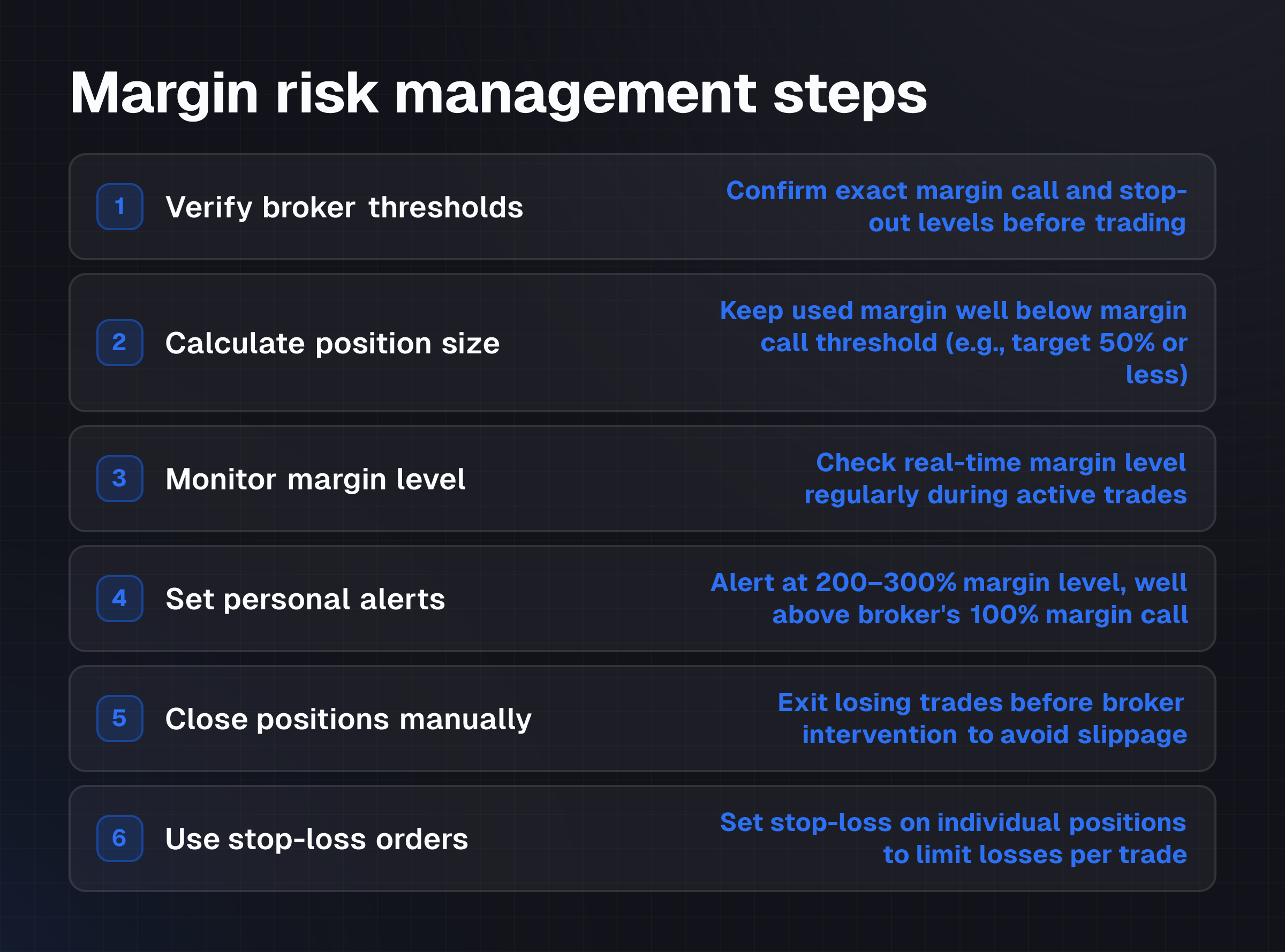
Practical checklist: Steps to manage margin risk
-
Understand your broker's specific thresholds.
Verify the exact margin call percentage and stop-out level at your broker. At NextTrade, review your account terms or contact support to confirm these levels before trading. -
Calculate position size based on your account equity and risk tolerance.
Use a position sizing formula that keeps your used margin well below your margin call threshold (e.g., target no more than 50% margin level in normal conditions). -
Monitor your margin level during active trades.
Most platforms display margin level in real-time. Check it regularly, especially during volatile market conditions or if a trade moves against you. -
Set a personal alert level well above the broker's margin call level.
For example, if the broker's margin call is at 100%, set your own alert at 200% or 300%. This gives you a buffer to respond before the official margin call arrives. -
Close positions manually if your margin level approaches your alert.
Don't wait for the broker to intervene. Taking control of the outcome reduces the risk of unexpected slippage during stop-out. -
Use stop-loss orders on individual positions.
A stop-loss closes a single position at a specified price, giving you more control than waiting for broker-initiated stop-out, which may close multiple positions at worse prices. -
Avoid using maximum leverage on every trade.
Even though NextTrade offers 1:1000 leverage, using it frequently increases the speed at which margin calls occur. Lower leverage reduces vulnerability. -
Keep a cash buffer in your account.
Don't deploy 100% of your equity into open positions. Maintain free margin as a cushion.
FAQs
What is margin level, and why does it matter?
Margin level is (Equity / Used Margin) × 100%. It shows how much of your required margin is covered by your current account equity. A high margin level (e.g., 500%) means you're comfortable; a low margin level (e.g., 100%) means you're at the margin call threshold. It matters because it determines when your broker will issue a warning (margin call) and when it will close your positions automatically (stop-out).
How is free margin different from available balance?
Free margin is Equity − Used Margin. It's the equity currently unused by open positions and available to open new trades or absorb losses. Available balance usually refers to cash balance only, excluding unrealized profit or loss. During a losing trade, your equity (and thus free margin) falls, but your balance may remain unchanged until you close the position.
Can I prevent a stop-out by depositing more money after a margin call?
Yes, you can deposit funds to increase your equity and raise your margin level above the stop-out threshold. This treats the symptom, not the cause. The underlying issue is that your position size was too large. Repeatedly depositing to keep losing positions open is reactive and can lead to repeated margin calls and larger cumulative losses. The disciplined approach is to review your position sizing and risk management.
What happens to my account if stop-out executes at a price worse than the stop-out level?
The excess loss is covered by your account equity (and then your balance if equity is exhausted). NextTrade provides negative balance protection, which means your loss can't exceed your deposit amount. Negative balance protection activates after the stop-out executes; it doesn't prevent slippage during execution.
Does stop-out close all my positions or just some?
Stop-out closes enough positions to restore your margin level above the stop-out threshold. Often this starts with the least profitable positions and continues until the margin level recovers. In a multi-position account, you may lose some positions while others remain open, depending on their profitability and size.
How quickly can a margin call turn into a stop-out?
It depends on market volatility and liquidity. In a quiet market, the margin call threshold (100%) and stop-out level (50%) provide time to act. During rapid price movements, news events or illiquid market conditions, your margin level can fall from 100% to 50% in seconds. This is why monitoring your margin level during active trades is essential.
Practical checklist for a deep dive
To understand your specific margin mechanics at NextTrade, review your account terms, check the NextTrade Spreads & Trading Costs: Full 2026 Breakdown to understand all trading costs, and familiarize yourself with Forex Leverage Explained: How 1:1000 Works at NextTrade to see how leverage affects your position size calculations.
Next step
Margin calls and stop-outs aren't failures. They're safety mechanisms designed to protect your account from losses larger than your equity can absorb.
The key is managing your risk proactively by sizing positions appropriately, monitoring your margin level, and responding to warnings before they become automatic closures.
Before trading with leverage at NextTrade, review your account type in the NextTrade Account Types: Standard, Raw & VIP Explained guide and ensure you understand the costs and mechanics. Use a demo account to practice managing margin-related scenarios without real capital at risk. Check Markets Available at NextTrade to understand the asset classes and liquidity characteristics that will affect your stop-out execution prices during different market conditions.
Risk Warning: Leveraged trading in forex and CFDs carries a high degree of risk and is not suitable for all traders. You can lose more than your initial deposit. Past performance does not indicate future results. This material is provided for educational purposes only and is not financial advice. Always read the terms of service and risk disclosures before opening a live account. NextTrade Broker provides negative balance protection; however, this does not guarantee execution at a specific price during volatile market conditions. The information above is for general educational purposes and does not constitute advice specific to your circumstances.
TagsTrading Educationprop tradingprop firms