
You can open a forex trading account with as little as $50, but that minimum deposit is an access requirement, not a realistic amount for effective trading. The actual capital you need depends on position size, stop-loss distance, leverage, margin requirements, and what you can afford to lose entirely. Most beginners underestimate how quickly small account balances deplete under normal market volatility, especially when proper risk management is applied. This guide explains what steps to take to begin trading and how to calculate a practical starting amount based on your trading approach.
Quick answer: Starting capital versus broker minimums
While broker minimums allow you to open a forex trading account with as little as $50, a realistic starting capital for a beginner is typically $200 to $500. This buffer is necessary to cover standard risk management rules (risking 1-2% per trade), absorb normal market volatility, and support minimum micro-lot position sizes without immediate liquidation.
NextTrade’s Standard account has a $50 minimum deposit, but this is an account-opening gateway rather than an adequate trading balance. A practical starting amount depends on your position size, stop-loss distance, leverage usage, and margin requirements.
What the term means: Forex fundamentals
Forex (foreign exchange) trading is the buying and selling of currency pairs to profit from fluctuations in their exchange rates. Traders speculate on whether one currency will strengthen or weaken against another. Buying EUR/USD means wagering that the euro will appreciate relative to the US dollar; selling means the opposite.
Key terms used throughout this guide include:
- Leverage: Borrowed capital provided by a broker to control positions larger than your account balance. A 1:100 leverage ratio allows a trader to control $100,000 in positions with $1,000 of capital. Leverage amplifies both gains and losses.
- Margin: The portion of your trading capital held by the broker as collateral for open leveraged positions. When margin falls below a required threshold, a margin call forces the closure of positions to protect the broker.
- Position size: The quantity of currency units traded, typically expressed as standard lots (100,000 units), mini lots (10,000 units), or micro lots (1,000 units).
- Stop-loss: An automated order that closes a losing trade at a predetermined price, limiting potential loss on that position.
- Pip: The smallest price increment in a currency pair, typically 0.0001 for most pairs. Price movements are measured in pips.
- Spread: The difference between the bid (buy) and ask (sell) price of a currency pair; this is a direct trading cost that reduces profitability on every trade.
How it works: Steps to start forex trading
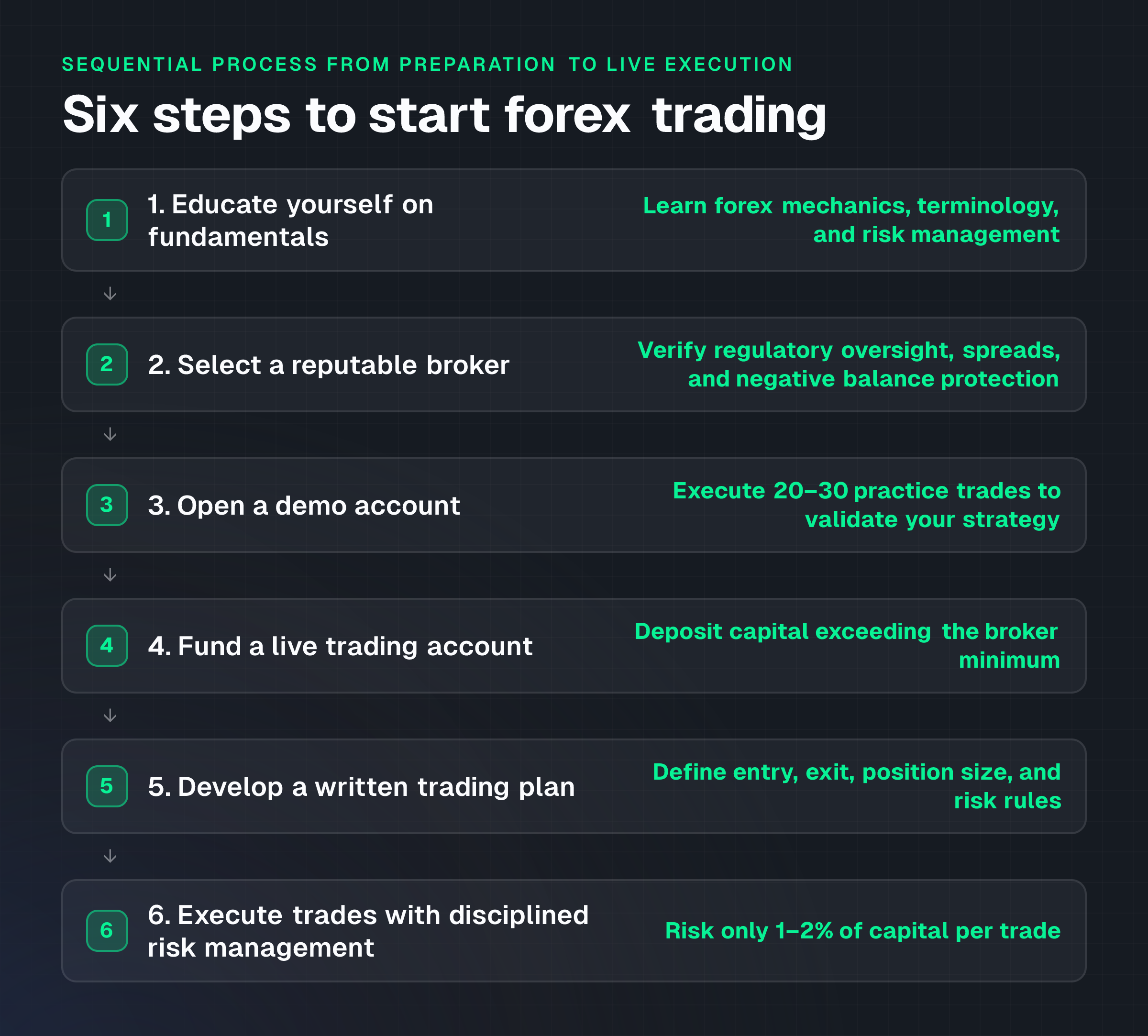
Starting forex trading involves six key stages.
1. Educate yourself on fundamentals
Before depositing real money, understand forex market mechanics, trading terminology, risk management principles, and basic trading strategies. This foundation helps traders recognize market conditions and avoid impulsive decisions.
2. Select a reputable broker
Brokers are the gateway to forex markets. Choose one with strong regulatory oversight, authorities such as ASIC, ESMA, NFA, or CFTC, competitive trading costs (spreads and commissions), reliable trading platforms, and segregated client funds. Verify that the broker offers negative balance protection, which prevents account losses beyond your deposit in adverse market conditions.
3. Open a demo account
Most brokers provide free demo (practice) accounts with virtual funds. Use the demo account to familiarize yourself with the trading platform, execute test trades, and validate your strategy without financial risk.
Demo trading helps build confidence and identifies weaknesses in your plan before live capital is deployed.
4. Fund a live trading account
Once confident, deposit real capital to a live account. You must meet the broker's minimum deposit requirement to open an account. NextTrade, for example, accepts $50 for a Standard account and $100 for a Raw account. These minimums allow account access; they don't constitute adequate capital for meaningful trading.
5. Develop a written trading plan
Define your trading goals, risk tolerance, preferred trading strategy, entry and exit conditions, and money management rules. A written plan creates discipline and prevents emotion-driven decisions in real market conditions.
6. Execute trades with disciplined risk management
Place trades according to your plan, using position sizes and stop-loss distances that align with your account size and risk tolerance. Never risk more than 1-2% of total capital on a single trade. This approach preserves capital through inevitable losing periods.
Worked example: Calculating realistic capital needs
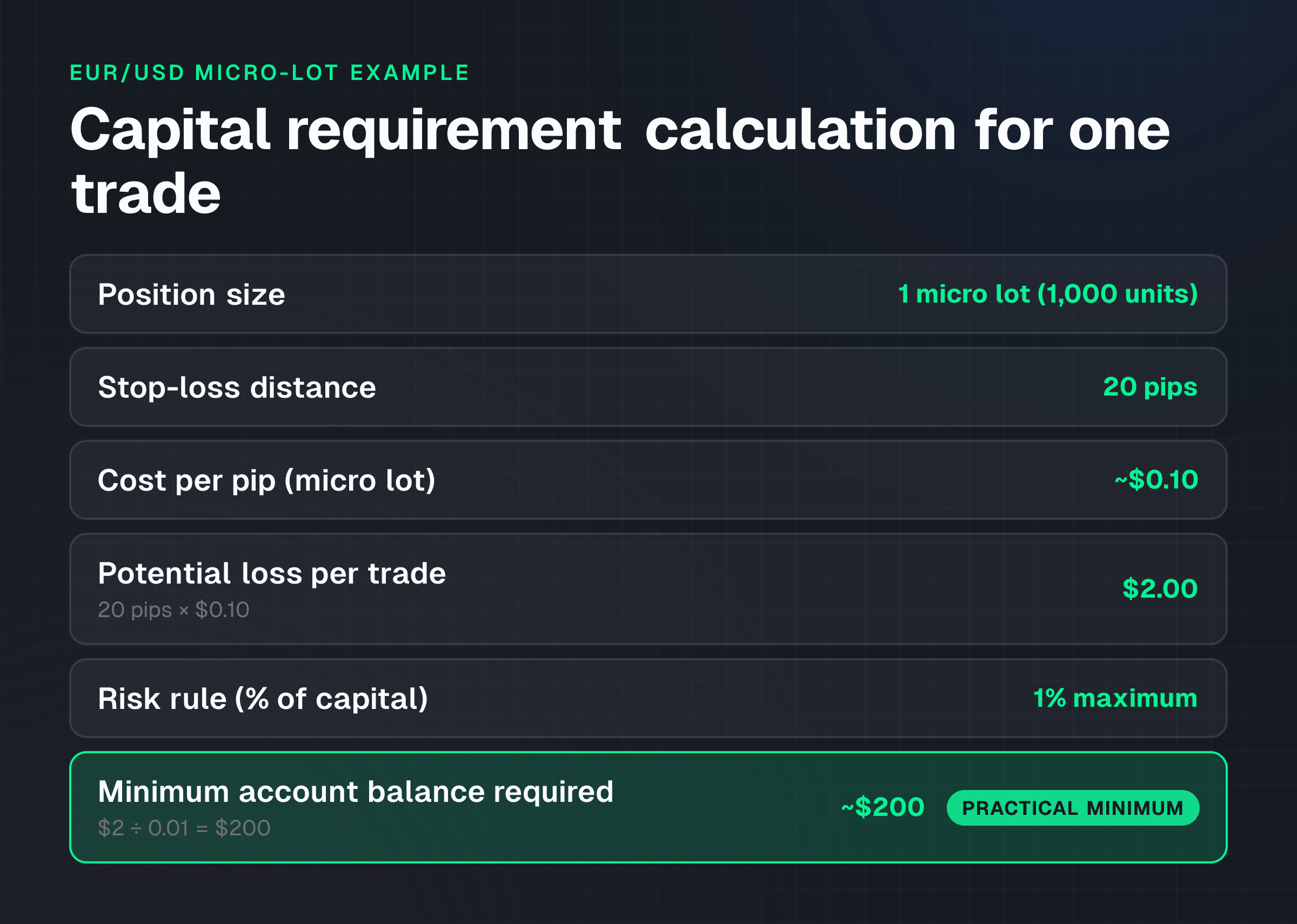
This example illustrates how practical trading capital is determined. It's educational and not a recommendation to place a trade.
Assume a trader plans to trade EUR/USD with the following parameters:
- Position size: 1 micro lot (1,000 units)
- Stop-loss distance: 20 pips
- Risk per trade: 1% of total account balance
- Each pip on a micro lot: approximately $0.10 for USD-denominated pairs
Calculation:
Potential loss per trade = 20 pips × $0.10 per pip = $2
If the trader adheres to a 1% risk rule, the loss of $2 must equal 1% of total account balance:
$2 ÷ 0.01 = $200 minimum account balance
In this example, a trader placing even the smallest practical trade with a reasonable stop-loss requires approximately $200 in capital, not the $50 minimum deposit. Scaling this to multiple positions, wider stops, or multiple open trades quickly increases capital needs.
A trader opening a live account with only $50 can't safely execute this trade without breaching their 1% risk rule or removing stop-loss protection entirely, both dangerous practices.
Costs and practical constraints: What reduces profitability
Several factors reduce net returns or constrain trading at minimum deposits.
Spreads: The bid-ask difference is a cost charged on every trade entry and exit. Tight spreads (1-2 pips on major pairs) still represent meaningful percentage losses on small account balances. A 2-pip spread on a $50 account represents 2-4% of capital before any market move occurs.
Commissions: Some brokers charge per-trade commissions in addition to spreads, further eroding profitability on small positions.
Minimum position size constraints: Some brokers enforce minimum position sizes, forcing traders to risk more per trade than their risk management rules permit.
Margin requirements: Leverage increases market exposure, but brokers require margin (collateral) to hold open positions. High leverage uses substantial margin, limiting the number of simultaneous positions a small account can hold.
Slippage: The difference between the intended trade price and the actual execution price, caused by market volatility or fast-moving news events. Slippage can turn a planned $2 loss into a $5 loss in seconds.
A $50 account with $1-2 per-trade losses means each losing trade represents 2-4% account drawdown before any spread or slippage cost is factored in. Realistic starting capital should allow traders to absorb normal trading costs and several consecutive losses without account liquidation.
Risks and limitations: Why leverage and volatility matter
Forex trading carries substantial risks, particularly for undercapitalized accounts.
Over-leverage: High leverage (such as 1:1000 available at some brokers) magnifies potential losses dramatically. A 1% adverse market move on a 1:100 leverage position produces a 100% account loss. Smaller accounts have even less margin for error.
Margin calls and liquidation: When account equity falls below margin requirements, brokers automatically close positions at market prices, often at the worst possible price, to recover owed funds. Rapid liquidations prevent traders from waiting out temporary market reversals.
Volatility and geopolitical risk: Currency markets react sharply to central bank announcements, economic data, and geopolitical events. A single news item can move prices 50-100 pips in seconds, far exceeding the stop-loss distance on a small account.
Psychological pressure: Trading with capital one can't afford to lose creates fear and emotional decision-making. Traders may override stop-losses, add to losing positions, or abandon their plan, accelerating losses.
Research by the European Securities and Markets Authority (ESMA) documented that high leverage produces substantial losses for retail forex traders. The agency subsequently restricted retail CFD leverage to 1:30 or lower in European jurisdictions, citing evidence that substantial losses occur when leverage is unrestricted. This regulatory action reflects the proven risk of trading with insufficient capital and excessive leverage.
Common misunderstandings: Broker minimums and trading reality
Traders frequently misinterpret what a broker's minimum deposit means.
Misunderstanding 1: "A $50 minimum means I can trade with $50." The minimum is a gateway fee, not a trading capital recommendation. Actual trading capital should reflect position size, stop-loss distance, and risk management rules.
Misunderstanding 2: "High leverage compensates for low capital." While leverage does allow larger market exposure with less upfront capital, it also accelerates account depletion. A $50 account with 1:1000 leverage can be wiped out in a single unfavorable trade.
Misunderstanding 3: "I can build a portfolio starting with $50." Realistic portfolio building requires capital sufficient to hold multiple positions, absorb losses across a series of trades, and maintain discipline. A $50 account lacks the buffer to do this.
Misunderstanding 4: "Demo trading results predict live trading results." Demo trading removes emotional pressure and slippage; live trading adds both. A strategy profitable in demo may fail under the stress and friction of real capital.
Misunderstanding 5: "I can generate meaningful income from $50." Income generation requires a ratio of account size to position size that allows profit to exceed trading costs and losses. A $50 account can't produce income sufficient to justify time invested.
Practical checklist: Before opening a live account
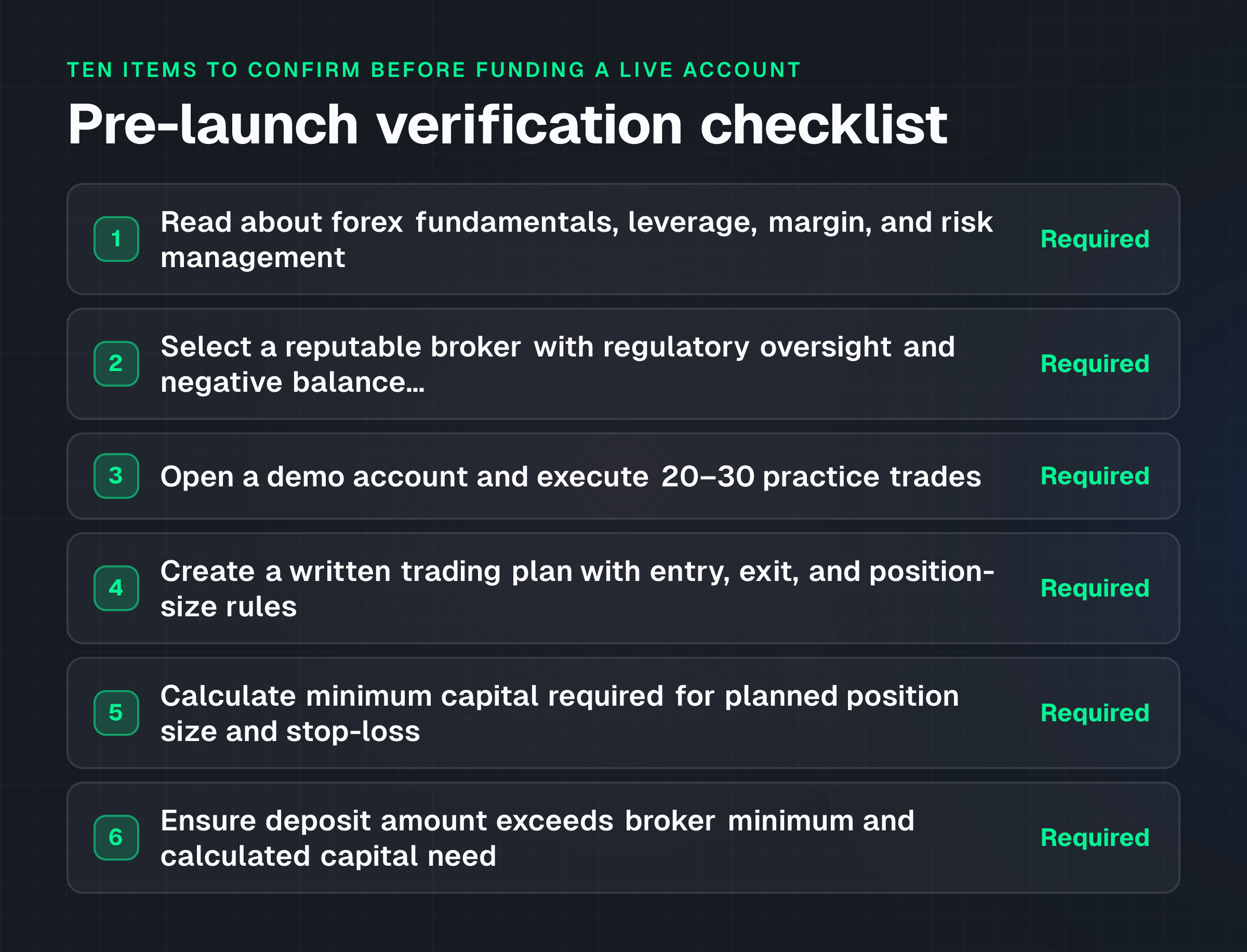
Traders should verify the following before funding a live account:
- The trader has read about forex fundamentals, leverage, margin, and risk management principles.
- A reputable broker has been selected with strong regulatory oversight, client fund segregation, and negative balance protection.
- A demo account has been opened and the trader has executed at least 20-30 practice trades to familiarize themselves with the platform and trading process.
- A written trading plan exists that defines entry rules, exit rules, position size, stop-loss distance, and the maximum percentage risk per trade (ideally 1-2% of account balance).
- The trader has calculated minimum capital required based on position size, stop-loss distance, and risk percentage (using the worked example above as a guide).
- The deposit amount exceeds the broker minimum and aligns with the calculated minimum capital for the planned trading approach.
- The trader understands that leverage amplifies losses as well as gains and has decided on an appropriate leverage level.
- The trader has confirmed the current spreads, commissions, and other costs charged by the broker on the intended trading pairs.
- The trader has reviewed the broker's withdrawal process, fees, and timelines to ensure capital can be recovered if needed.
- The trader accepts that losses are a normal part of trading and that the account size can be lost entirely.
FAQs
Can I start forex trading with just the broker's minimum deposit?
Technically yes, a $50 or $100 deposit opens an account. Practically, no. The minimum is an access fee, not adequate capital for risk management. Position sizes are so constrained that spreads and single losses represent disproportionate account percentages. Most traders using only the minimum will exhaust capital within weeks or months.
How much capital do I actually need to start forex trading?
There's no fixed amount. Capital needs depend on your position size, stop-loss distance, leverage usage, and risk per trade. As the worked example shows, a trader using 1 micro lot, 20-pip stops, and a 1% risk rule requires approximately $200. Traders planning larger positions or wider stops need more. Start with what you can afford to lose entirely.
What does leverage do to my capital requirements?
Leverage allows larger positions with less upfront capital but increases the speed and scale of losses. High leverage (1:500, 1:1000) doesn't reduce capital requirements safely; it only means losses occur faster. A $50 account with 1:1000 leverage is extremely vulnerable to a single adverse price move.
Why do traders lose money quickly at minimum deposits?
Minimum deposits force traders into one of three dangerous situations: (1) position sizes so small that spreads consume most potential profit, (2) stop-losses so tight they trigger frequently on normal volatility, or (3) no stop-loss protection at all. Combined with market volatility and the psychological pressure of limited capital, account depletion follows quickly.
Should I skip demo trading and go straight to live trading?
No. Demo trading removes emotional pressure and allows strategy testing without financial risk. A trader confident in demo trading but failing in live trading often faces a margin call before learning from real-world friction. Demo trading is free and builds confidence; skipping it increases the likelihood of rapid losses.
Is there a "safe" starting capital amount?
No guaranteed safe amount exists; however, traders with $500-$1,000 have substantially more buffer than those with $50-$100. More capital allows smaller position sizes relative to account balance, tighter risk management, and resilience through losing streaks. The more capital available, the more margin for error during the learning phase.
Next step
Before opening a live account, traders should experiment in a risk-free environment. Try a free demo account with a regulated broker to practice order execution, position management, and strategy testing. Spend time understanding how leverage operates in real trading conditions and how spreads and costs affect profitability. Review the trading platforms available and select one that fits your workflow. Once demo trading produces consistent results and a written plan is in place, the decision to fund a live account becomes clearer.
Risk Warning, Contracts for Difference (CFDs):
CFDs are complex instruments and come with a high risk of losing money rapidly due to leverage. Between 74-89% of retail investor accounts lose money when trading CFDs. You should consider whether you understand how CFDs work and whether you can afford to take the high risk of losing your money.
General Information Disclosure:
This article is for educational purposes only and does not constitute investment advice, a recommendation to buy or sell, or an offer to enter into any financial transaction. Past market performance does not indicate future results. Trading forex and CFDs involves substantial risk of loss. Leverage amplifies both gains and losses. Before trading, ensure you fully understand the risks involved and that any capital deployed is money you can afford to lose entirely. Verify all current fees, leverage limits, and regulatory conditions with your chosen broker before opening or funding an account.
TagsTrading Educationprop tradingprop firms